Look at this chart. The tallest bar counts fourteen children, but our page only has room to count up to about eight. The bar runs right off the top!
What could we change about the numbers up the side so the tall bars still fit on the page?
Take three hands-up answers, not open call-outs. Steer toward counting up the side in twos instead of ones without confirming it yet — that is the whole point of Watch and Notice.
Here is the same idea, but now each step up the side counts two: 0, 2, 4, 6, 8, 10, 12. Read the scale marks aloud first, then read where each bar lands.
It does not stop on a mark. It stops halfway between two marks, so it counts the odd number in between.
Point at each scale mark and count aloud in twos with the class: two, four, six, eight, ten, twelve. Then trace the Walk bar across to the 8 mark and the Bus bar across to the 10 mark.
Land the key move on the last bar, Car: it stops between the 6 and 8 marks, so it shows 7. Ask which two marks is this bar sitting between? before you name it.
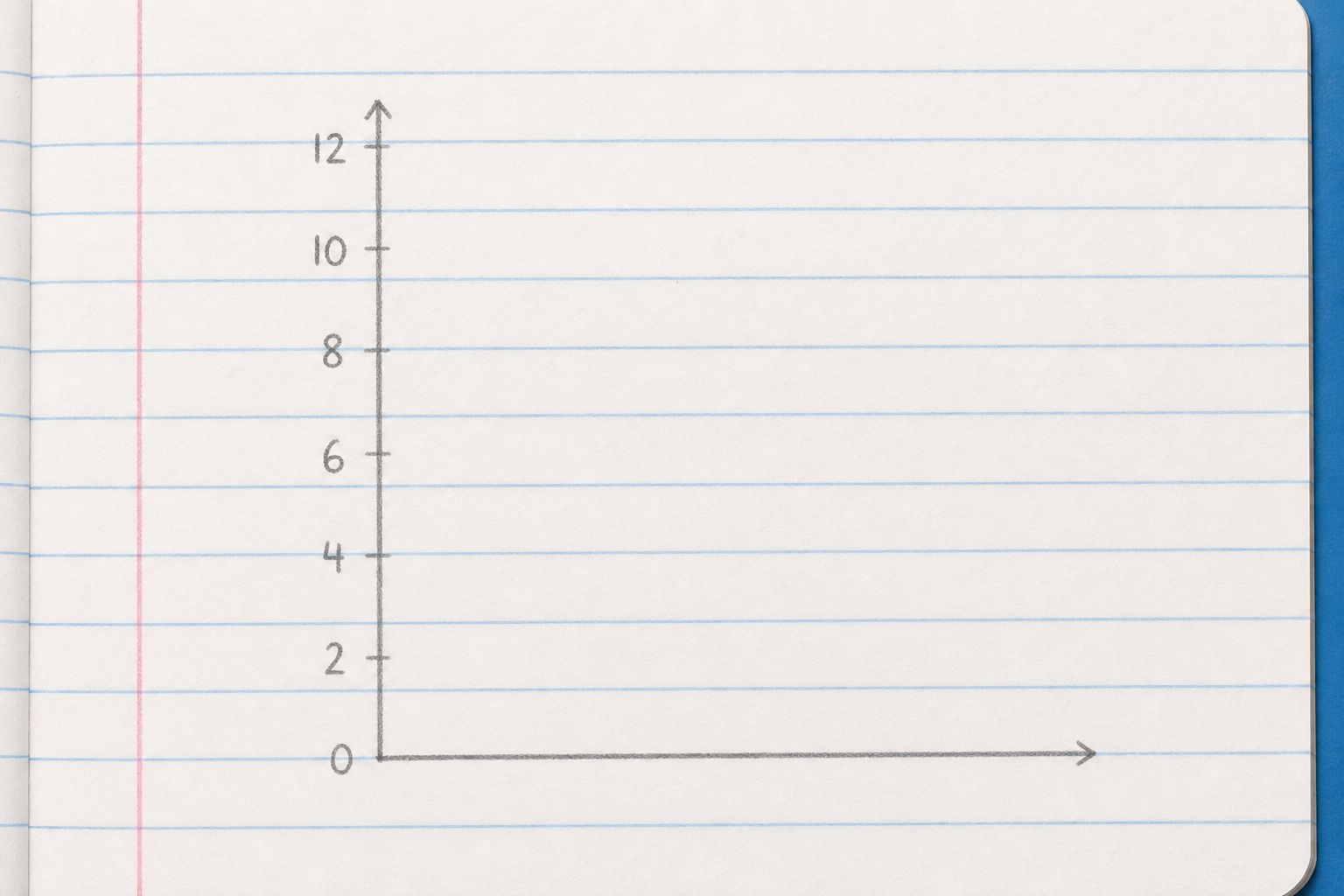
In your maths copy, draw a scale up the side marked 0, 2, 4, 6, 8, 10, 12. Then sketch one bar reaching 6 and one bar that stops halfway between two marks to show 7.
Walk the room glancing that the scale marks are evenly spaced and that the "7" bar really lands halfway between the 6 and 8 marks. No individual marking — this is whole-class copybook practice, not assessment.
Today we work through four bars together on a scale of two. Name which two marks each bar sits between before you read it. The in-between ones catch people out.
Talk this one through together — pupils take turns at the board and the class agrees or corrects out loud.
Start with the bar on the 4 mark (on a mark — easy). Then the bar at 10 (on a mark). Then the bar halfway between 8 and 10: ask on a mark, or between two marks? before anyone answers 9. Finish by having a pupil drag the last bar up from 0 to a count of 11, checking it lands halfway between the 10 and 12 marks.
Keep asking the same question each time: is this bar on a mark, or between two marks?
Your turn now. Same scale of two, but you predict and build each bar before we check it. Watch for the bars that stop halfway between two marks.
This is the practice round — pupils take turns at the board, check each answer, and the class confirms before moving on. Keep the board work brisk rather than over-explaining.
The two bars that land between marks (9, and the 11 build) are the make-or-break ones. Before each, ask the class to predict: is 9 on a mark, or between two marks? Watch for pupils who set the in-between bar to 8 or 10 by snapping to the nearest mark — remind them the bar stops halfway.
You're previewing this lesson. Get full access to this lesson and hundreds more — each one ready to teach, with interactive activities, printable resources and pupil progress tracking built in.