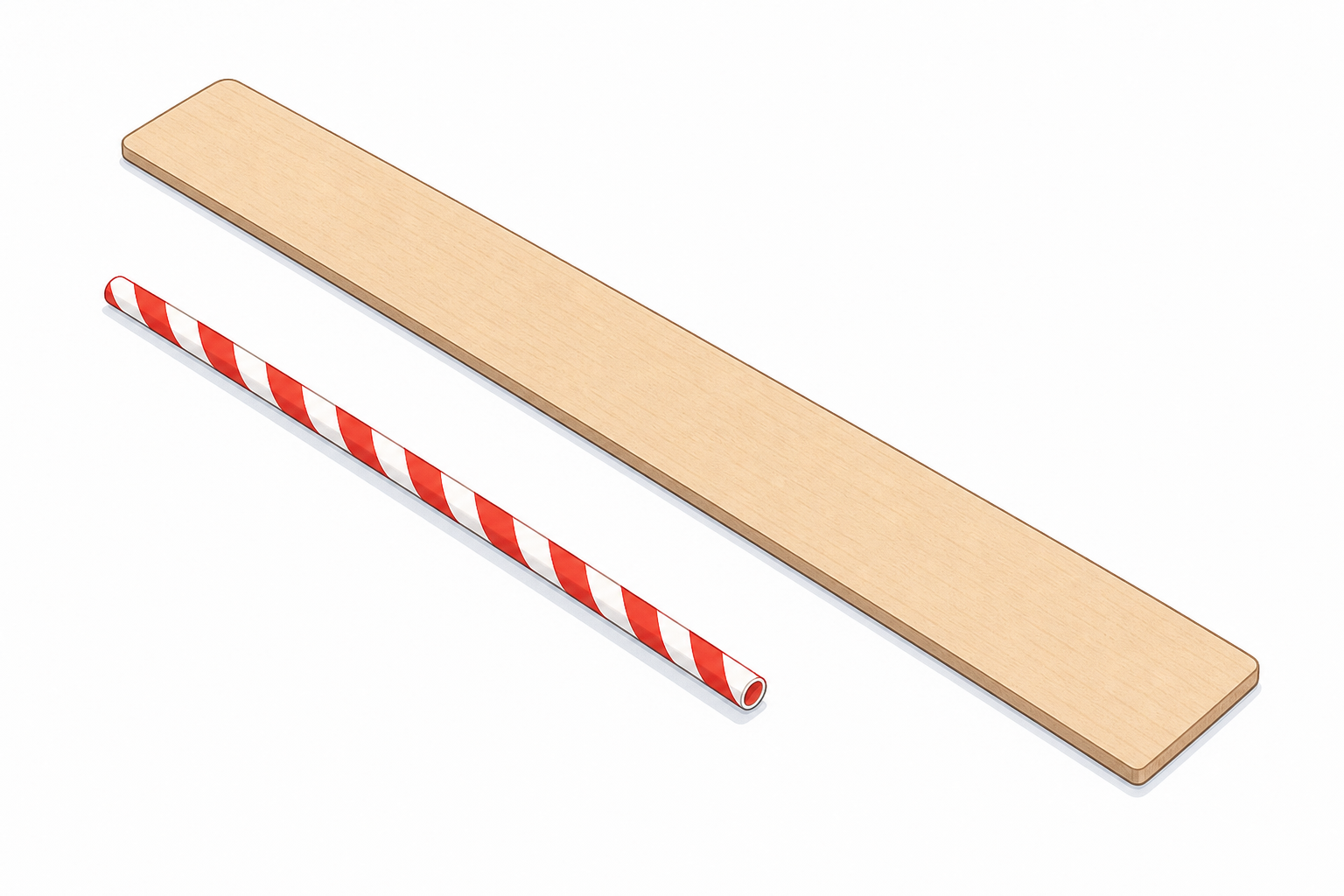
Look at this drinking straw in my hands. What do you think will happen if I gently bend it?
Now look at this wooden ruler. What do you think will happen if I gently try to bend that one?
Hold up one drinking straw and one wooden ruler only so the class can see them in your hands. Keep the rest of the tray out of sight so the hook stays light. There is nothing on the board for this step; the objects are the visual.
Gently bend the straw so the class sees it curve. Then try the same gentle push on the ruler so they see it stay straight. Ask: What was different?
Do not name bendy and stiff yet, and do not lay out the full set of materials. That comes next.
Who helps us: later we will talk about people who choose bendy material when something needs to curve.
Today's words: bendy — it curves when we gently push it. stiff — it stays straight and does not bend easily.
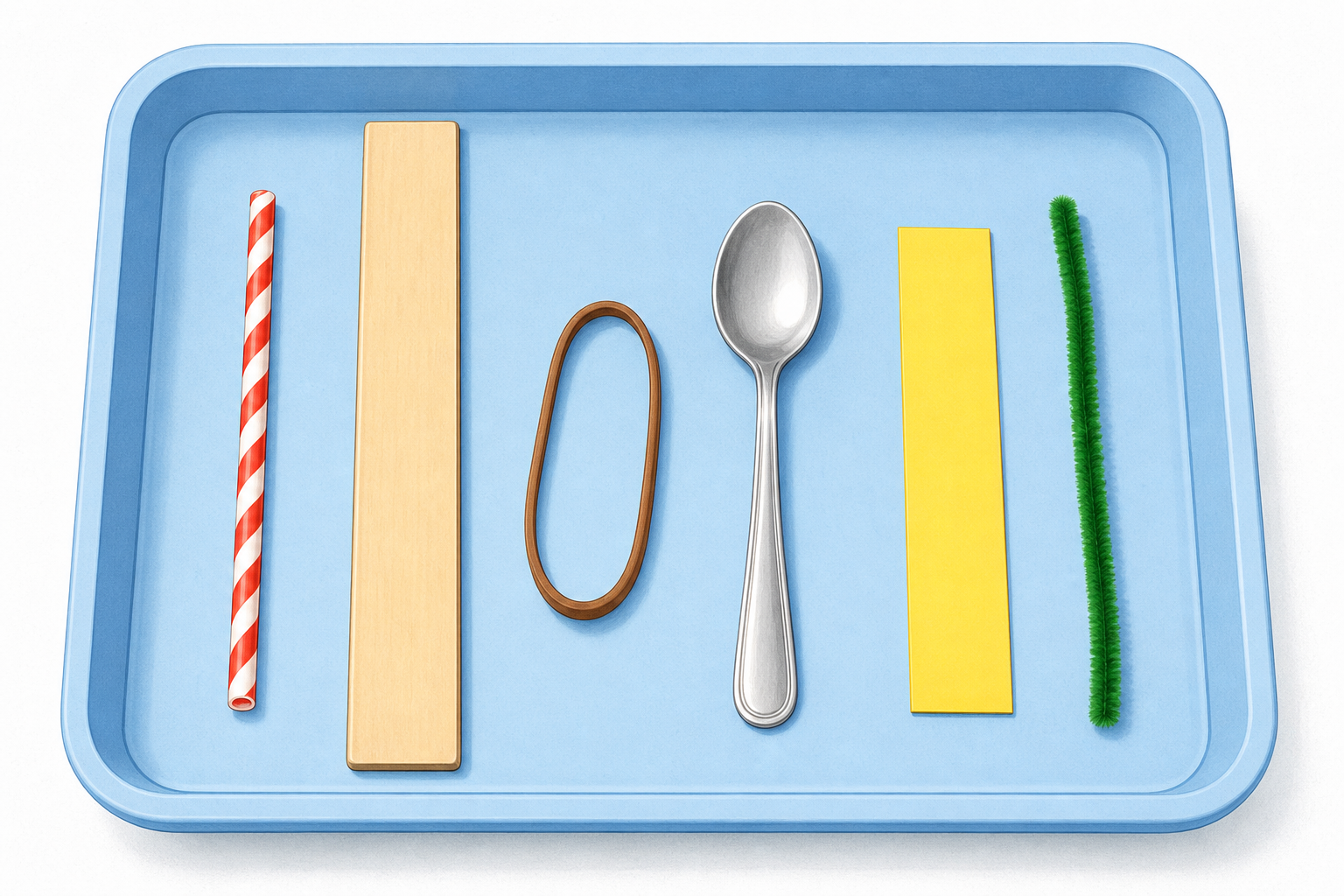
Look at our tray. Which things do you think will bend? Which do you think will stay stiff?
Prep reading (not for the live 3 minutes):
| Concept | Why it matters | Example |
|---|---|---|
| Bendy — a material that curves when you gently push or press it | People choose bendy materials when something needs to curve, like a soft wire for a craft shape | A drinking straw or pipe-cleaner curves easily in little hands |
| Stiff — a material that stays straight and does not bend easily | People choose stiff materials when something must stay straight and strong, like a ruler for drawing a line | A wooden ruler or metal teaspoon stays straight when gently pressed |
Live beat (keep oral and visual): Show the tray of items: drinking straws, pipe-cleaners, lolly sticks, a metal teaspoon and a wooden ruler. Invite children to point (not grab yet) at ones they think will bend. Guesses are never wrong; they are the start of the fun. Revoice gently: You think the pipe-cleaner will bend. Let's find out soon.
One short modelled cycle (say aloud once before children try): I wonder if this straw will bend. I think it will. I press gently with two hands… it curved! So I think the straw is bendy. Then with the ruler: I wonder about this ruler. I think it will stay stiff. I press gently… it stayed straight. So I think the ruler is stiff.
Misconception to head off: children may think stiff means heavy, or that anything metal is stiff. Keep the test simple: did it curve, or did it stay straight?
At your tray, gently try to bend each thing with two hands. Does it curve, or does it stay straight? Take turns. Keep it away from faces.
Set trays ready for small groups (about 4–6 children per tray). Each tray needs: several drinking straws, several pipe-cleaners, several lolly sticks (enough bendy items so children can try at the same time), plus one metal teaspoon and one wooden ruler.
Bendy items (straws, pipe-cleaners, lolly sticks) stay on the tray for simultaneous gentle tries. The teaspoon and ruler are the scarce stiff pieces: pass each one around the group one child at a time. While a child presses the spoon or ruler, fold the others in with a quick question: What do you think will happen? Did it stay straight? Run as two short bursts with a quick regroup in the middle, not one long sit.
Circulate and model gentle two-handed presses. Say: Away from faces. Soft hands.
What to expect: straws and pipe-cleaners bend easily. The teaspoon and ruler stay stiff. Lolly sticks may bend a little or stay mostly stiff; talk about what the children notice rather than forcing one answer.
Key questions: Does it bend? Does it stay stiff? What does it feel like when you try?
Differentiation: offer hand-over-hand support for children who need help pressing gently. Confident children can try a second straw or pipe-cleaner and compare.
Safety: bend gently, away from faces and eyes. Supervise pipe-cleaner ends (they can be pokey). No putting items near mouths.
Now sort your things at your group's hoops. Put the bendy ones in one hoop. Put the stiff ones in the other hoop. Tell a friend why each one goes there.
Staging (all groups at once): Every group sorts at their own two hoops. You circulate and sample reasons; do not run a front-of-class presentation in this step.
Place two hoops (or two trays) per group. You may use simple picture labels or say the words aloud each time: bendy and stiff. Children do not need to read the labels.
Invite children to place one item at a time and say a short reason to a friend: The straw is bendy because it curved. As you move between groups, sample one reason aloud and ask nearby children: Do you agree? Where would you put it?
Look-fors:
If a group disagrees (for example about a lolly stick), celebrate the careful trying: You both tested it. What did your hands feel? There can be a short talk at that table rather than one forced answer.
On your Investigation Journal page, show the bendy things and the stiff things. Draw or mark one bendy thing and one stiff thing. Point to which is which.
Hand out the Investigation Journal page. Keep the real tray items visible as referents while children work.
Brief teacher model first (about 1 minute): On your own page or on the board, make a very simple mark or scribble on the bendy side and say This side is for things that bent. Then a simple mark on the stiff side: This side is for things that stayed straight. Show that a scribble, blob, or one simple shape counts fully — children do not need a recognisable drawing of every material.
Support by sitting with a small group and saying: Show me one that bent. Draw or mark that on the bendy side. Show me one that stayed straight. Draw or mark that on the stiff side.
Treat scribble-sort or one mark per side as full success for Junior Infants. Do not invent extra boxes or named columns on the page. Children show what they sorted.
Fast finishers: draw or mark a second bendy or stiff thing from the tray, or whisper to a partner one more thing in the room they think is stiff (a table leg, a book).
You're previewing this lesson. Get full access to this lesson and hundreds more — each one ready to teach, with interactive activities, printable resources and pupil progress tracking built in.