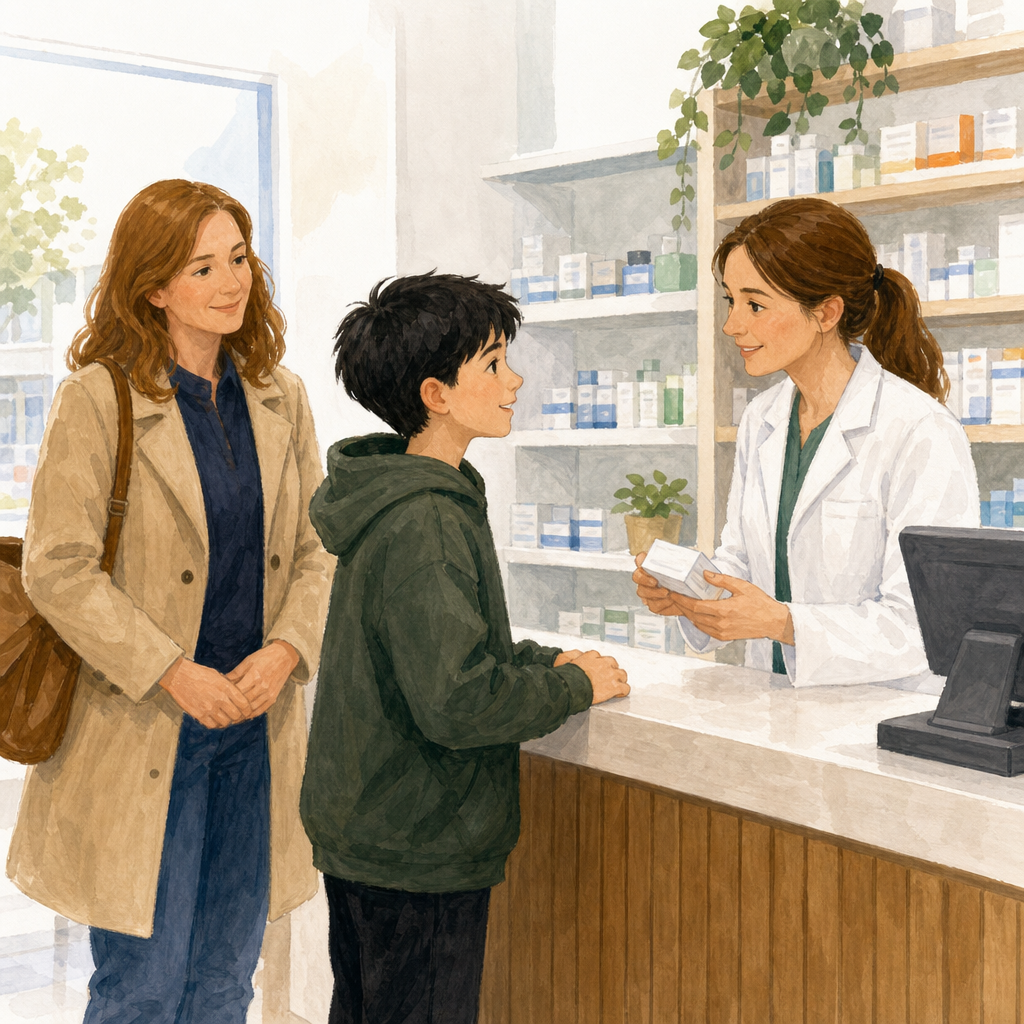
How would you tell someone your arm hurts if you had no words for it? Pointing helps for a moment, but not if you need a chemist, a doctor, or a parent on the phone.
Take two or three mime answers only, then move on. The point is that gesture is limited once you need help, not that pupils invent a full mime dictionary. Keep the tone practical and encouraging: this is useful language for travel and everyday life, and by the end of the lesson they will have real sentences they can say aloud.
We will see English first on the board. Listen to the Spanish with el or la, repeat it together, then reveal the back of the card. Keep the article with every word.
Run this whole-class on the IWB with volunteers. For each card: play or say the Spanish with the article first, class repeats twice, then flip to confirm. Pupils should not guess Spanish from English before they have heard it. Insist on the article every time: brazo is not enough, el brazo is. Big cheer for anyone who keeps el/la every time: that is real Spanish.
After the eight cards, add a short choral-repeat beat for the key phrase only (no colour adjectives today). Model clearly: Me duele la cabeza (meh DWEH-leh lah kah-BEH-thah) means my head hurts. Then Me duele el brazo (meh DWEH-leh el BRAH-thoh). Point out that Spanish keeps the article after me duele. Class repeats each model twice. Optional 60-second stand-up point-along chant once through the list: cabeza, brazo, mano, pierna, pie, nariz, pelo, boca.
Leave the phrase frame on the board: Me duele + el/la + body part.
Flip two cards at a time and find each Spanish body part with its English meaning. Whisper the Spanish as each card turns, article included.
Use this as calm consolidation, not a race. If the same pair is missed twice, pause and say the Spanish together before continuing. Listen for missing articles and for the soft final sound in nariz (nah-REETH). Praise full forms: la mano, not bare mano.
Open your copy. Write one full sentence saying that a part of you hurts, using Me duele.... Then copy two labelled body parts from the board, article included.
Leave one clear model on the board while they write: Me duele la mano. (meh DWEH-leh lah MAH-noh). Also leave two sample labelled nouns visible, e.g. el pie, la nariz. Walk the room and check two things only: the article after me duele, and spelling on words they have just said and seen in the farmacia labelling and pair round. Do not collect the copies. Support: word bank of the eight parts with articles. Extension: a second Me duele... sentence with a different part.
Imagine you are at a farmacia (chemist) in Seville. Look at the figure and click the correct Spanish label for each body part. Say the word to yourself as you place it.
Whole-class turns on the board work well here. After labels are placed, switch into the travel scene: you are explaining what hurts to the pharmacist. Point to three or four parts and have the class, then named pupils, say the full phrase: not just la cabeza, but Me duele la cabeza. This is the main oral production check before anyone writes.
Then a quick pair round (about one minute): Partner A points to a body part on themselves or the board figure; Partner B says Me duele... with article and part; swap. Coach warmly: "Nice full sentence!" when the article is there.
If a pupil offers a plural part not on today's list, model once if needed (Me duelen los ojos for eyes) and steer straight back to today's singular Me duele... patterns with the eight parts on the board. Do not open a grammar side lesson.
You're previewing this lesson. Get full access to this lesson and hundreds more — each one ready to teach, with interactive activities, printable resources and pupil progress tracking built in.