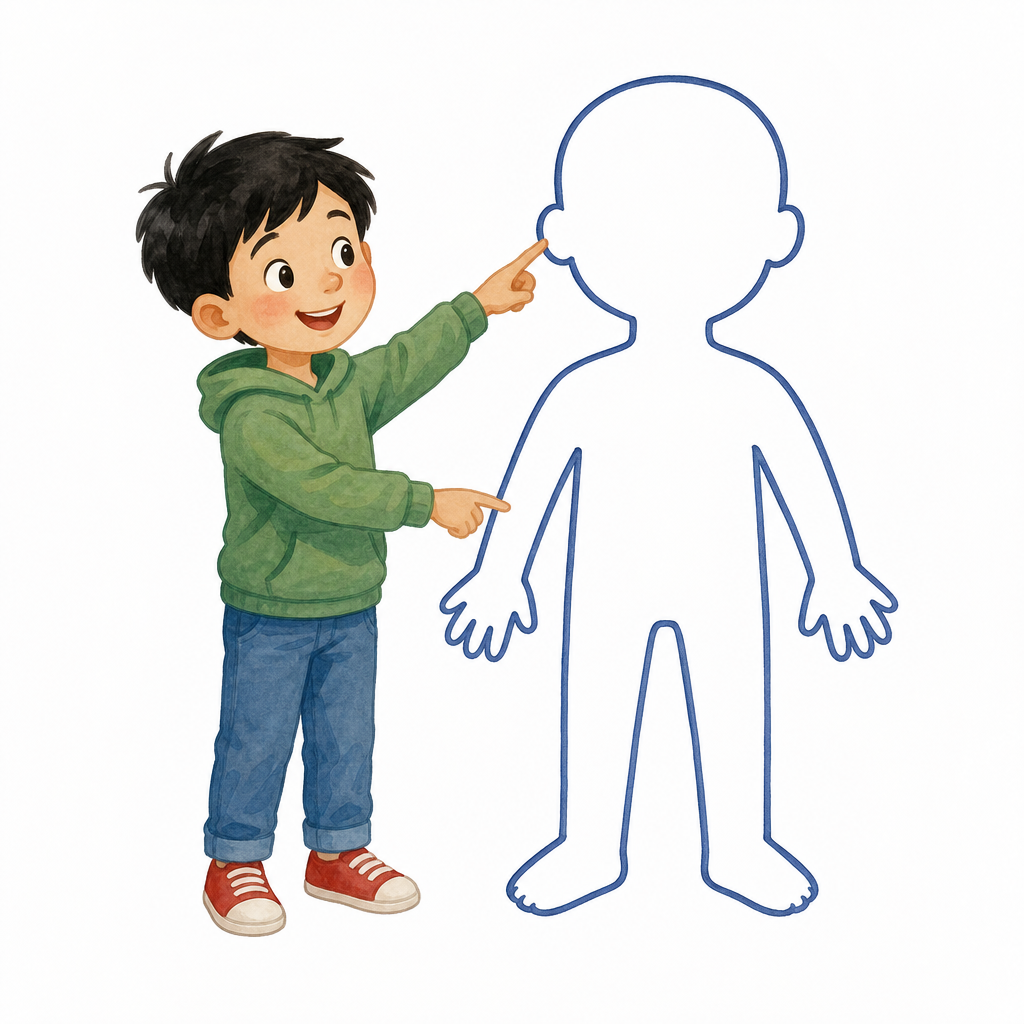
 How would you show that your arm hurts if you had no words for it? Everyone mime an injury from your seat: hold your head, rub your knee, clutch your arm. Watch two or three classmates show theirs.
Mime only gets you so far abroad. Today you learn eight body parts in French and the real sentence that says something hurts:
J'ai mal à... (zhay mal ah): I have a pain in...
By the end of this lesson, you will be able to:
- Name eight body parts in French with le, la or les
- Say that a part of you hurts with J'ai mal à...
- Pick the body-part phrases you would need if you were ill abroad
Listen first, then repeat. You will hear the French with its article; echo it before the card flips. English is on the front to help you remember the meaning.
When the French is revealed, say it again, article included. Then build the full sentence from the board stem using the pattern below.
| Concept | Why it matters for learners | Example in target language (with English gloss) |
|---|---|---|
| à la: à + la stays as two words | Feminine body parts keep à la, so you do not squash the words together | J'ai mal à la tête (I have a pain in my head) |
| au: à + le becomes au | Masculine body parts need this short form; saying à le bras sounds wrong to a French speaker | J'ai mal au bras (I have a pain in my arm) |
| aux: à + les becomes aux | Plural body parts (eyes, hair) take aux, not à les | J'ai mal aux yeux (I have a pain in my eyes) |
Keep that pattern visible while you practise all eight parts.
Race the board: click each French body part, then its English meaning. Say the French out loud as each word is picked, article included, and point to that part on yourself.
When a pair is found, the finder leads one clear body-part phrase (article + word) while pointing. Keep the pace high; we save the full doctor sentences for the next step.
Open your copy. Write two sentences saying that a part of you hurts, using two different body parts. Take care with the accents, the articles, and whether you need à la, au or aux.
Keep the model on the board while you write:
- J'ai mal à la jambe.
- J'ai mal au pied.
- la tête — head
- le bras — arm
- la main — hand
- la jambe — leg
- le pied — foot
- les yeux — eyes
- les cheveux — hair
- le nez — nose
You are at the doctor's in France. Look at the figure and put each French label on the right body part. As you place a label, point to that part on yourself and say the full doctor line:
Bonjour docteur, j'ai mal à... / au... / aux... plus the body part.
Unlock the full learning experience
You're previewing this lesson. Get full access to this lesson and hundreds more — each one ready to teach, with interactive activities, printable resources and pupil progress tracking built in.
This lesson is copyright of Coding Ireland 2017 - 2026. Unauthorised use, copying or distribution is not allowed.