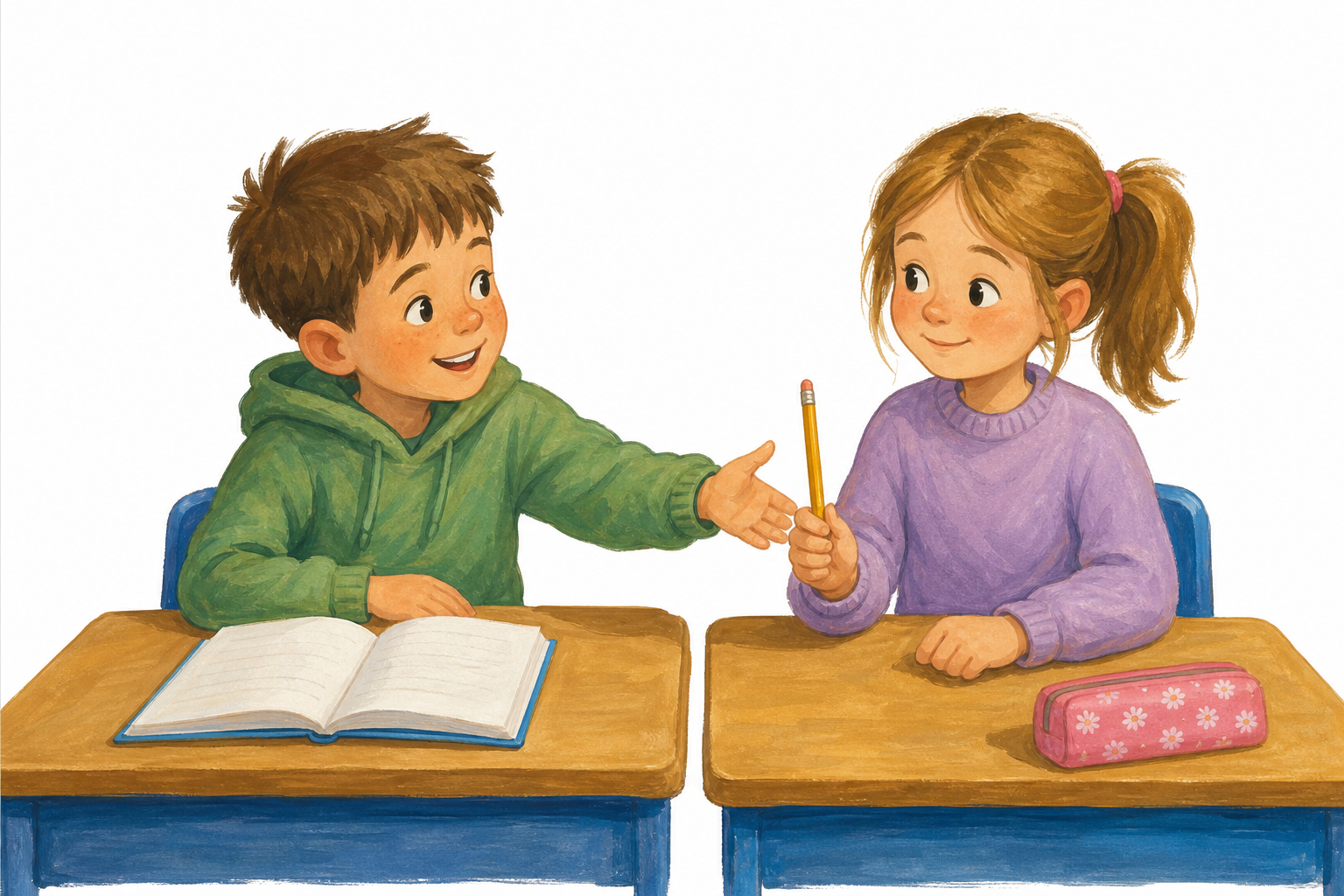
 You have no pencil. We need to ask a classmate for one.
Irish or a mix is fine for this first try. We will learn the German lines next.
By the end of this lesson, you will be able to:
- Ask to borrow something from a classmate in German
- Give a polite no when you cannot lend it
Here are today's eight classroom words. Tap each one, listen, then say it back together with der, die or das.
How you ask:
Kann ich bitte den Bleistift haben?
(kan ikh BIT-tuh den BLYE-shtift HAH-ben) Can I please have the pencil?
How you say a polite no:
Tut mir leid, ich brauche ihn selbst.
(toot meer LYTE, ikh BROW-khuh een ZELBST) Sorry, I need it myself.
| What changes | Why it matters | German example (with English) |
|---|---|---|
| The article after the ask — when the thing you want is the object, masculine der changes to den; die and das stay the same | Without this change, Kann ich bitte der Bleistift haben? sounds wrong to a German speaker, like mixing up subject and object | den Bleistift (the pencil, object) · die Schere (the scissors) · das Heft (the exercise book) |
| The pronoun in the refusal — replace the noun with ihn (masculine), sie (feminine) or es (neuter) | A bare nein is too blunt with a classmate; the full line needs the matching pronoun so the polite no still names the thing | ich brauche ihn selbst (I need it myself, for der Bleistift) · ich brauche sie selbst (for die Schere) · ich brauche es selbst (for das Heft) |
Partner practice: Partner A asks using the question above and one noun from the table. Partner B gives the full polite no with the matching pronoun. Then swap. Everyone says both lines aloud.
Use the bingo card on your desk. Listen carefully and mark each classroom word as you hear it. When every word on your card is marked, call Bingo!
Open your copy. Keep both model lines on the board. First say each line twice with the class, then whisper the exchange once to your shoulder partner. Then write the question that asks to borrow something, and one polite answer that says no.
Take care with a capital letter on every German noun (Bleistift, not bleistift) and keep the full polite sentence, not just nein.
- der Bleistift — the pencil
- der Kugelschreiber — the biro
- das Heft — the exercise book
- das Buch — the book
- die Schere — the scissors
- der Radiergummi — the rubber
- das Lineal — the ruler
- das Federmäppchen — the pencil case
Listen to a short scene in a classroom: a teacher asks two pupils their favourite colour. You know these colour words from earlier in the year. Listen twice, then answer the questions together.
Unlock the full learning experience
You're previewing this lesson. Get full access to this lesson and hundreds more — each one ready to teach, with interactive activities, printable resources and pupil progress tracking built in.
This lesson is copyright of Coding Ireland 2017 - 2026. Unauthorised use, copying or distribution is not allowed.