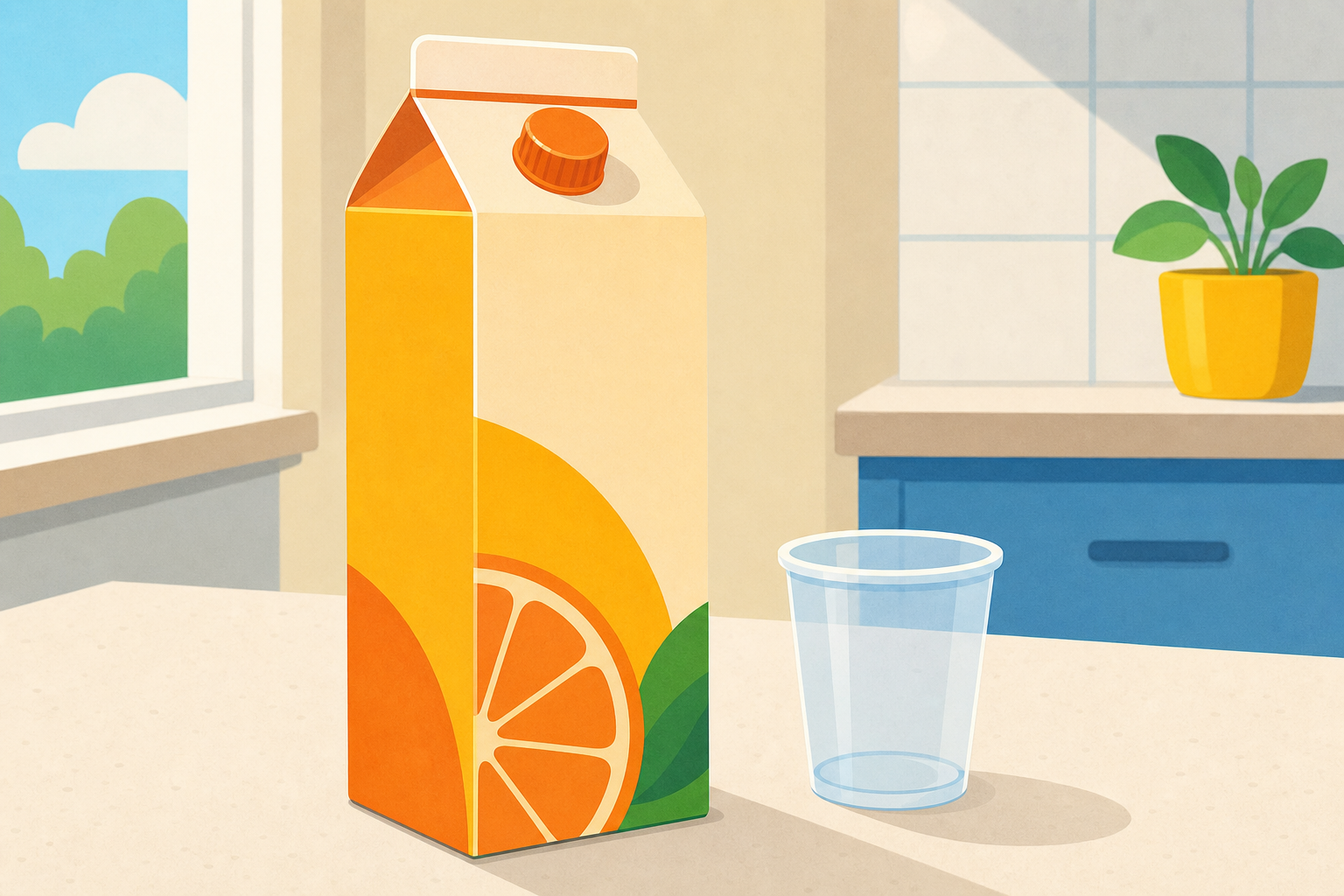
Look at this picture: a full one-litre carton of juice sitting beside a small cup. How many of those little cups do you think it would take to empty the whole carton? And which one is measured in litres, do you think?
Display the carton-and-cup image as pupils settle. Take three hands-up guesses at the number of cups, not open call-outs. Don't confirm an answer yet — the point is to get them thinking about big and small amounts before we name the units.
Look at each jug of juice, mark by mark. Read the level each time, keeping the jug flat and your eye level with the line. What big amount are the marks heading towards?
250 ml: model the two rules aloud, jug flat and eye level with the line. Crouch to show the eye-level check. Class say two hundred and fifty millilitres.
500 ml: line climbs to 500, half of a litre. Ask which big number the marks are heading towards, pause before revealing next jug.
750 ml: line at 750. Point at the room left, not just the number, only 250 ml to full.
1 litre: the key one. Full to the top, 1 litre = 1,000 ml. Class say it back.
Find the nearest big mark below the line, then count the little 50 ml lines upwards.
We will drag our one jug on the board to four amounts in turn: first 100 ml, then 300 ml, then 600 ml, then 950 ml. Some of these do not land on a big 250 mark. Read each one aloud before we check.
This round is for talking it through together — pupils take turns at the board and the class agrees or corrects out loud.
Call a pupil to the board to drag the single jug's liquid level to each named amount in turn (100, then 300, then 600, then 950), then read it aloud. The rest of the class calls the reading first, then the pupil confirms. There is one explore jug, dragged to each amount — not four separate diagrams.
On your Capacity Record Sheet (or in your maths copy), list three containers you can see or hold. Write your estimate for each one first, choosing millilitres or litres — for example "mug: about 300 ml". Leave a space beside each so you can write the real measured amount later.
Pupils record their three estimates on the printable capacity_record_sheet, which gives them a ready-made table (container, estimate + unit, measured amount + unit) so the paper practice matches the three containers they will measure in the Class Challenge. Walk the room glancing at whether pupils chose a sensible unit (ml for small, l for large) and left space for the measured value. This is whole-class copybook practice, not marking.
Estimate first, then measure. Write both down on your Capacity Record Sheet with the unit.
At your station you have a real jug and some water. Estimate then measure three containers, going from smallest to largest: an egg cup, a mug, and a small bottle. On your Capacity Record Sheet, write down your estimate first, then the real amount and its unit.
Before the stretch, watch this worked example of pairing containers to make 1 litre. Suppose a mug measures 300 ml and a small bottle measures 700 ml. Write both amounts, add them: 300 + 700 = 1,000 ml. That is exactly 1 litre, so this pair works. If the total is a little under or over 1,000 ml, say about 1 litre.
Stretch task: using your own measured amounts, find two containers that together hold about 1 litre. Write both amounts, add them, and check the total.
These are the practice questions. Real objects circulate (or sit at stations) and pupils measure each one with their own jug, logging estimate and measured value on the capacity_record_sheet. Three core containers (egg cup, mug, small bottle) keep the smallest-to-largest rhythm realistic; keep the pass-on brisk, and the class confirms each reading aloud at the end.
Before the stretch, teach the pairing skill with one board example. Write: mug 300 ml, bottle 700 ml. Method: (1) measure each and record with unit, (2) add the two amounts, (3) check against 1,000 ml = 1 litre. Class says the sum: 300 + 700 = 1,000 ml = 1 litre. Note that a total near 1,000 ml (for example 950 ml) still counts as about 1 litre.
Slip to watch: pupils adding without matching units, or guessing a pair without using their measured numbers. Remind them both amounts must be in ml before adding.
Watch for the two reading errors: tilting the jug and reading from above the line. Remind groups to set the jug flat and get eye-level. Fast finishers then try the stretch with their own three measured amounts. If a group has no real jug, gather them at the front measurement jug so they can read a physical jug there.
You're previewing this lesson. Get full access to this lesson and hundreds more — each one ready to teach, with interactive activities, printable resources and pupil progress tracking built in.