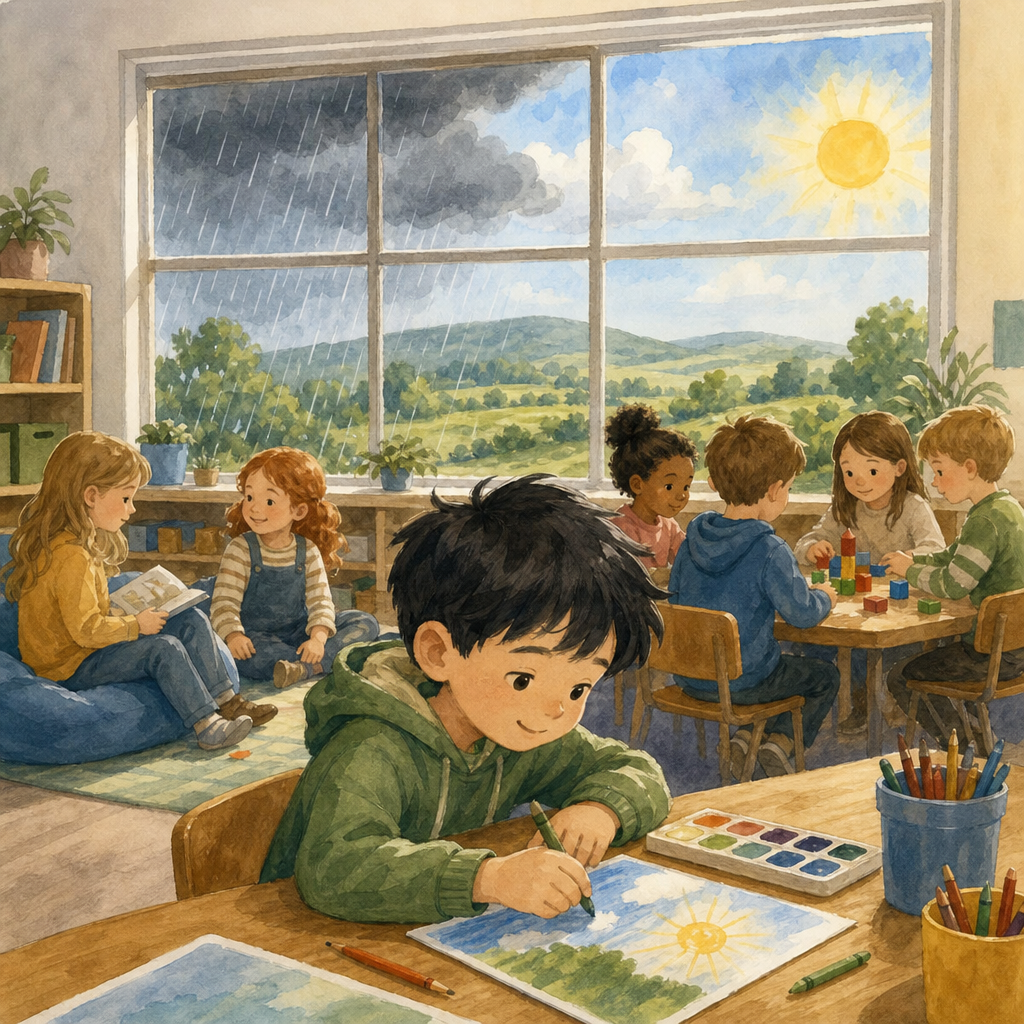
What is the weather doing right now? Everyone answers in English in three words only. Ready? Go.
Collect answers quickly around the room: sunny, cloudy, a bit windy, and so on. Do not translate yet. The point is to get them thinking about weather language before they meet the German. Glance out the window if you can, so the hook stays real. You can name the topic once in German as you move on: das Wetter means the weather. Then go straight into the eight words.
Morning forecast from Köln: here are today's eight German weather words. First look at the picture, listen to the German, and repeat together. Only after we have heard each word do we flip English to German to check we remember. Watch the capital letters: every German noun starts with one.
Work on the IWB in two clear passes. Do not ask pupils to guess German from English before they have heard a model.
First pass (four words): Die Sonne (dee ZON-uh), Der Regen (dair RAY-gen), Der Schnee (dair SHNAY), Der Wind (dair VINT). For each card: show the image, play or say the German, class repeats twice (whole class, then by table). Quick point-to-the-image check before the next card.
Second pass (four words): same routine for Der Nebel (dair NAY-bel), Der Blitz (dair BLITS), Der Donner (dair DON-er), Der Sturm (dair SHTOORM). Der Blitz and Der Donner are the dramatic pair: lightning and thunder. Invite a soft clap-stomp when the class nails them.
Pattern spotlight: seven words take Der; only Die Sonne takes Die. Cheer the table that remembers the odd one out.
Then flip English→German for short recall on a few cards. Revisit all eight once more chorally before you leave this step so the listen activity has a firm base.
Two friends in München talk about the weekend weather on the phone. You will hear German weather talk on the class speakers. Listen twice before anyone answers.
Your job: you do not need every word. Listen for which kinds of weather come up, then match each one to today's German weather words on the board (Der Regen, Die Sonne, and the rest). Choose the best answer for each on-screen question, then say the matching German noun together.
Bridge rule (read this first): Today's taught set is eight nouns (Die Sonne, Der Regen, Der Schnee, Der Wind, Der Nebel, Der Blitz, Der Donner, Der Sturm). The weather-chat interactive may play everyday German weather talk (full expressions about rain, sun, wind, storms). Do not ask pupils to repeat full clauses they have not been taught. Success = catch the weather idea, then name or point to today's matching noun.
Before class (sticky notes): Open this interactive once on the IWB. Copy each on-screen question word for word onto a sticky. Beside it, write only the matching noun from today's list and its pronunciation. If a question's options are English (rain, sunny, windy, storm), that is fine: the German we celebrate after each answer is the noun. Never invent exact interactive wording from memory in front of the class.
Chat frame for the class: two friends in München are checking the weekend weather by phone. Ears ready: no shouting out until after the second play. Quiet thumbs-up for anyone who catches a weather idea early; high-fives after the class names the matching German noun.
How to run:
Concept map (weather idea you hear or see → today's noun to say):
If an on-screen option does not match any of today's eight, skip forcing a noun and move on; do not invent extra vocabulary. Keep the pace on listening and noun matching, not on guessing from options alone.
Open your copy. Using today's German words on the board, write one line for today's weather and one for the weather you would like tomorrow. Write as if you are texting a friend in Hamburg before a trip along the Rhine. Example: Der Regen / Die Sonne.
Pause the board games and keep the full list of eight German words (with articles) on screen for the whole three minutes. Everyone writes in German: one word or short line for today and one for the weather they would like tomorrow (e.g. Der Regen, Die Sonne). Frame it lightly: two full German lines beat ten English words; look for bold openers with the right article and capital letter. Walk the room and check they are copying real German from the board, not English glosses. Do not collect these.
It is 8am in Köln. The teacher spins the forecast wheel. When it lands, your table whispers the German word together first, then one named pupil says it aloud for the class. Look at the image and the German on the wheel so you are ready.
Spin on the IWB. On each landing: (1) whole table whispers the German together, (2) you name one pupil to say it aloud. Show image and German on the landing; if a pupil stalls, model once yourself (e.g. Der Nebel, dair NAY-bel) and let them try again. Accept a clear attempt. If the same word comes up twice, ask for it louder or ask the table to chorus it. Keep energy high: this is production with a safety net, not a test. Aim to hear most of the eight before you stop.
You're previewing this lesson. Get full access to this lesson and hundreds more — each one ready to teach, with interactive activities, printable resources and pupil progress tracking built in.