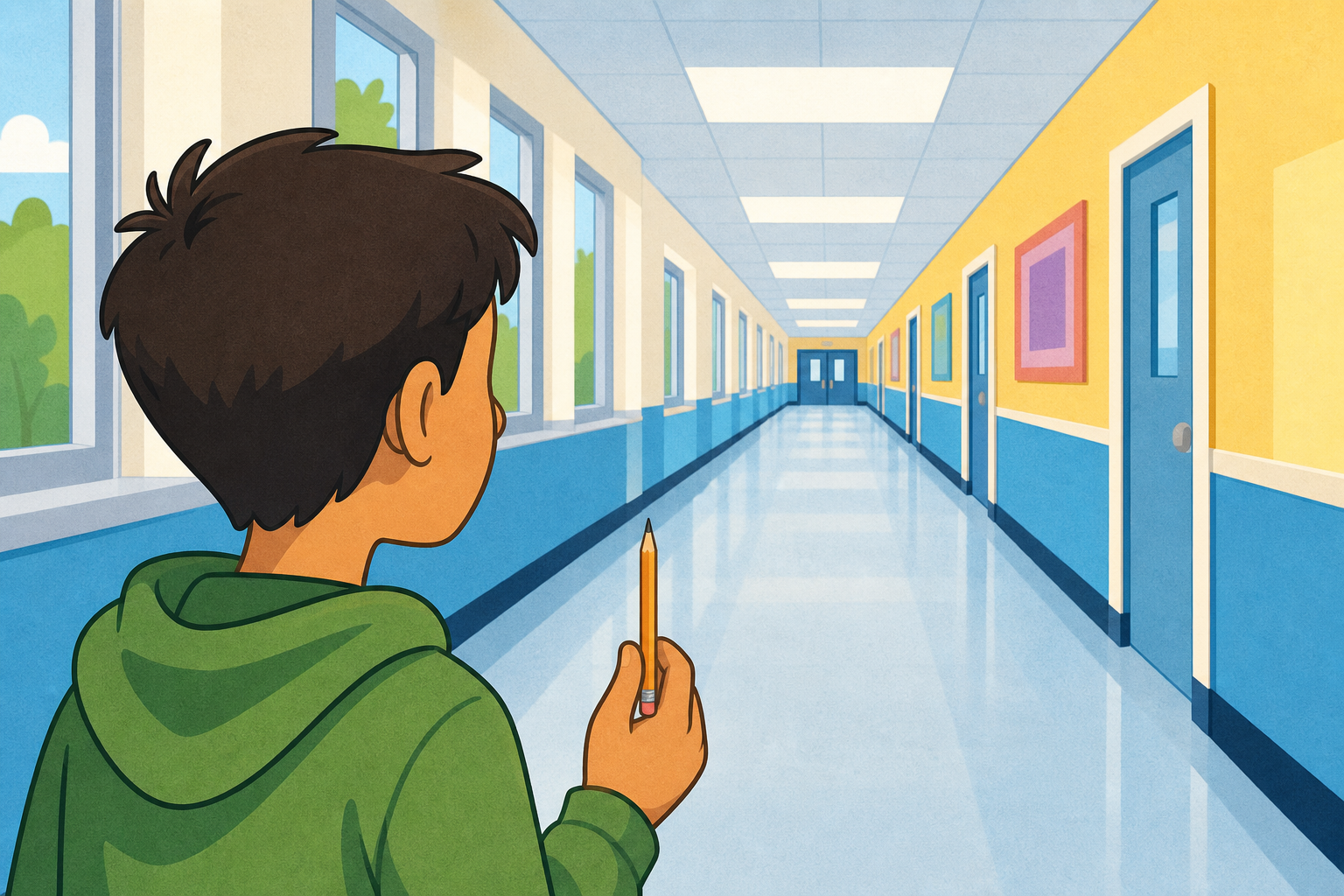
Imagine I told you the corridor outside our classroom is 30,000 millimetres long, and your pencil is one five-thousandth of a kilometre long. Both of those are true! But would you ever actually say them that way?
Which unit would you really choose for the corridor? Which for your pencil? And why does picking the wrong one make a number look silly?
The converter changes lengths between km, m, cm and mm, one example at a time. Look at each result: the decimal point stays put and the digits have stepped into new columns. Notice how many places they stepped, and which way.
We work through three conversions together on the converter. For each one, the whole class decides first: are we going up the ladder or down, and do we multiply or divide? Say your answer aloud so we can agree or correct it. One pupil comes up to drive the converter while everyone else watches the digits and checks the result.
Each conversion uses different units, so the pupil at the board changes both the start unit and the end unit before converting: 4.2 m to centimetres, then 6500 mm to metres, then 0.75 km to metres.
In your maths copy, write each of these lengths in two different units, side by side. Underline the unit you would actually choose to measure that real object.
For example: pencil — 18 cm or 180 mm (underline cm). If your teacher has handed out the printable conversion-ladder worksheet, use it to keep your two units lined up in their columns.
Now we tackle fresh conversions, getting trickier as we go: 7.3 m to centimetres, 4200 mm to metres, 0.62 km to metres, and then the stretch — express 1250 cm in kilometres using the two-jump route we saw earlier.
Why does the decimal point seem to move three places between millimetres and metres, but only two places between centimetres and metres? What is happening to the digits each time?
Next we move from measuring along a line to measuring all the way around a shape, when we work out the perimeter of regular and irregular shapes.
You're previewing this lesson. Get full access to this lesson and hundreds more — each one ready to teach, with interactive activities, printable resources and pupil progress tracking built in.