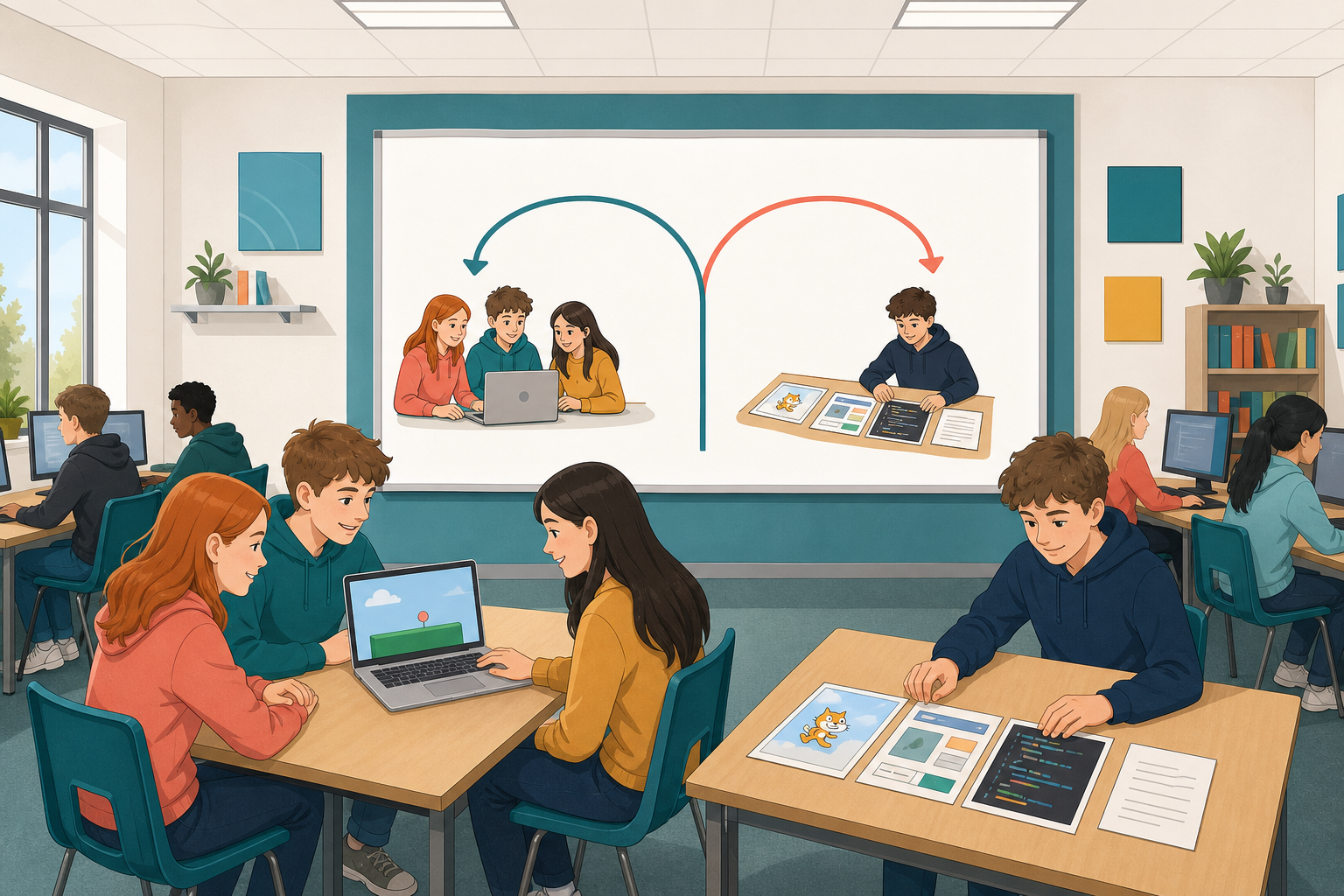
Your Classroom-Based Assessment starts now. It is called Putting the pieces together, and it is the piece of work that goes on your Junior Cycle Profile of Achievement.
There are two approaches you can take: a final software project in a team, or a portfolio of your own work. Today you learn what each path asks of you, weigh them against the work you already have, and choose.
This is a checkpoint session, not a build day. By the end every student should have named a path and a rough reason. Do not let anyone drift into designing the project itself; that is the next session.
Open by naming the CBA calmly: two valid approaches from the course (team software project, and portfolio collection). Several weeks of work are still ahead. If anyone looks anxious, stress that the choice is about fit, not which one is harder.
Confirm your school's local reporting practice before the lesson. Student copy presents both approaches as valid; if your school only reports one route, say so briefly and guide students toward that path without rewriting the framing as unofficial.
There are two CBA approaches. Neither is a shortcut. Pick the one that fits your strengths and the evidence you already have.
Approach 1: a final software project. You work in a team of two or three. Together you research a problem, design a solution, build it, test it, document it, present it, take peer feedback, and reflect. The heart of the evidence is one working program or website and the story of how you made it.
Approach 2: a portfolio collection. You work on your own. You gather finished examples of your own work from across the course (for example Scratch or Arcade games, a website or micro:bit project, and Python work) and write a reflection on how your learning and problem-solving grew. The heart of the evidence is the range, tied together by that reflection.
On either path, good work shows a clear purpose, planning and testing, work another person can follow, and honest reflection.
Keep this tight. Walk the two paths on the board as two equal columns if it helps, then stop. Do not expand into milestone planning; that is the next checkpoint.
Quick oral check before moving on: hands up who already leans toward the project; hands up who leans portfolio. No judgement either way.
Common misconception: some students hear portfolio and think it is lighter. Name that it is not. A strong portfolio needs finished pieces and a reflection that actually joins them up.
If local practice means only one route is reported in your school, tell students once after this screen and steer them accordingly. Do not present either approach as unofficial in student copy.
Features of Quality stay in student language. Avoid NCCA jargon; the one plain sentence in the student copy is enough for today.
First, take two minutes for an evidence rummage. Open your saved work folder or notebook and star two pieces you are proud of.
Next, open one of those starred pieces. In one line, note what still works and what is broken or unfinished. You will use this when you choose a path.
Then open the interactive activity. Read both cards carefully, then answer the two prompts at the end against your own work so far.
If you finish early, swap with a neighbour: challenge one risk on their card and name one extra evidence piece they could star.
There is no better path, only the one that fits you. Be honest about what you already have and where the risk sits.
Give a hard two-minute timer for the rummage before devices open the cards. Then give about three minutes for the one-line check on a starred piece so students touch real work before they choose. Students with almost no saved work still star whatever they can find (screenshots, half-finished builds, notes); the next session is where they scope what to rebuild or gather.
Circulate while students work the cards. Listen for two things: are they matching the path to real evidence they already have, and can they name a risk without panicking?
If a student is stuck between the two, ask: Which pile of work would you rather open on Monday? That usually surfaces the real answer.
Early finishers should not start designing the full project. The neighbour swap (challenge one risk, star one extra evidence piece) keeps them usefully busy.
Teams for the software project are not locked in today. Students can lean toward the project path without naming partners yet; partnering happens at the start of the next checkpoint if needed.
Write a short choice note (about half a page). Save it where your class keeps short notes. Include all four points below.
Sentence starters if you need them:
Done looks like: a named path, two real pieces of evidence, a risk with a plan, and the AI line filled in. You are not designing the full project or listing every portfolio piece today.
This is a decision record, not a full plan. Stop anyone writing a ten-page proposal. Four short bullets is plenty.
Collect or have students save the notes where the class keeps short work so you can see the split between project and portfolio before the next checkpoint. That split shapes how you group teams and how you set up the planning session.
On AI: point back to the class ground rules written earlier. If those rules are still on the wall or in the class folder, show them. Frame them clearly as class or school rules, not as NCCA CBA rules. The three non-negotiables are: help is allowed within the rules, the work must be yours to explain, and AI use is noted honestly. Plain wording to use if students ask: AI can help you learn, draft, or explain, but the work you hand in must be yours to explain. Anything AI helped with is noted honestly. AI must not do the assessment work in your place; you must be able to explain every part you hand in.
If two students both want the project path and already work well together, they may pencil in a possible team, but do not force partnerships today.
Recovery line for anyone with almost no saved work: they can still choose; the next session is where they scope what to rebuild or gather.
Use the extra circulation time here. Brief pair-share before writing is fine for anyone still unsure: thirty seconds each on which path and why, then write alone.
Both paths are real work. The software project rests on one working thing and a team process. The portfolio rests on range and a reflection that joins the pieces up.
Your choice note is the starting point for the next checkpoint, where you will scope the work and set milestones. Nothing is built or finished today.
Quick whole-class pulse: hands up for project, hands up for portfolio. No judgement either way. If the split is very uneven, note it for grouping next time.
Re-state once that this was a choice session. The build and the gathering start after planning.
You're previewing this lesson. Get full access to this lesson and hundreds more — each one ready to teach, with interactive activities, printable resources and pupil progress tracking built in.