1 - Getting Started ~5 mins
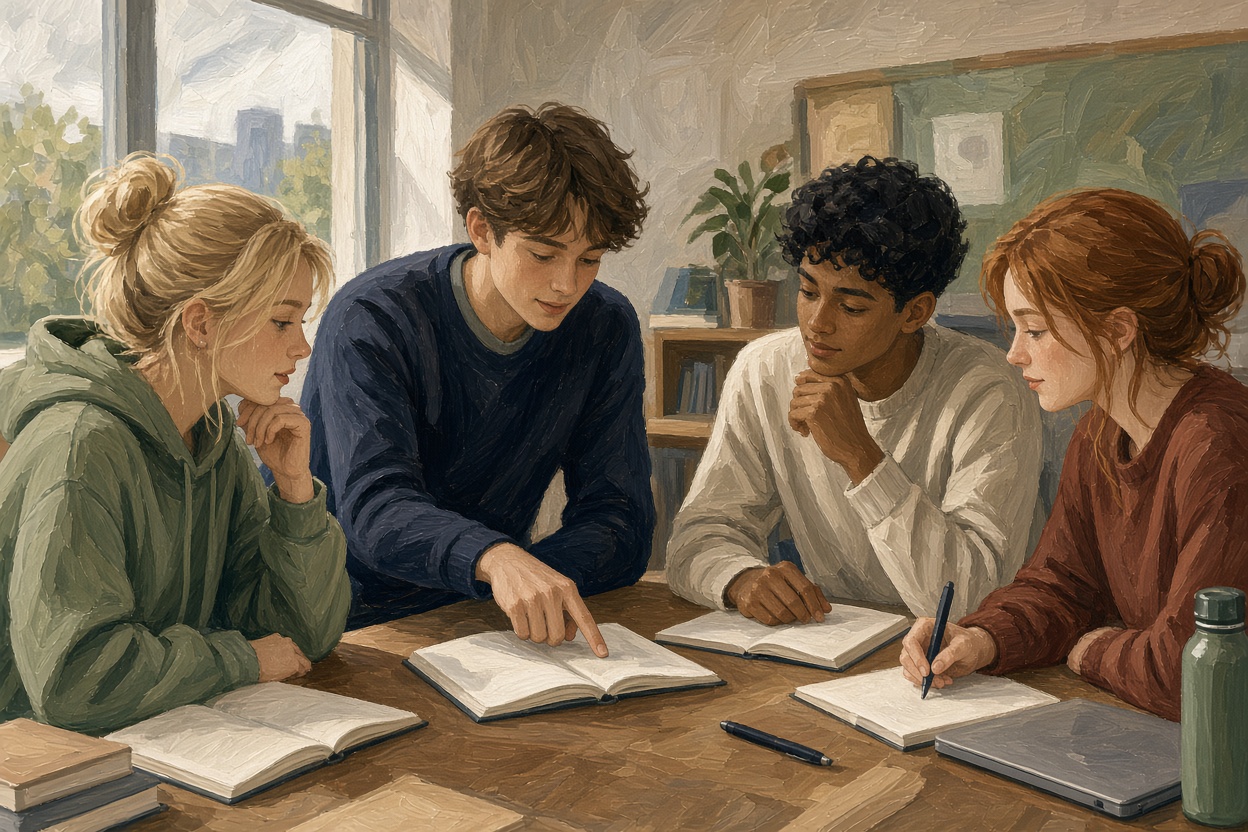 Designers start by getting clear about the problem before they go anywhere near an answer, and that is what your group does today. You already have your Community Issue Investigation documents from the earlier lessons on local issues, so now you choose one issue together, map who is really affected by it, and write a problem-definition statement sharp enough to guide the next five lessons.
This is where your group's work together starts, and the wording matters: if the issue you pick stays vague, every hour that follows is spent guessing, whereas a clear one gives you something solid to build on.
2 - Key Terms ~5 mins
Three terms you will use for the rest of the collaborative task. Read them once before you open the worked example.
| Term | What it means for you | Real example |
|---|---|---|
| Problem definition | A short statement of the real problem, written from the people affected, not as a ready-made solution. This is the sentence your group will bank today and return to every time you ideate, develop or plan. | Teenagers need a free supervised place after school because paid options and empty streets leave them nowhere safe. |
| Empathy map | Four quick notes on what a person says, thinks, does and feels about the issue. It stops your group solving a problem that only exists in your own heads. | An older neighbour without a car: misses the market, avoids night trips, feels cut off from the town centre. |
| Collaborative task | Your small group's design-thinking response to one real community issue across the next lessons, later reflected on for ALT 3. Today's definition is the spine of that task. Every member saves the same statement. | Our group of four will clarify, ideate and plan a response to one local issue, then reflect on the skills we used for ALT 3. |
3 - Define Your Group's Issue ~35 mins
Aoife's group's problem-definition statement is on the board, with annotations your teacher will open one at a time. Follow them so you can see what makes a definition usable: a named user, a real need, and an insight grounded in evidence rather than a solution dressed up as a problem.
Then your group does the clarifying work itself.
- First, share (about 7 minutes). Each member reads out the community issue they investigated earlier, and the group notes who is impacted and how. Leave solutions out of it for now.
- Then choose (about 5 minutes). Agree one issue to take forward, and decide by the end of these five minutes; if you are still tied, your teacher picks from your top two. The issues you drop still need a reason, so write one sentence each on why they did not win (too broad, nobody in the room has real contact with the people affected, already being well handled locally, or not something a student group could credibly propose on).
- Then map (about 8 minutes). For your chosen issue, pick two people or groups affected, and for each one jot four lines: what they might say, think, do and feel. Pull anything concrete you can from your investigations, so that the lines rest on what you found out rather than on what you assume.
- Last, write and bank (about 10 minutes, and this block cannot be skipped). Draft one problem-definition statement in this shape: [Who] need(s) [what] because [insight from your map or investigation]. Keep it under 40 words. It must name people, not abstract causes, and it must not smuggle in your favourite solution. Do not let the earlier talk eat into this time, because the banked definition is the piece of work that has to leave the room with you.
Each member creates (or opens) Collaborative Task Problem Definition in the Strand 2.1 folder if it is not there yet. Save the same three sections:
- Problem-definition statement (shared wording, under 40 words)
- Empathy maps (both maps: four lines per person under say / think / do / feel; type them in or paste a clear photo of the page)
- Discard paragraph (what the group considered and left behind, and why; this is not optional)
That document goes into your Digital Portfolio under Strand 2.1. The shared statement is the problem spine your group will return to in later lessons and reflect on for ALT 3.
Problem definition: Aoife's group, after-school space in their town
4 - Think About It ~10 mins
Talk these through with your group before you pack up. Add anything useful to the discard paragraph in your Collaborative Task Problem Definition document if a point was missing.
- Which discarded issue was hardest to let go of, and what would have had to be true for your group to keep it instead?
- If someone outside this room read only your problem-definition statement, could they tell who is affected and why it matters, without you explaining it?
5 - What You Covered ~5 mins
Today you started the collaborative task in the clarifying stage of design thinking.
- You studied what makes a problem-definition statement usable: named people, a real need, and an evidence-based insight.
- Your group chose one community issue from your investigations and mapped who is impacted using empathy maps.
- You banked a shared problem-definition statement, both empathy maps, and a short paragraph on what you considered and discarded in Collaborative Task Problem Definition (Strand 2.1, Digital Portfolio).
- Next lessons move into ideating responses to this same definition, so keep the wording tight and shared.
Unlock the full learning experience
You're previewing this lesson. Get full access to this lesson and hundreds more — each one ready to teach, with interactive activities, printable resources and pupil progress tracking built in.
This lesson is copyright of Coding Ireland 2017 - 2026. Unauthorised use, copying or distribution is not allowed.