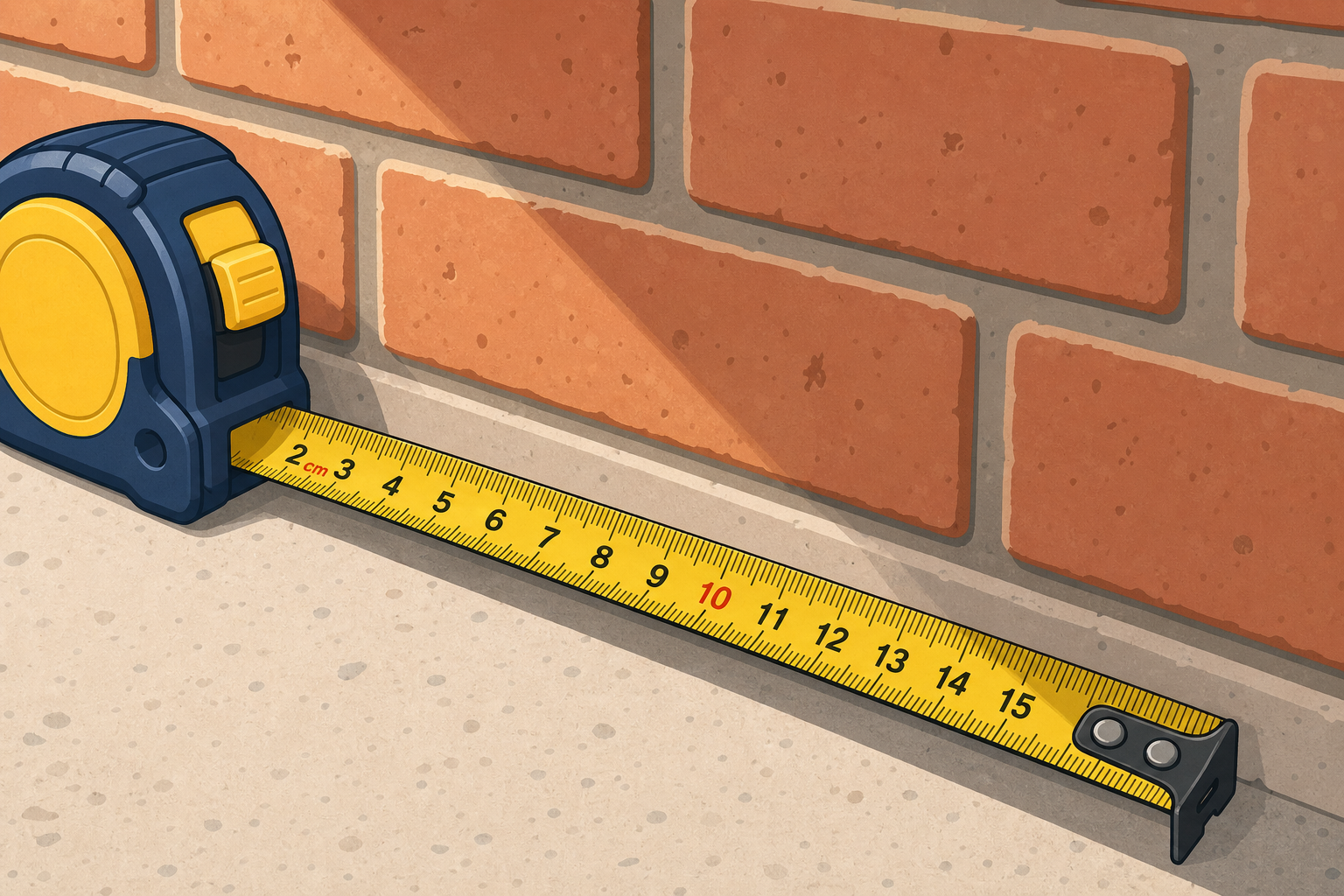
Here is a builder's measurement: a wall is 4.7 metres long. The builder needs to write that same length in centimetres for the plan. How many centimetres is 4.7 m? Have a quick estimate before we work it out together.
Take two or three hands-up estimates, not open call-outs. Don't confirm yet, we'll check it on the ladder in a moment. If a pupil says "multiply by 100", revoice it as a question to the class: why 100 and not 10?
Before we use the ladder, look at what happens to the digits. To change 4.7 m into centimetres, there are 100 centimetres in every metre, so we multiply by 100. Each digit slides two columns to the left. The decimal point does not move, the digits do.
So 4.7 m becomes 470 cm. The number got bigger because a centimetre is smaller than a metre, so it takes more of them to make the same length.
Say it slowly: the 4 was in the ones, now it sits in the hundreds; the 7 steps from the tenths into the tens. The single idea to land here is the digits move, the decimal point stays put. This digit-shift is the why; the ladder steps that follow are the practice.
The interactive shows a unit ladder converting the same length between millimetres, centimetres, metres and kilometres. Notice which way each length sits along the ladder, and how the number changes as the unit changes. Look out for where the decimal point appears.
Point at the rungs; name the factor before each jump lands so pupils hear which rule fits which rung.
4.7 m to 470 cm (×100) to 4,700 mm (×10). Going down to smaller units makes the number bigger. Confirm the hook estimate here; note the two jumps use different factors.
250 mm to 25 cm (÷10) to 0.25 m (÷100). Going up to bigger units divides and makes the number smaller. Pause on the decimal appearing.
0.085 km to 85 m (×1000) to 8,500 cm (×100). The small decimal trips pupils. Ask which unit is biggest, then why km carries the smallest number.
Today we work through this conversion together on the ladder: 1.5 km all the way down to millimetres. The ladder is live, so we tap one rung at a time and say the factor out loud before the digits step across: ×1000 from km to m, ×100 from m to cm, then ×10 from cm to mm.
This round is for talking it through together. Pupils take turns at the board and the class agrees or corrects out loud.
The ladder is live, so tapping a rung steps the digits across straight away. Work down one rung at a time: before each tap, ask the class which factor this rung-jump uses, then tap and watch the digits move. Name each factor as it lands: ×1000, then ×100, then ×10. Invite individual pupils up to tap a rung and name the factor before the digits slide. Watch for the pupil who tries to "move the decimal point", redirect to the digits move, the point stays.
In your maths copy, work each conversion as a chain. Draw an arrow between each step and label it with the factor you used.
Write ×10, ×100 or ×1000 on each arrow.
Walk the room glancing at the labels on the arrows, this is whole-class copybook practice, not marking. The arrow-labels are the bit that matters: a chain with no factors written on is the slip to catch. Note that the two chains use different factors at each rung, so pupils must think about each step rather than reuse one rule.
Today we hit these conversions on the ladder: 50 mm to cm, 4 cm to mm, 6 m to cm, 2.5 km to m, then the big chain, 3 km all the way down to millimetres. The chain takes three steps in a row, ×1000 from km to m, then ×100 from m to cm, then ×10 from cm to mm, so we'll say each step aloud before we check it.
These are the practice questions. Pupils take turns at the board, check each answer, and the class confirms before moving on. Keep the board work brisk rather than over-explaining.
On the multi-step chain (3 km → mm), the learner fills every rung in between, so let the class predict each rung before Check marks it, and name the factor each time (×1000, ×100, ×10). Watch for pupils stopping one step short on the chain. Use the on-screen ✓ as part of the narration, yes, that's it.
Going from kilometres down to millimetres took three steps, first ×1000, then ×100, then ×10. What does that tell us about how the units fit inside each other? If 3 km becomes 3,000,000 mm, why is the millimetre number so much bigger?
Listen for pupils naming the chain as three separate steps with different factors (km→m is ×1000, m→cm is ×100, cm→mm is ×10). Revoice a strong answer: so the smaller the unit, the more of them you need to make the same length. Head off the idea that bigger number means longer thing, the length never changed, only the unit did.
Next we'll use these length skills on real shapes, adding all the sides of a polygon to find the perimeter.
Quick recap. Keep the focus on the rule pupils can carry forward: smaller unit means multiply, bigger unit means divide, and check which factor each rung-jump needs.
You're previewing this lesson. Get full access to this lesson and hundreds more — each one ready to teach, with interactive activities, printable resources and pupil progress tracking built in.