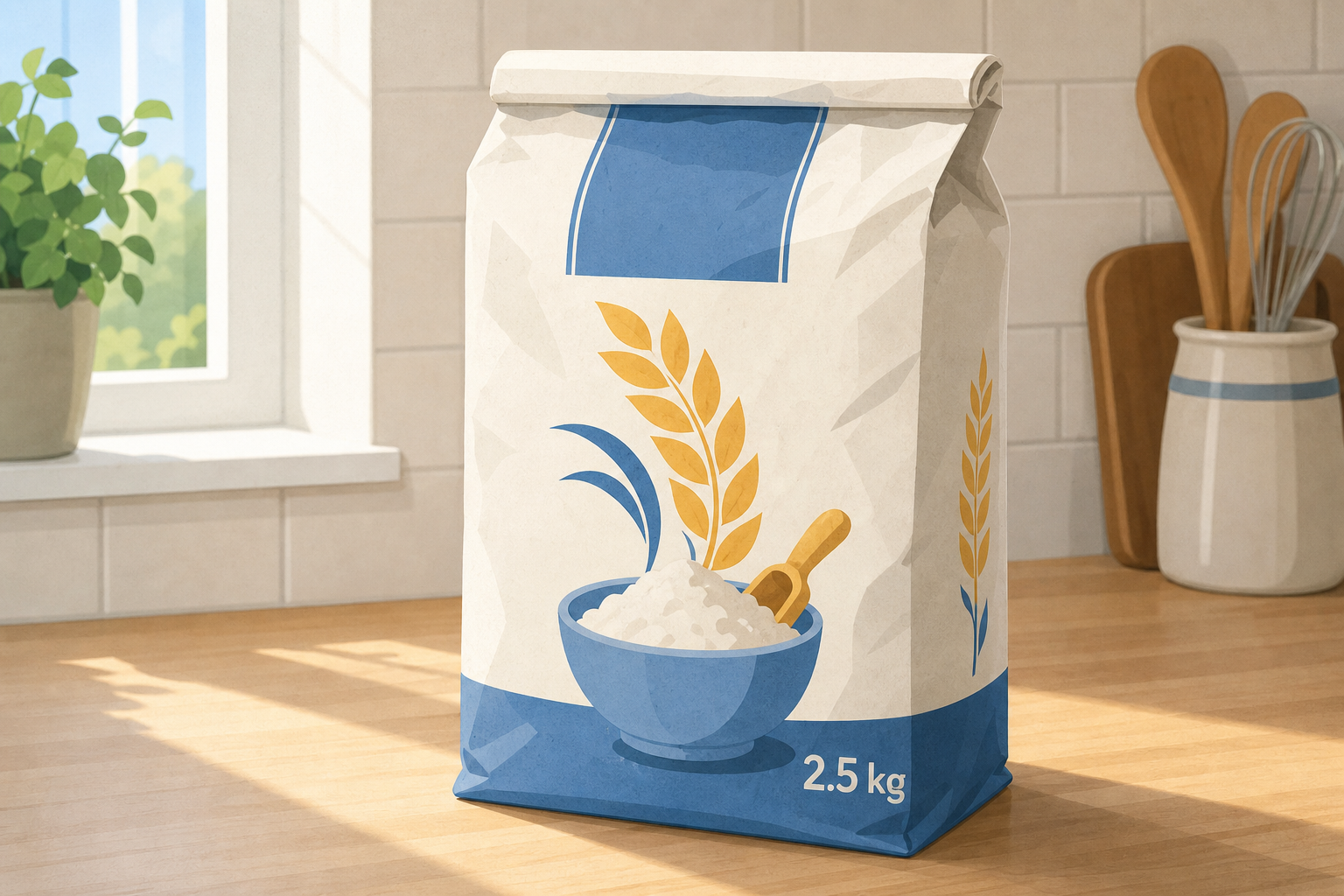
Here is a bag of flour. The label says 2.5 kg. If we wanted to write that same mass in grams instead, what would we write?
Take three hands-up answers, not open call-outs. Some pupils will guess 250 g or 25 g — leave every answer on the board and say you'll settle it by the end. Do not confirm the right answer yet; the ×1000 rule is what the lesson builds to.
The interactive shows a conversion ladder between kilograms and grams. Kilograms sit one rung above grams, and each rung down shows the digits moved three place-value columns to the left, that is × 1000. Look at each example, then hands up to say which way the digits moved.
The × 1000 chip sits between the kg and g rungs on each example — let the class read the rule off the screen.
2.5 kg → 2,500 g: friendly whole-times case, digits slide three columns left.
0.25 kg → 250 g: a decimal on the kg side, same rule holds.
75 g → 0.075 kg: going up the ladder, ÷ 1000, digits slide the other way. Hardest one — hold out for a pupil to notice the zero after the point before you name it.
Today we work these conversions together on the ladder. Say whether each one goes × 1000 or ÷ 1000 before we check it, and watch which way the digits slide. The whole class says the rule together before we tap Check.
Talk this one through together — pupils take turns at the board and the class agrees or corrects out loud.
The interactive is in guided mode: tap the destination rung and let the digits walk while the class names the rule. Order is deliberate: 1.75 kg → g is a clean × 1000; 500 g → kg lands on the friendly 0.5 kg (the number the wrap talks about); 0.4 kg → g checks the decimal-on-kg case; 8 g → kg is the tricky one — it gives 0.008 kg, three zeros work, so hold out for a pupil to say where the 8 lands.
In your maths copy, work each conversion as kg ↔ g. Draw a little arrow between them and label the arrow ×1000 or ÷1000 to show which way you went.
Walk the room glancing for the arrow label — the direction word is the check, not the answer. No individual marking; this is whole-class copybook practice.
Today we work through these conversions together. Say × 1000 or ÷ 1000 before each Check:
This is the practice round — pupils take turns at the board, check each answer, and the class confirms before moving on. Keep the board work brisk rather than over-explaining.
The practice set climbs from a clean whole-number kg through decimals to the very small grams case. 6 g → kg = 0.006 kg is the hardest — two zeros after the point; ask the class to predict the digit's column before Check. Individual pupils type each answer; the interactive marks it ✓ or not-yet.
You're previewing this lesson. Get full access to this lesson and hundreds more — each one ready to teach, with interactive activities, printable resources and pupil progress tracking built in.