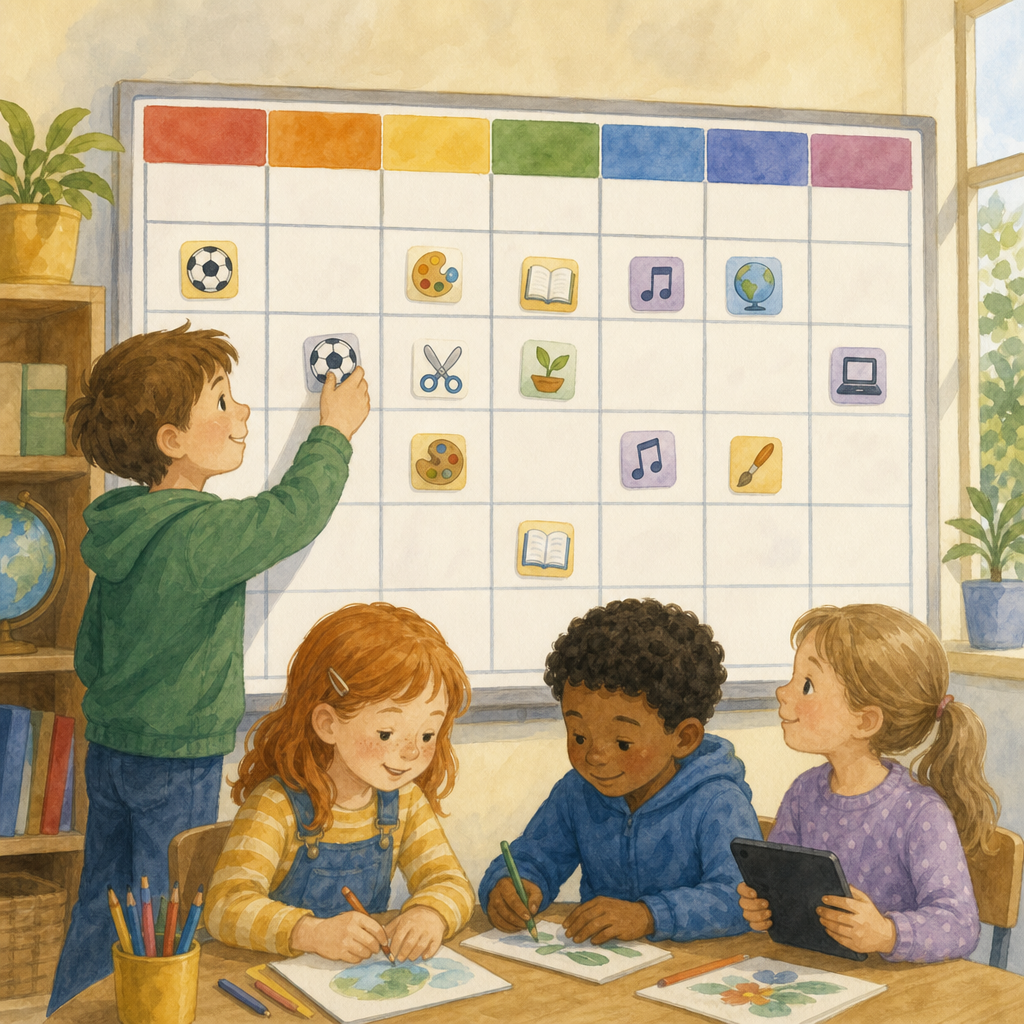
 What day is it today? What day comes next? You already know the answers in English, and probably in Irish too. Today we learn all seven days of the week in German, in order, so you can name any day of the school week, just as a class in Germany does on their wall planner.
By the end of this lesson, you will be able to:
- Name the seven days of the week in German
- Say the days in order from Monday to Sunday
- Spot the day words when you hear or see them in a game
Here is how a class in Hamburg labels their week on the wall planner. You will meet the seven days in two short chunks. For each card: hear the German and see it first, then say it with the class. Listen for the strong tahk ending on most days. Mittwoch is the odd one out: no tahk ending; it is MIT-vokh, like a soft clearing of the throat at the end. Have fun with it. Every German day starts with a capital letter.
A few of you will come up and click a word, then its meaning, on the board. Everyone else has a job: whisper the German day every time a volunteer picks one, and when a pair is found, say the German together with the class and listen to the audio.
Then you will see a simple German school timetable (Stundenplan) on the board. Your table says the full week Monday to Sunday in turn, and then you answer in German: which day is Sport? Which day is Musik?
Open your copy. The ordered list Monday to Sunday in German stays on the board — copy from the board; do not hide it. Write the seven days in order beside a mini weekly grid (seven boxes). Circle the day with PE on it, and write one real hobby or club on another day (English is fine). Take care with the capital letters.
- Montag — Monday
- Dienstag — Tuesday
- Mittwoch — Wednesday
- Donnerstag — Thursday
- Freitag — Friday
- Samstag — Saturday
- Sonntag — Sunday
Use the bingo card on your desk. Listen carefully for each German day as it is called. Mark the day on your printed bingo card when you hear it. When every day on your card is marked, stand and say Bingo, then read your marked days aloud in German.
Unlock the full learning experience
You're previewing this lesson. Get full access to this lesson and hundreds more — each one ready to teach, with interactive activities, printable resources and pupil progress tracking built in.
This lesson is copyright of Coding Ireland 2017 - 2026. Unauthorised use, copying or distribution is not allowed.