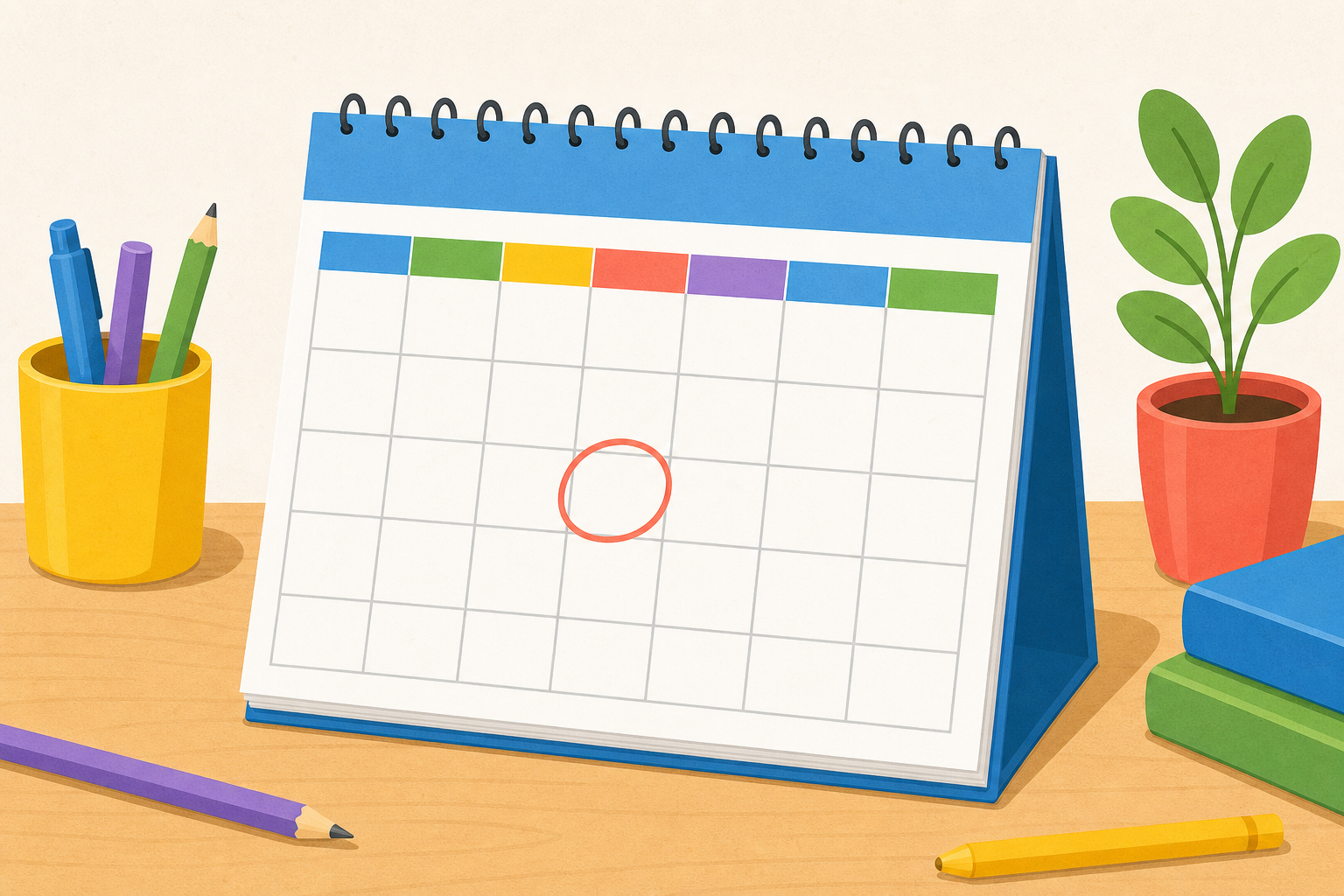
Here is this month's calendar. Today's date is somewhere on it. Hands up: how many days are there in one week? And if today is a school day, which day comes next?
Display the month calendar as pupils settle. Take two or three hands-up answers for the number of days in a week, not open call-outs. Point to today's date as your anchor for the rest of the lesson.

Look at the calendar together. The days run in seven columns: Monday, Tuesday, Wednesday, Thursday, Friday, Saturday, Sunday. Down the side, each row is one week. Now pick any date and see which weekday column it sits in. Then count on 7 days and watch it land on that same weekday, one week later.
Two anchor demonstrations on the displayed calendar. First: run a finger across the seven weekday columns and count the days in a week, then count the weeks down the month to read off its total days. Second: pick any date on your live calendar, name the weekday its column shows, then count on 7 to land on the same weekday and note the date has gone up by 7. The same weekday comes back after seven days. Ask what to watch for before you count, not after.
We'll do these together on the calendar. Point to each date before you read it off:
Talk this one through together. Pupils take turns at the board, and after each turn the class agrees or corrects out loud, so pupils not at the board stay in it.
Run this as a manipulative-task: each group has a printed month calendar and a counter to hold their place. After a pupil reads a date off the board, take a quick whole-class check: hands up for the weekday, then take two answers so the class confirms the new date and the weekday before you move on. Circulate and catch pupils who read the weekday header instead of counting down the date column. Work through the four tasks in order (find the 10th, find the last day, count on 7 from the 3rd, Friday to next Friday), giving each a fresh pupil at the board.
In your maths copy, write the seven days of the week in order and the twelve months of the year in order. Then circle the month we are in now.
First we will build both lists together on the board so you can see the order before you write.
Watch one full run-through on the board, for example: Monday, Tuesday, Wednesday, Thursday, Friday, Saturday, Sunday — then January, February, March, April, May, June, July, August, September, October, November, December. Check that February sits second.
The calendar stays on the board so you can check the day names and which month we are in now. Copy both lists into your book in that same order, then circle this month.
Whole-class copybook practice, not marking. Before pens go down, write both full lists on the board once as the worked model: days Mon–Sun in a column, months Jan–Dec in a column. Point as you say each name so order is seen and heard end to end. Leave the lists up.
Worked steps: (1) chorally build days from Monday to Sunday and count to 7; (2) chorally build months from January to December and count to 12; (3) underline or tick the current month on the board list and on the displayed calendar; (4) pupils copy both lists and circle this month.
Slip to watch: months jumbled (e.g. September before June) or February left out; days starting on Sunday if that is not your board order. Glance for order and spelling as you walk. Pupils unsure of month order check the board list, not a guess.
We'll work through these together, each one a little harder. The first one is read from your calendar; the others give the weekday and date:
This is the practice round. Pupils take turns at the board, check each answer, and the class confirms before moving on. Keep the board work brisk rather than over-explaining.
The first question asks for a weekday, so its answer must be read off your own class calendar for this real month, not from any fixed key. The remaining three are pure date arithmetic and hold for any month. For the project question, listen for pupils who add 7 twice (two weeks = 14 days) rather than guessing. Revoice a strong answer: so Monday plus two weeks stays a Monday, and the date goes up by 14. The order builds: read a weekday from the board, jump one week, count a stretch of days, then jump two weeks.
You're previewing this lesson. Get full access to this lesson and hundreds more — each one ready to teach, with interactive activities, printable resources and pupil progress tracking built in.