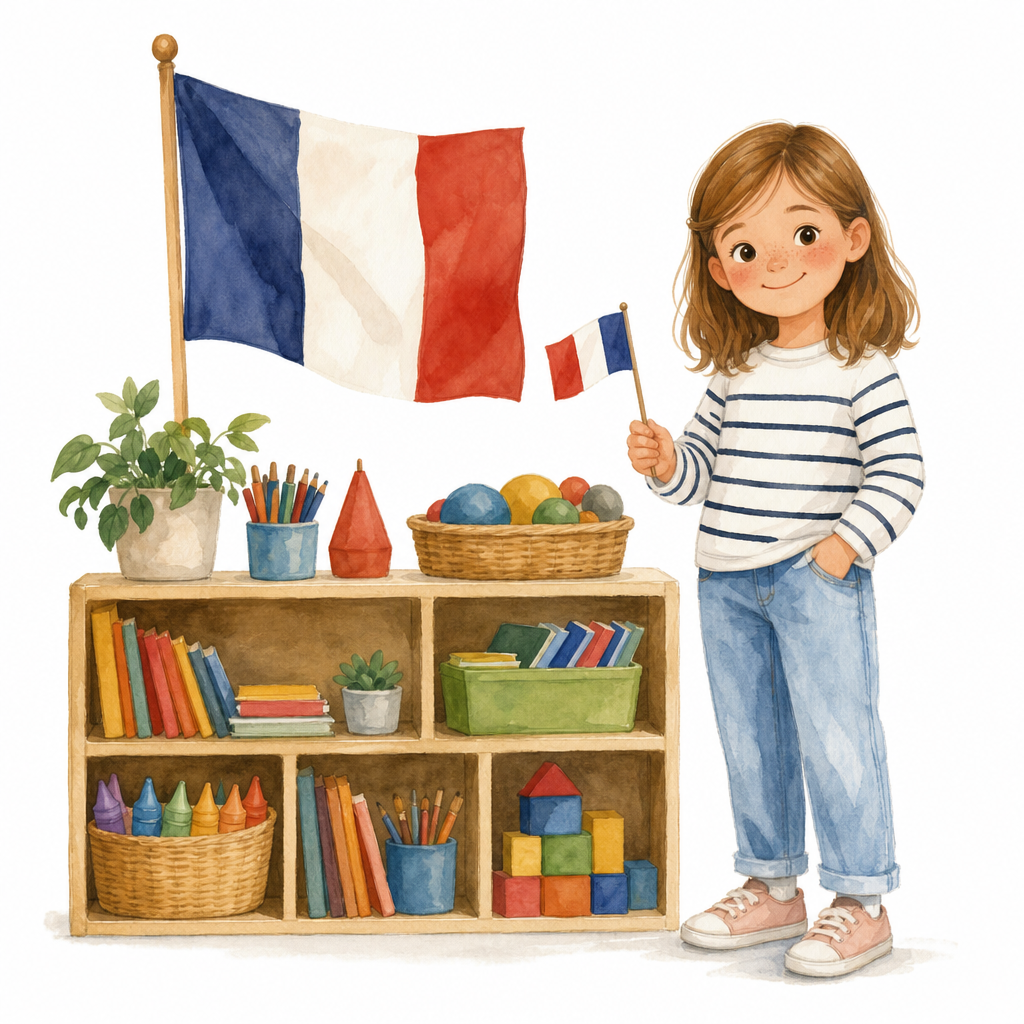
 Look around the room. Name three things you can see and say their colours in English.
Today you will do the same in French. You will also notice something English never asks you to do: the colour word can change shape to match the thing it describes.
One French picture to keep in mind: le drapeau bleu, blanc, rouge (the blue, white and red flag). Three of today's colours, in an order French children know by heart.
By the end of this lesson, you will be able to:
- Name eight colours in French
- Use a colour word with a thing, in a short description
- Spot when a colour word needs a different ending
Listen to each colour on the card, then say it twice with the class. Listen for the soft zh in rouge and orange, like the s in treasure. Make rouge juicy, not "roog".
English shows first so you know which colour you are aiming for. Wait for the audio, then join the class repeat. No guessing out loud before you have heard it.
Click each French colour, then its English meaning. When a pair is found, say the French colour together as a class, then picture one thing that colour could describe.
Open your copy. Using the models below, write three short descriptions: a thing and its colour, with the colour word in the right form.
Models to copy and adapt:
- un cahier bleu (a blue exercise book)
- une fleur verte (a green flower)
Thing words you may use: un cahier, un ballon, un stylo · une fleur, une pomme
Colour forms: bleu / bleue · vert / verte · noir / noire · blanc / blanche · gris / grise · jaune, rouge, orange (no change)
Start by copying one model, change the colour once, then write one line of your own from the word banks above.
Look at the picture in this activity. As each colour label is placed on it, the whole class says the French colour together. If you are not at the board, point in the air or tick the colour in your copy as it is said.
After the labels are on, try these short descriptions with the class:
- un cahier bleu (a blue exercise book) — with un cahier the colour stays bleu
- une fleur verte (a green flower) — with une fleur it becomes verte (extra e)
- le drapeau bleu, blanc, rouge (the blue, white and red flag)
Unlock the full learning experience
You're previewing this lesson. Get full access to this lesson and hundreds more — each one ready to teach, with interactive activities, printable resources and pupil progress tracking built in.
This lesson is copyright of Coding Ireland 2017 - 2026. Unauthorised use, copying or distribution is not allowed.