Model first: Today it is sunny and twenty-two degrees.
Hands up: who can give today's weather in English like a radio presenter? Weather and a temperature in one full sentence, not a single word.
Show the model line on the board first, then take three or four full-sentence English forecasts with hands up. No materials: invent them live from today's real weather if you like. The point is the shape (weather plus a number), not a long chat. You will rebuild that shape in Spanish after the word-table. A small number bank for temperatures is taught in the next step, so you do not need prior number lessons.
Listen when each Spanish weather word is played, then say it back together. We will learn them in two short sets of four, with a thumbs-check in between.
Forecast rule: keep the weather word exactly as it appears on the word-table (including el / la). Then add the temperature on the next short line with Hace + a number + grados.
Forecast frame (chorus once with the class):
Hoy (today) + [weather word exactly as on the table].
Hace (it is) + [number] + grados (°).
Example: Hoy el sol. Hace veintidós grados. (Today the sun. It is twenty-two degrees.)
Example: Hoy la lluvia. Hace diez grados. (Today the rain. It is ten degrees.)
Sunny example: Hoy soleado. Hace treinta grados. (Today sunny. It is thirty degrees.)
Temperature strip (stay on the board all lesson):
diez (10) · quince (15) · veinte (20) · veintidós (22) · treinta (30) + Hace … grados (It is … degrees)
Set 1 (chorus twice each): El sol, Soleado, La lluvia, La nieve. Thumbs-check: can everyone say those four?
Set 2: La nube, La niebla, La tormenta, El trueno. Stress soft ll in lluvia (YU-byah, like y in yes) and ñ in nieve / niebla (tongue on the roof of the mouth, not a plain n).
One frame for every table word (teach explicitly after Set 1): pupils always keep the exact table spelling, including the article. They never drop el / la and they never rebuild the weather half with a different verb. Capitals follow normal sentence rules (Hoy and the start of the temperature line). The temperature line is always Hace + number + grados. Write the two-beat frame once and leave it up:
Hoy + [table word].
Hace + [number] + grados.
Why this frame (read for you; optional one-liner for a curious class): everyday Spanish radio often packs weather into set phrases such as hace sol, llueve, nieva. Those phrase strings are not the eight rows on our platform word-table. This lesson keeps every spoken and written weather half identical to the table (so the board, copy and Activity Book stay aligned) and puts the natural weather verb on the temperature half, where Spanish really does say hace … grados. Two short lines make one forecast turn without forcing an unnatural y join onto a noun. Both halves are understood; non-specialist teachers never have to invent off-table spellings.
Which words to push in full forecasts today: prioritise production with El sol, Soleado, La lluvia, La nieve, La niebla and La tormenta (clear weather-report sense). Treat La nube and El trueno as secure recognition and map labels; if a pupil uses them in the frame, accept the accurate table form rather than blocking them, but do not make them your main oral models.
Frame language to teach explicitly (not on the word-table, but on the board): Hoy (oy), hace (AH-seh), grados (GRAH-dohs). Chorus each once. Stress that hace here belongs with the number on the temperature line, not as a replacement for the table weather word.
Temperature number bank (write on the board as a permanent strip; this lesson teaches these five numbers plus hace and grados here because the course has no separate numbers lesson yet): diez (DYESS, 10), quince (KEEN-seh, 15), veinte (BAYN-teh, 20), veintidós (bayn-tee-DOHS, 22), treinta (TRAYN-tah, 30). Chorus the strip once top to bottom before the worked examples. Then chorus Hoy el sol. Hace veintidós grados., swap to Hoy la lluvia. Hace diez grados., then Hoy soleado. Hace veinte grados., then one heat-leaning line Hoy soleado. Hace treinta grados. so the frame is not locked to one weather or one temperature and the Seville discussion has a spoken model.
Cheer the first table that nails the full two-beat forecast with the table word copied exactly: make a small fuss so the sentence pair feels like a win. Keep the word-table, the frame and the number strip on screen for the copybook later.
Volunteers flip two cards at a time on the board and find each Spanish weather word with its English meaning.
When a match is found, everyone whispers the Spanish together. Between turns, the whole class repeats two words so every row keeps speaking.
Then, all together: the teacher points at a weather picture and a number from the strip. The class says one full forecast using the two-beat frame from the board (table word exactly as shown, then Hace + number + grados).
Whole class on the IWB with volunteers taking turns. If a pair is missed twice, stop and say the Spanish together before moving on. Listen for the soft ll in La lluvia (la YU-byah) and the ñ in La nieve / La niebla (NYEH). Keep the pace brisk: this is recognition after the present beat, not a first look.
Oral forecast beat (about 2 minutes at the end): point at one weather image and one number on the strip (diez / quince / veinte / veintidós / treinta). Prefer images that fit the production set: sun, sunny, rain, snow, fog, storm. Class choruses the full two-beat frame with the table form unchanged, e.g. Hoy el sol. Hace veinte grados., Hoy la lluvia. Hace diez grados., Hoy la niebla. Hace quince grados., or Hoy soleado. Hace treinta grados.. If anyone rebuilds the weather half into an off-table phrase, stop, point at the word-table, and remodel the exact table form. Do three rounds with different weather + number pairs so every pupil has said a full forecast before pens move. Smile and name one strong sound you heard (clear hace, exact table word, brave ñ, full number).
The word-table, forecast frame and number strip stay on the board. One more all-class oral forecast together, then pens ready.
Open your copy. Write one full forecast (two short lines). Copy one weather word exactly from the table, then write Hace + a number from the strip + grados on the next line. Success looks like a full Spanish forecast, not a bare English word.
Pause the board games. Chorus one more oral forecast, then everyone writes for three minutes: this is the only stretch where every pupil's pen is moving. Leave fully visible: (1) the word-table, (2) the two-beat frame (Hoy + [table word]. / Hace + [number] + grados), and (3) the number strip (diez, quince, veinte, veintidós, treinta + Hace … grados).
Walk the room. Accept as success a full frame with the table form copied correctly from the production set, e.g. Hoy el sol. Hace veinte grados., Hoy la lluvia. Hace diez grados., Hoy la nieve. Hace quince grados., Hoy la niebla. Hace diez grados., Hoy la tormenta. Hace veinte grados., or Hoy soleado. Hace treinta grados.. Gently correct off-table weather halves by pointing at the word-table. If a pupil reaches for cloud or thunder, steer them to a production-set word or accept accurate copying of the table form in the same frame. Prompt from the board supports rather than inventing spellings. Do not collect these. Quiet praise for anyone who used the full two-beat frame with exact table word plus Hace + number + grados without shrinking to one English word.
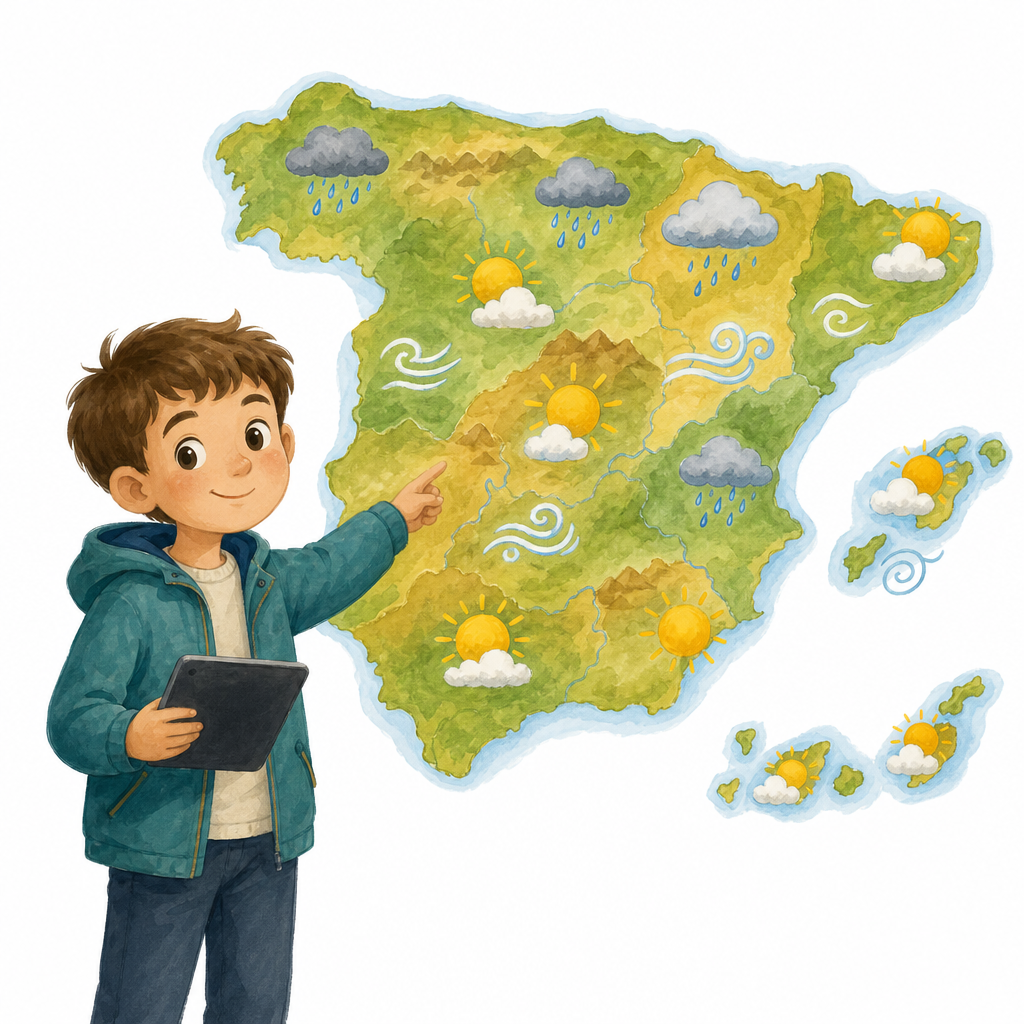
Look at the weather map of Spain and put each Spanish label on the right region. Read the phrase aloud as you place it.
While a volunteer places a label, everyone else points to that word in the on-screen list and mouths it. After each placement, the whole class says the Spanish once together.
IWB volunteers only (call different tables up so more voices are heard). No devices pathway. After three or four labels are placed, stretch production with the same two-beat frame and number strip as step 4, but only on production-set labels (sun, sunny, rain, snow, fog, storm). Scripted prompt: point at the placed label and say, 'Now all together: Hoy + [exact label from the map]. Then Hace + [number from the strip] + grados.' If the label shows La tormenta, the class should say Hoy la tormenta. Hace treinta grados. (table form unchanged). For La nube or El trueno, keep the beat as choral reading of the label only. Correct gently toward the full forecast with exact table word plus Hace + number, not a single English shout-back. Celebrate a clean full forecast out loud so the map game still feels like speaking practice.
You're previewing this lesson. Get full access to this lesson and hundreds more — each one ready to teach, with interactive activities, printable resources and pupil progress tracking built in.