1 - Getting Started ~5 mins
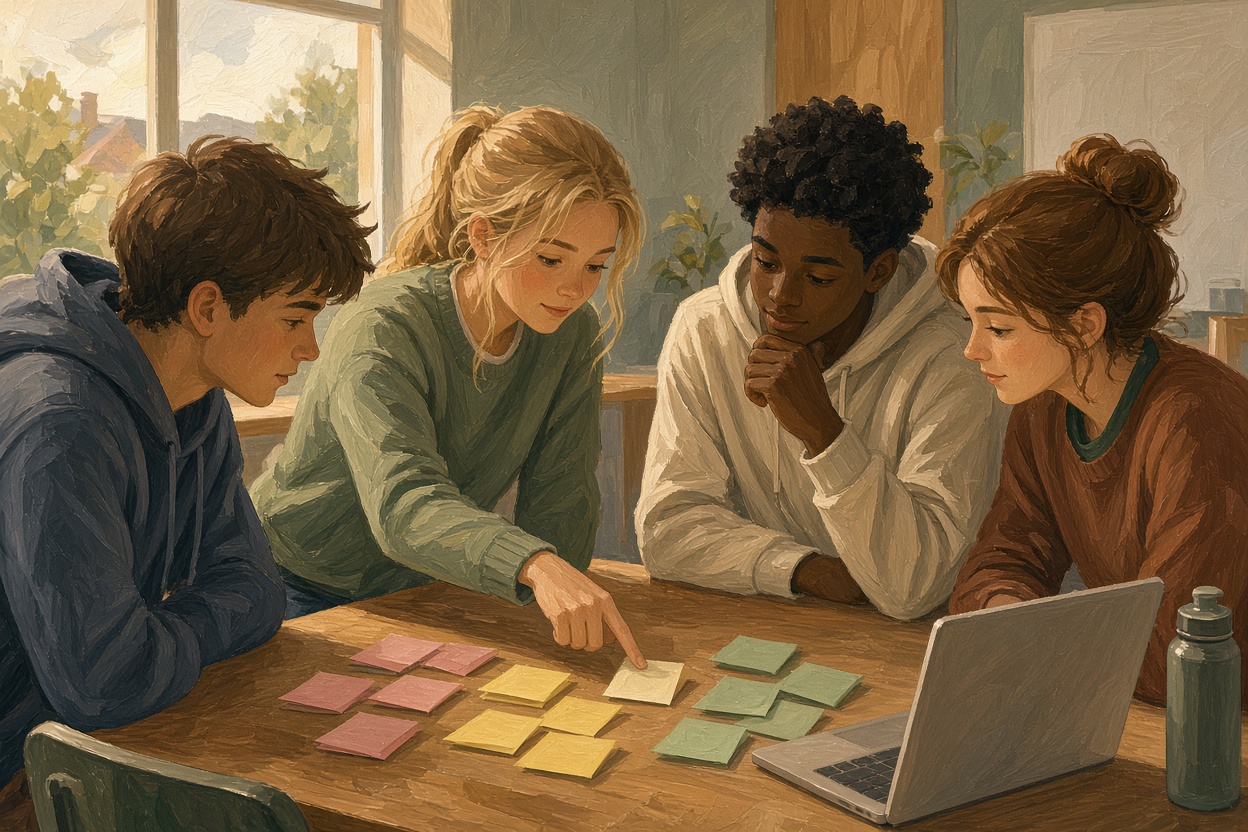 Your group has generated a wide board of ideas and starred three. Today you stop generating and start filtering: instead of adding more ideas, you test the ones you have and cut the ones that will not hold up.
A starred idea is still only a title. By the end of this period your group will hold one developed solution on a single page: what it does, who it serves, how it works, what it costs, and what could go wrong.
If you have fewer than three stars, take two minutes now to star from the full ideation board. If you cannot open the Collaborative Task Ideation document in the Strand 2.1 folder, tell the teacher before Part 2 starts.
2 - Key Terms ~5 mins
Developing means taking the strongest one or two ideas and making them real enough to test. Design teams filter with three questions. Sort every claim through all three before you commit.
| Term | What it means for you | Real example |
|---|---|---|
| Feasibility: can we actually deliver this with the people, skills, time and access we have? | If your group cannot staff, book or build the first version, the idea dies here even if it sounds brilliant. | A lunchtime peer-mentoring rota in your own school is often feasible; redesigning the town bus network is not |
| Desirability: would the people affected want, use and support this? | Your group liking an idea is not enough. Desirability sits with the people named in your problem definition. | A community garden that older residents asked for beats a youth-only mural nobody outside the group requested |
| Viability: can this keep going after the first burst of energy? | Cost, who pays, who owns it when your group leaves, and what happens in summer are viability questions. | A free one-day workshop can be viable once; a weekly café needs ongoing stock, insurance and a named owner, often with a small community or ETB grant |
An idea that clears only one of the three is not ready. The one you develop should be the idea that survives the hardest honest pass through all three.
3 - Filter, Then Write the Solution ~35 mins
Two moves this period. First, practise the three-lens filter on the board so the whole class shares the same test. Then your group applies that test to your own starred ideas and writes the one-page developed solution. The page you write today is the document you will need next lesson to plan how the solution would actually be carried out, and you will keep it in your portfolio to draw on for Portfolio in Action, your answer to the SEC brief.
Part 1: filter practice (about 8 minutes). Drag each card into the lens it belongs to: feasibility, desirability or viability. Some cards could fit more than one lens. Place each where you would defend it, and be ready to say why. When the class is settled, discuss the two prompts on the activity aloud as a group (no typed answers on this page). Note which cards caused the longest argument: those are the questions your own idea must answer in writing.
Part 2: choose and develop (about 27 minutes). Open your Collaborative Task Ideation document and your problem-definition statement. Run each starred idea through all three lenses out loud as a group. Drop any idea that fails two lenses. If two still stand, pick the one a community stakeholder could take seriously next month, not the one that only sounds clever in the room.
Then write Collaborative Task Solution in your Strand 2.1 folder. One page. Every group member saves their own copy. Cover all five headings:
- What it does: one plain paragraph on the solution itself
- Who it serves: the people named in your problem definition, not "the community" in general
- How it works: the steps a stranger could follow
- What it would cost: rough but real figures (venue, materials, print, transport, time, or a small community/ETB grant). "Not much" is not a figure
- Risks: at least three things that could go wrong, and what you would do about each
If a heading is empty, the solution is not developed yet. Cost and Risks are non-negotiable exit checks: finish any incomplete page before the next lesson. Capture anything from the Part 1 talk that changes your choice under Risks or How it works on Collaborative Task Solution.
Which lens is this testing?
4 - Think About It ~10 mins
Think about these with your group (talk only; no typed answers on this page):
- Which starred idea did you leave behind, and which lens killed it: feasibility, desirability or viability?
- If a community stakeholder read your one-pager tonight, which heading would they challenge first, and what evidence would you need by next lesson?
Then close the page properly: add at least one sentence to Collaborative Task Solution under the weakest heading (often Risks or What it would cost), naming either the evidence you still need or the lens that killed the dropped idea. No empty Cost or Risks when you save.
5 - What You Covered ~5 mins
Today you took your group's starred ideas and filtered them down to one solution you can develop.
- Feasibility, desirability and viability as three separate tests, not one vague "is it good?"
- Filtering your starred ideas until one solution survived an honest pass through all three lenses
- Writing Collaborative Task Solution in your Strand 2.1 folder: what it does, who it serves, how it works, cost and risks
- Naming what you left behind and why, so the next stage builds on a real choice rather than a favourite title
Next lesson you move to implementing: a realistic plan a community stakeholder could recognise as a credible proposal. Bring a complete Collaborative Task Solution with you.
Unlock the full learning experience
You're previewing this lesson. Get full access to this lesson and hundreds more — each one ready to teach, with interactive activities, printable resources and pupil progress tracking built in.
This lesson is copyright of Coding Ireland 2017 - 2026. Unauthorised use, copying or distribution is not allowed.