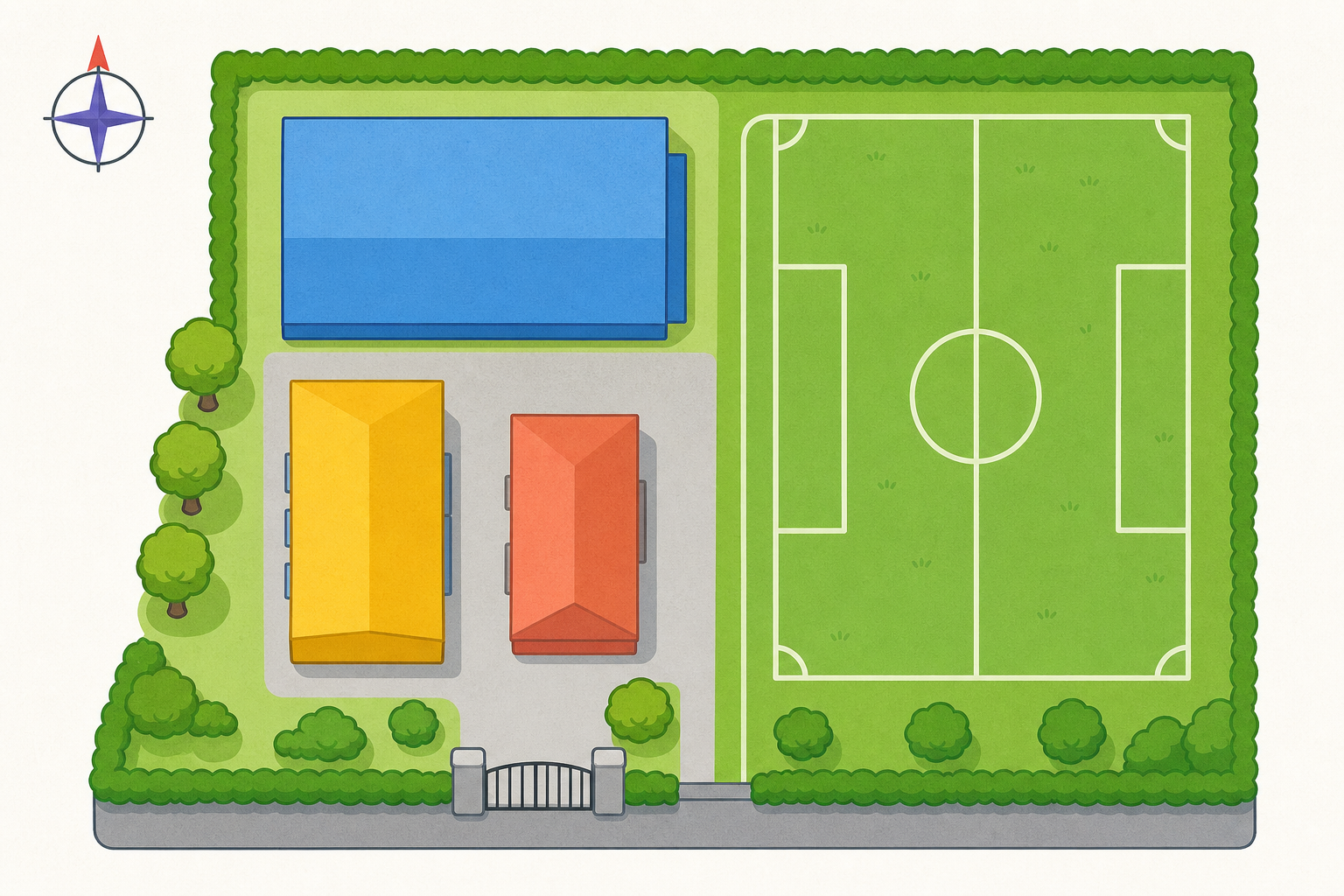
Look at the map of a schoolyard on the board. It shows the gate, the hall, the office and the pitch. North is marked at the top. You are standing at the gate, facing North.
Put your hand up if you know: what is on your right? Which way would you walk to reach the hall door?
Display the schoolyard map with North clearly marked at the top and the gate, hall, office and pitch all visible before pupils settle. Take three hands-up answers, not open call-outs. Hold out for pupils saying which way they are facing, not just naming a place.
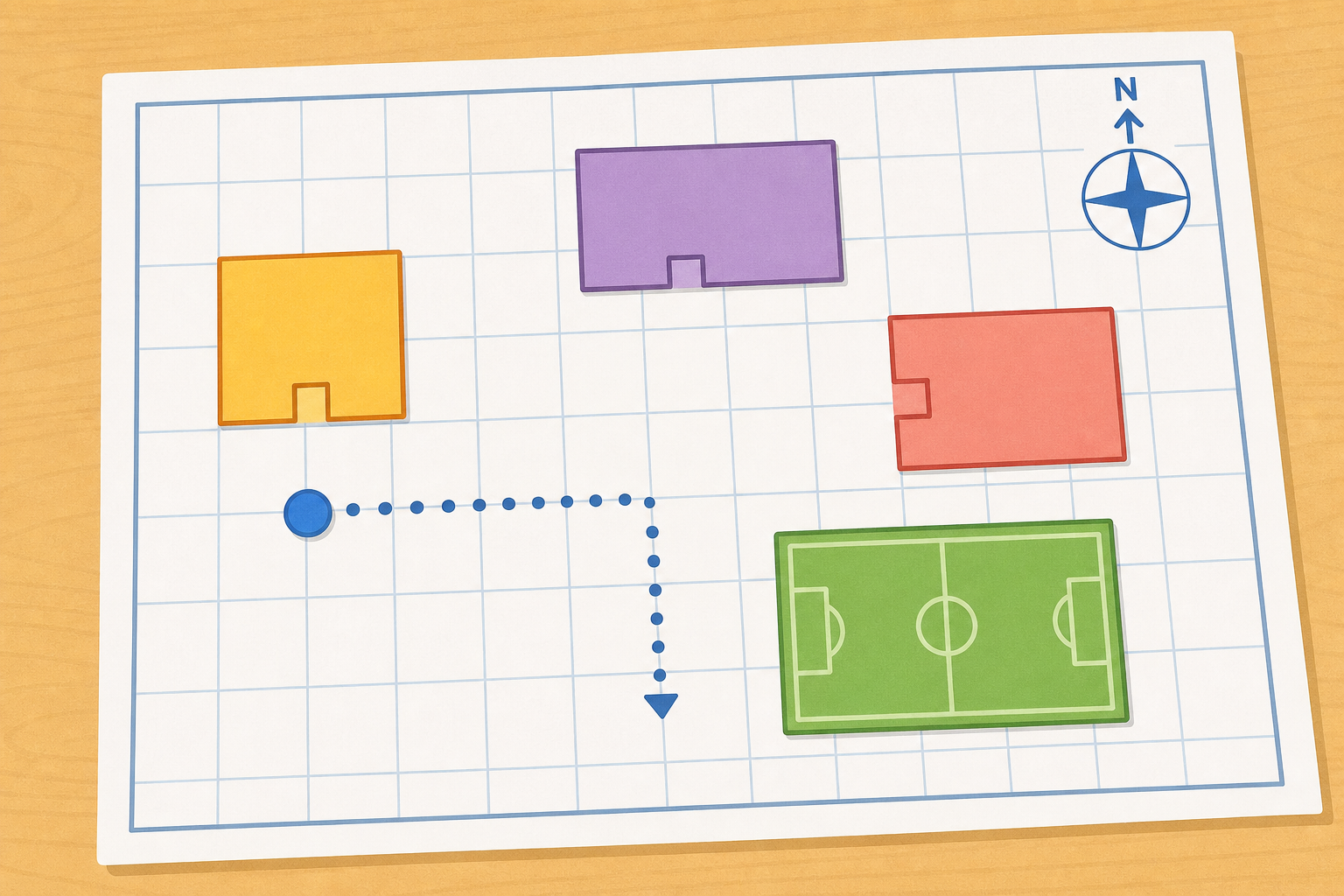
Look at the schoolyard map. North is marked at the top. The gate is on the bottom row, second square from the left. The hall is two squares North and one square East of the gate. The pitch is two squares North and three squares East of the gate.
Watch a counter start at the gate, facing North. First route to the pitch: forwards two squares (still facing North), turn right (now facing East), then forwards three squares. Check that the counter lands on the pitch. Notice that each step changes either where the counter is or which way it is facing.
On the second route the counter uses only compass points: two squares North, then one square East, to reach the hall. Watch how North stays fixed at the top the whole time, even as the counter turns.
A turn changes the facing direction. A forwards step changes the place. North stays at the top no matter which way the counter turns.
Before pupils settle, mark this layout on the printed schoolyard map (or a 5-by-5 grid): North at the top. Gate on the bottom row, second square from the left. Office two squares East of the gate. Hall two squares North and one East of the gate. Pitch two squares North and three East of the gate.
Walk a counter on the visualiser. Start at the gate facing North.
Route 1 (forwards / right): forwards 2 (two North of gate, still face North) → turn right (now face East) → forwards 3 → lands on the pitch. At each turn, name the compass direction now faced.
Route 2 (N/E only): two squares North, then one square East → lands on the hall. Point at the compass rose after every move: North never moves.
Key move to draw out: a turn changes facing direction, a forwards step changes position. North stays at the top no matter which way you turn.
Slip to watch: pupils thinking the map itself turns with the counter. Point back at North at the top after every turn.
For each route, walk the counter square by square and name the direction you are facing at every turn.
Today we work through routes together on the schoolyard map. First route: start at the gate facing North, forwards two, turn right, forwards one to reach the hall. Second route: start at the gate, go two North, one East to reach the hall. Third route: start at the gate facing East, forwards three, turn left, forwards two to reach the pitch.
Talk this one through together — pupils take turns at the board and the class agrees or corrects out loud.
A pupil walks the counter square by square on the printed schoolyard map while the class checks each step. At every turn, ask the whole class which way are you facing now? and revoice one pupil's answer before the next move — this keeps the watching class with it. Rotate a few pupils, mixing left/right routes with N/S/E/W routes.
In your maths copy, write a set of three or four directions that gets you from the classroom door to your own seat. Use forwards, back, left, right, or the compass points North, South, East and West.
Walk the room glancing at whether each route is in order and would actually work — this is whole-class copybook practice, not marking. Prompt any pupil who has written places instead of directions.
Today we follow and write routes on the schoolyard map, one task at a time.
Watch the worked route first. Start at the office, facing North. Route: forwards two, turn right, forwards one. After the turn you face East. You land on the pitch. A turn changes the way you face; a forwards step changes your place.
Now you try, one task at a time.
First: start at the pitch, facing North. Follow this two-step route to the gate: two squares West, then one square South.
Second: start at the gate, facing North. Follow this three-step route to the hall: forwards two, turn right, forwards one. At each turn, name the compass point you are facing now.
Third: write your own directions from the office to the pitch, in order. Use three or four steps.
Stretch task: find the shortest route between two places (the shortest route is the one with the fewest squares) and say which compass direction you travel in the most.
This is the practice round. Reveal one task at a time. Real schoolyard maps circulate; pupils walk a counter for the follow tasks and write directions for the make-your-own task.
Worked example first (board, you narrate): counter on the office, facing North. Forwards two (still facing North). Turn right (now facing East, point at the compass rose). Forwards one, lands on the pitch. Say out loud: turn changes facing, forwards changes place. North stays at the top.
Then pupils:
Slips to watch: turning left instead of right; losing square count (have them touch each square); naming the place instead of the facing compass point.
Stretch only once the first three are secure. For a stuck pupil on shortest route: could you get there in fewer squares a different way?
You're previewing this lesson. Get full access to this lesson and hundreds more — each one ready to teach, with interactive activities, printable resources and pupil progress tracking built in.