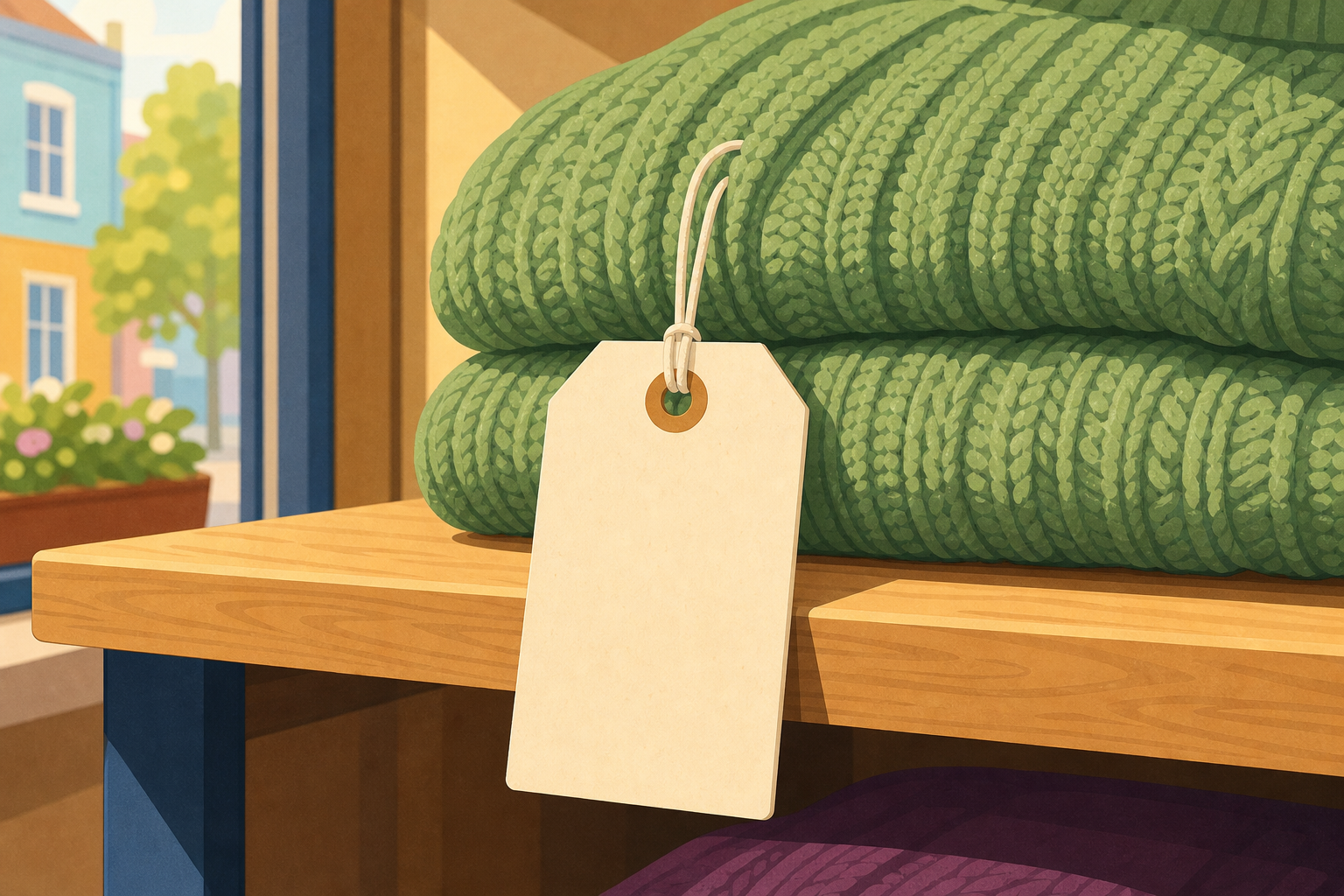
Here is a real shelf-tag from a shop: "€30 jumper — 20% OFF!"
So what do you actually hand over at the till? Is it €10? €24? €28? Have a think before anyone says a number.
Show the €30 / 20% off tag as pupils settle. Take three hands-up answers, not open call-outs, and write each guess on the board without saying which is right.
Listen for the common trap: pupils who read 20% off and jump to pay €20, treating the percent as the price. That's the misconception the lesson unpicks. Do not correct it yet, just note it.
Each ratio bar shows a price. The shaded slice is the percent that changes. On a discount bar the rest is what you pay. Watch how the slice gets thinner as the percent gets smaller, and notice which one breaks the pattern.
Point at each bar, name the shaded part aloud: this slice is the money off (or on), the rest is what you pay. Keep it plain: find the percent first, then take off or add on.
€30, 20% off: build 20% as two lots of 10%, €3 + €3 = €6. Kills the "pay €20" trap. Discount €6, pay €24.
€40, 25% off: quarter, €40 ÷ 4 = €10, pay €30. Pause and ask them to predict the €50 boots before revealing.
€50, 10% off: thinnest slice, discount €5, pay €45. Land smaller percent, smaller slice.
€20 add 15%: the one that bends the rule. Nothing taken off, so the whole bar now shows the new total. Say the change to "the whole" aloud. 15% = 10% (€2) + 5% (€1) = €3, total climbs to €23.
€25, 10% off: first decimal case. €25 ÷ 10 = €2.50, so pay €22.50. Stress a percent can land on cent, not just whole euro. Flag that €2.50 is the building block for 40% next step.
Today we shade the discount part and read off the price left. We'll work these on the ratio bar together, in this order: first a €60 LEGO set with 30% off, then a €25 jumper with 40% off, and finally a €30 lunch with 15% added on for a group booking. The last one flips the rule — nothing comes off, an extra part is added on instead.
For the €25 jumper, remember the €2.50 we found on the board for 10% of €25. Build 40% from four lots of that amount, then read off what you pay.
This round is for talking it through together — pupils take turns at the board and the class agrees or corrects out loud.
Keep asking "is that the money off or the money you pay?" — the confusion is always which slice is which. Have a different pupil drive each bar.
In your maths copy, work each shop-tag scenario in two lines. On the first line, find the percent off (or the percent added on). On the second line, take it off (or add it on) to find the final price. Do these two:
Underline the final price on each one.
Walk the room glancing at the two-line layout — this is whole-class copybook practice, not marking. Watch for pupils who write the percent as the answer (€20) instead of the price you pay (€24); that first line — writing the money-off amount separately — is what catches it.
Now some real Irish-shop problems. Read each one, spot whether it's a take-off or an add-on, then work it. We'll do them in this order: a Smyths board game on sale, a Centra birthday cake with a service charge added on, a coffee-shop group order with a service charge, a Penneys jumper on sale, and a Dunnes coat on sale.
These are the practice questions — pupils take turns at the board, check each answer, and the class confirms before moving on. Keep the board work brisk rather than over-explaining.
The activity confirms the operation and the answer with Check; use the ✓ as part of the narration.
You're previewing this lesson. Get full access to this lesson and hundreds more — each one ready to teach, with interactive activities, printable resources and pupil progress tracking built in.