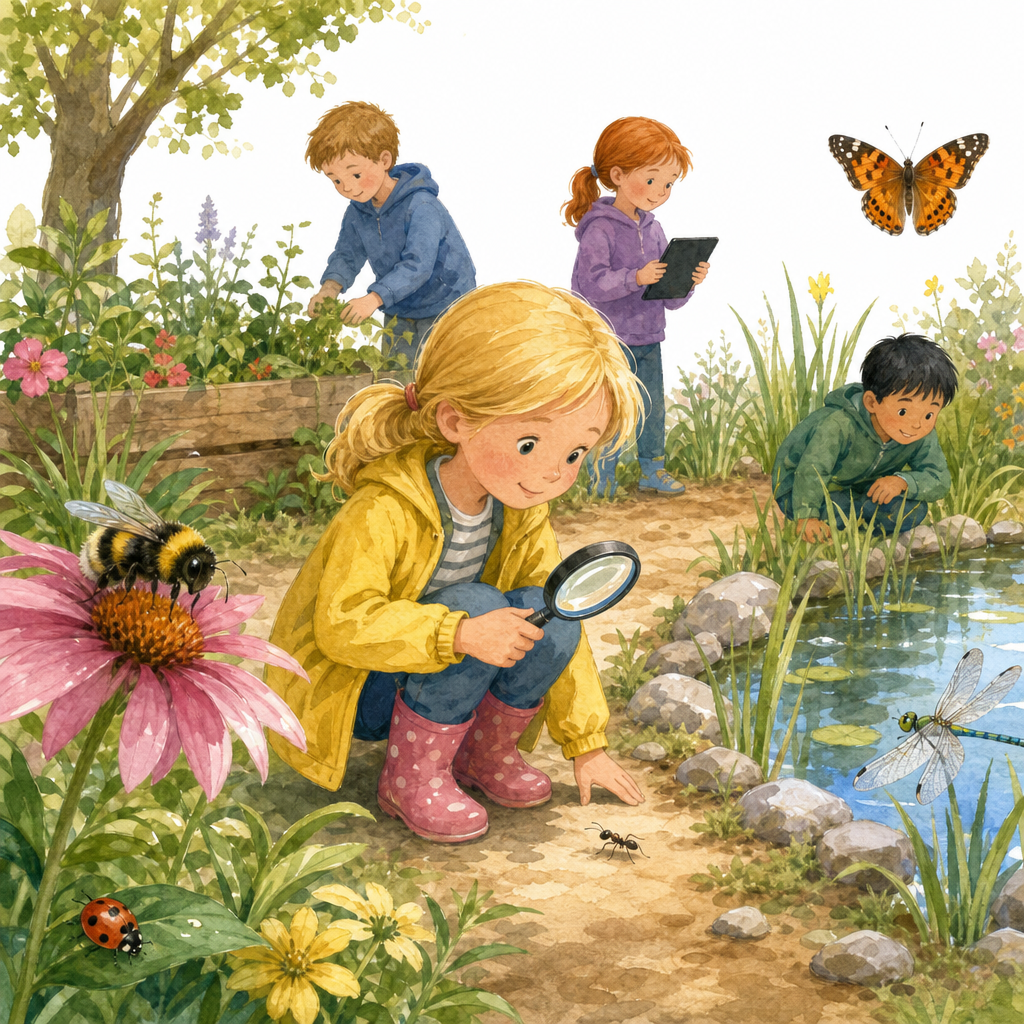
 How many insects have you seen today without noticing? A ladybird on a leaf, an ant on the path, a bee on a flower. Tiny creatures are everywhere, and today we learn their German names and where they live.
By the end of this lesson, you will be able to:
- Name eight insects in German
- Say where each one lives in a short sentence
- Explain how bees help people in Germany
Here are today's eight insects. Tap each one, listen, then say it back together. Watch the article: some take der and some take die.
Then we join each insect to a place with one shared frame:
Die/Der ___ lebt ___. (The ___ lives ___.)
Our places sit in a German school garden and park:
- im Schulgarten (in the school garden)
- am Teich (by the pond)
- im Gras (in the grass)
- im Haus (in the house)
- unter dem Stein (under the stone)
Listen for the pattern: insect + lebt + place chunk. Models: Die Biene lebt im Schulgarten. · Die Libelle lebt am Teich. · Die Ameise lebt unter dem Stein.
Keep the place bank on the board:
- im Schulgarten · am Teich · im Gras · im Haus · unter dem Stein
Frame: Die/Der ___ lebt ___.
First, whisper the frame together once. Then spin the wheel. When it lands on an insect, say the German word with its article, then finish the sentence with a place from the bank.
Open your copy and write two sentences, each naming an insect and where it lives. Use the frame on the board. Keep the article and every capital letter.
Models still on the board:
- Die Biene lebt im Schulgarten.
- Die Libelle lebt am Teich.
- Die Ameise lebt unter dem Stein.
- die Biene — Bee
- der Schmetterling — Butterfly
- die Ameise — Ant
- der Käfer — Beetle
- der Marienkäfer — Ladybird
- die Heuschrecke — Grasshopper
- die Libelle — Dragonfly
- die Wespe — Wasp
A garden picture goes up on the board, and the insect words sit beside it as tags. When a classmate drags a tag onto the right spot, say the German word together with its article. Then be ready to make a short sentence about that insect and where it lives, using our frame: Die/Der ___ lebt ___.
Unlock the full learning experience
You're previewing this lesson. Get full access to this lesson and hundreds more — each one ready to teach, with interactive activities, printable resources and pupil progress tracking built in.
This lesson is copyright of Coding Ireland 2017 - 2026. Unauthorised use, copying or distribution is not allowed.