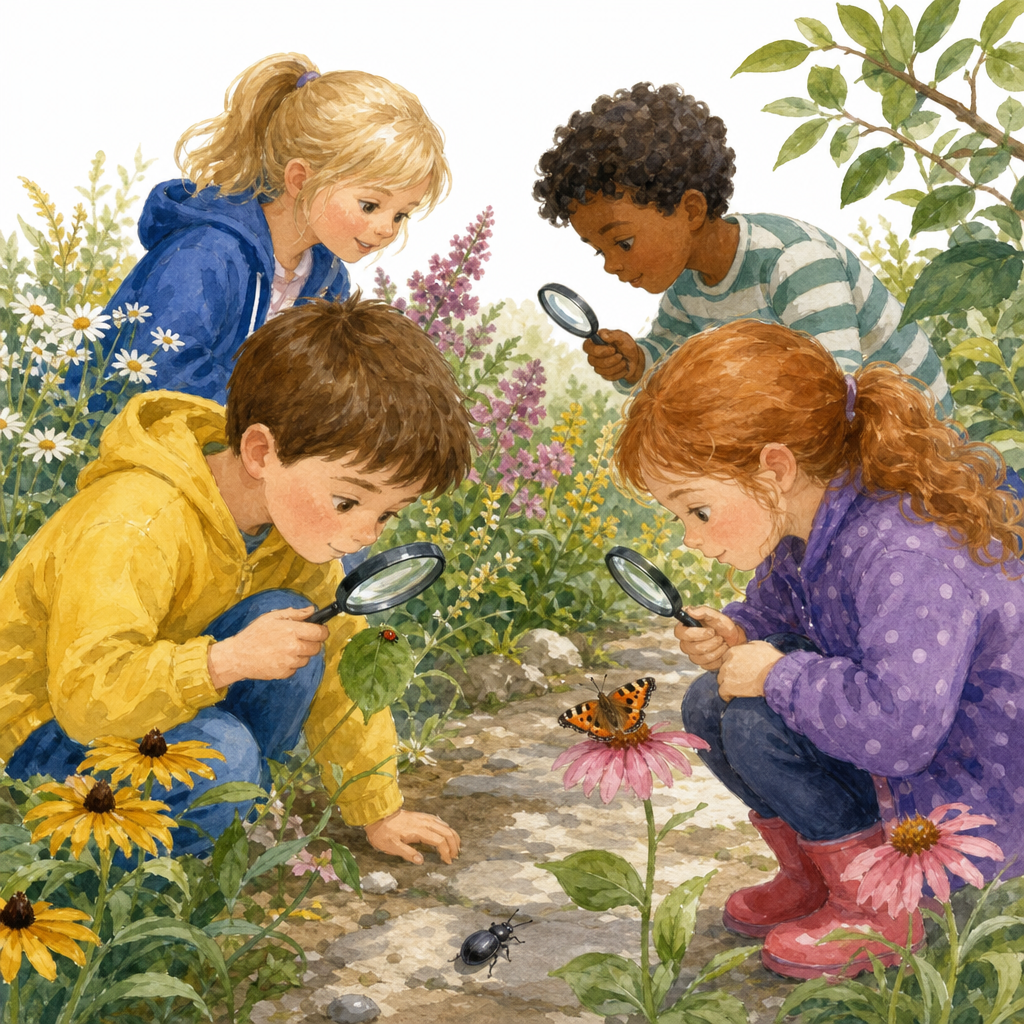
How many insects have you seen today without noticing? An ant on the path, a bee on a flower, a beetle under a leaf: they are everywhere once you start looking.
Take four or five quick answers about insects pupils have already seen today. Keep it light and curious; the point is noticing, not a long list. You can recycle a nature word from earlier in the course if one comes up (for example el jardín, el har-DEEN, the garden), but do not teach new habitat words yet.
Here are today's eight insects. Tap each one, listen, then say it back together. Watch which ones take la and which take el.
Place strip (we will use these today):
Sentence frame: ___ vive en ___
La abeja vive en la colmena. (The bee lives in the hive.)
La oruga vive en el pino. (The caterpillar lives in the pine.)
La mariposa vive en el parque. (The butterfly lives in the park.)
Chunk the names first. Tap the first five on the board (la abeja, la mariposa, la hormiga, la avispa, el saltamontes). Class repeats each twice: once all together, once by table. Quick point-and-say check on those five, then do the last three (la mariquita, el escarabajo, la oruga) the same way. Point at the article every time so the pair is what they hear.
Pronunciation guides: la abeja (lah ah-BEH-hah), la mariposa (lah mah-ree-POH-sah), la hormiga (lah or-MEE-gah), la avispa (lah ah-BEES-pah), el saltamontes (el sahl-tah-MOHN-tes), la mariquita (lah mah-ree-KEE-tah), el escarabajo (el es-kah-rah-BAH-hoh), la oruga (lah oh-ROO-gah). Escarabajo is a satisfying mouthful: celebrate a bold attempt even if it is not perfect first time.
Then the place strip (show and choral-repeat before any full sentences): la colmena (lah kol-MEH-nah), el jardín (el har-DEEN), el árbol (el AHR-bol), el parque (el PAR-keh), el pino (el PEE-noh). State clearly: these are the only places we will use today. Stress that vive en (BEE-beh en) means "lives in/on".
Model the three sample sentences slowly, then have the class echo them. Finish with a two-minute teacher-led substitution drill: point at an insect image, point at a place on the strip, class says the full X vive en Y together. Answers set in a Spanish plaza, parque or pinar are welcome later too.
Spin the wheel. When it lands on an insect, say the Spanish word, then finish the frame using a place from the strip.
Frame: ___ vive en ___
Places we know:
Keep the place bank and the frame ___ vive en ___ visible on the IWB for the whole step. Spin on the board and cold-call the next pupil. Accept only the taught stems at first, for example La abeja vive en la colmena, La oruga vive en el pino, El saltamontes vive en el jardín. Do not introduce untaught structures such as cerca de.
If a pupil freezes, offer two place choices from the strip they can pick from, or accept the insect name alone plus pointing at a place on the bank. Keep the word-table visible if you can switch back quickly for support. Listen for the article with every noun. Spain-set answers (parque, pino, plaza) are a bonus, not a requirement.
Open your copy and write two sentences from the board bank. Each one names an insect and where it lives. Use el or la, vive en, and one place from the strip. Copy accents only if they appear on the model (for example the accent in jardín).
Pause the board. Everyone writes; this is the only three minutes where every pupil's pen is moving. Keep one full model sentence locked on screen for the whole three minutes, for example La mariquita vive en el jardín, with the accent on jardín marked in a contrasting colour. Also keep a mini word bank visible: the eight insects with articles plus the five place phrases from the strip. Pupils choose two pairings from that bank only; they are not inventing new places. Walk the room and check that each line has an article, the verb phrase vive en, and a place from the strip. Do not collect these.
Look at each picture on the board. On three, the whole class whisper-says the Spanish label. Then a volunteer clicks the answer. After each one, thumbs up if you agree.
Run label-the-image on the IWB only (whole-class). A volunteer clicks; before each reveal, count "one, two, three" and the whole class whisper-says the label together. After the click, a quick thumbs-up / thumbs-down check so every pupil responds, not only the volunteer. If a label is missed twice, stop and say the word together before moving on. If someone nails mariquita or escarabajo first try, get a quick class cheer. Quick stretch: ask one pupil to reuse vive en plus a place from the strip for the insect just labelled.
You're previewing this lesson. Get full access to this lesson and hundreds more — each one ready to teach, with interactive activities, printable resources and pupil progress tracking built in.