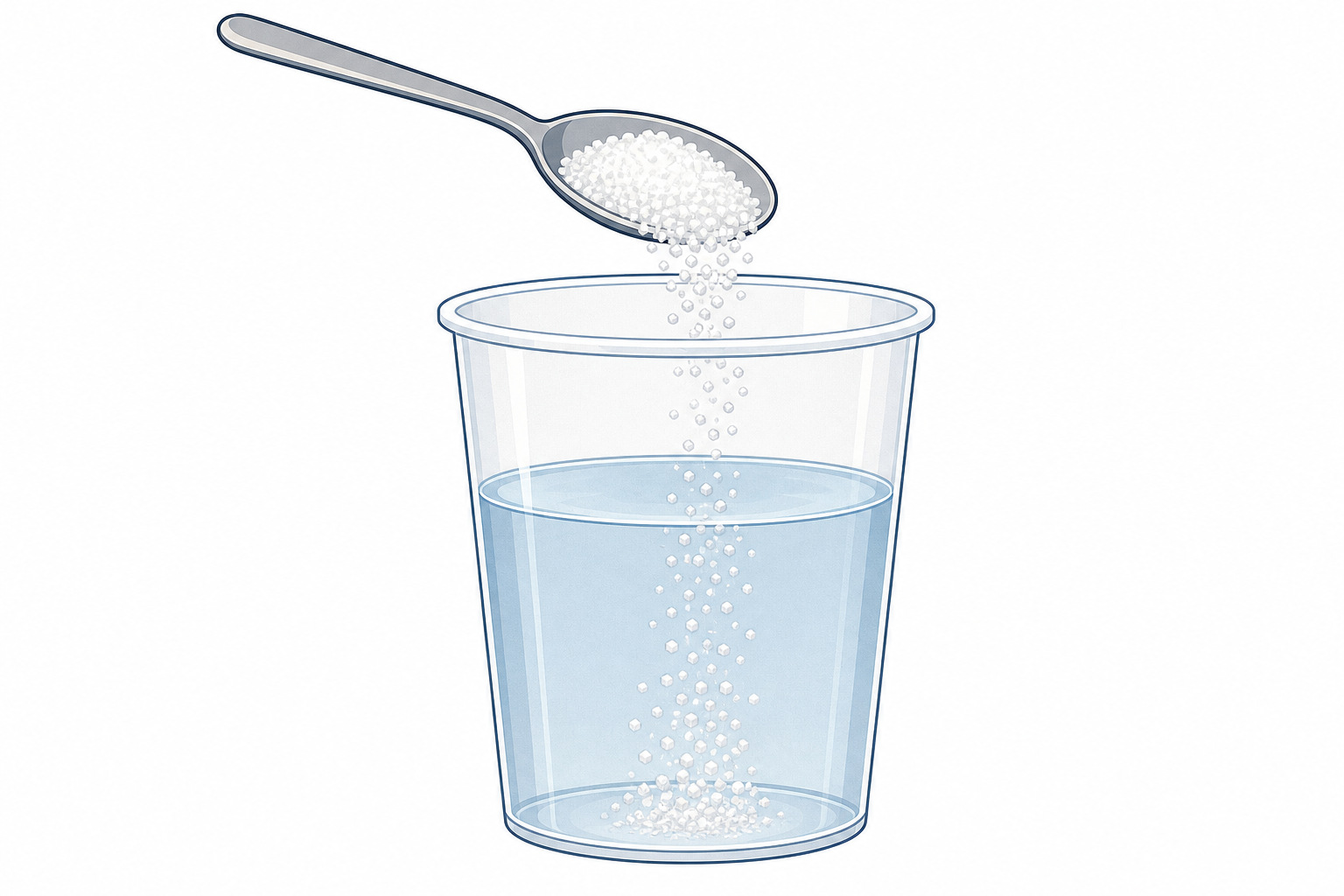
 Watch this spoon of sugar go into warm water. Where does it go? Does every solid disappear from sight like that, or do some stay behind?
Today we will test four materials fairly and find out which ones dissolve in water.
Six cards are waiting on the board. For each one, call out where you think it belongs and be ready to say why.
Your group’s design choice: agree how you will judge that a material has dissolved (for example, no solid pieces left on the bottom, or the liquid looks clear with no cloudy bits). Write that rule on your Investigation Journal page.
Then each of you notes a quick prediction: which materials will dissolve, and which will be fastest.
Which materials dissolve in water?
 Will salt behave like sugar, and what about sand and flour?
1. Watch first. We run one sugar trial together at the front, timed on the board, so every group times the same way.
2. Your group. Agree roles: one times, one stirs, one watches for pieces, one records. Test one material at a time.
3. One trial. Pour warm water into one cup just before each material, not all four at the start. Add one level teaspoon, start the timer and stir the same way each time.
4. What to write. On your Investigation Journal page, write dissolves or does not dissolve, and the time in seconds if it dissolves. Leave the time blank if pieces are still there at two minutes.
Time the dissolving
Look back at your Investigation Journal page. This is a quick check only: you should already have results from the trials.
Make sure every material has dissolves or does not dissolve, and a time in seconds or a blank. Fill any gaps from what your group saw. Save any “I think…” ideas for our discussion next.
 Let us share what your groups found. Which materials dissolved, and which ones did not? Of the materials that dissolved, which was fastest, and how do you know from your times?
Materials that dissolve are called soluble. Materials that do not dissolve are called insoluble. Use those words when you share.
Talk with the class about whether your prediction was close, and name one thing we kept the same so the test stayed fair. How did your group decide when to call stop?
Think back to the sugar at the start: if the pieces disappeared from sight, is the sugar still in the water?
Unlock the full learning experience
You're previewing this lesson. Get full access to this lesson and hundreds more — each one ready to teach, with interactive activities, printable resources and pupil progress tracking built in.
This lesson is copyright of Coding Ireland 2017 - 2026. Unauthorised use, copying or distribution is not allowed.