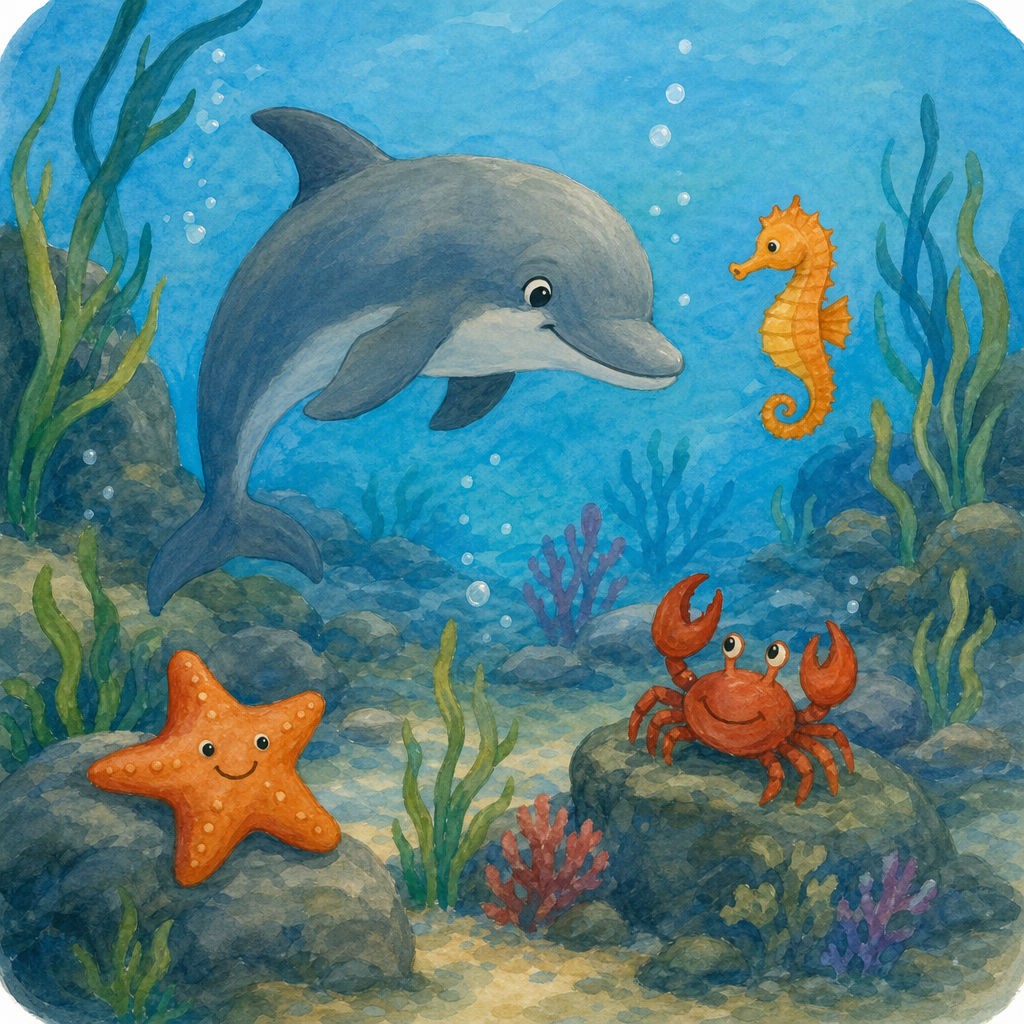
Ireland is an island. How many sea creatures can you name in English in twenty seconds?
Keep a quiet count in your head. We will see how many of those creatures also have a Spanish name you can learn today.
Time the class for twenty seconds while they call out English sea-creature names. Jot a few on the board if you like, but do not translate yet. The point is to warm up the topic and show how much they already know about the sea as an island nation. Move on once energy is high rather than waiting for a long list.
Here are today's eight sea creatures, in two groups of four. Listen to each one, then say it back together. Watch which ones take el and which take la, and listen for the stress on words like tiburón and delfín.
Run this on the IWB. Stage the eight words in two chunks so nobody is asked to hold eight brand-new phrases at once.
Group 1 (lock these first): el caballito de mar (el kah-bah-YEE-toh deh mar), el tiburón (el tee-boo-ROHN), el delfín (el del-FEEN), la ballena (lah bah-YEH-nah). Play each audio, class repeats twice (once all together, once by table). Point at the article every time so pupils hear the full pair, not a bare noun. Call out the easy anchor: delfín sounds like dolphin. Cheer the first clean tiburón; that final stress is a triumph.
Quick choral recall: Cover or minimise the board and fire the four English meanings; class calls back the Spanish with article.
Group 2: el pulpo (el POOL-poh), la estrella de mar (lah es-TREH-yah deh mar), el cangrejo (el kahn-GREH-hoh), la medusa (lah meh-DOO-sah). Same listen-and-repeat routine. Clap the rhythm for la estrella de mar. Memory hooks: estrella ~ star; medusa ~ Medusa. Quick grin moment: la medusa is also the snake-haired figure from the myth, same word. Pupils rarely forget it after that.
End with one fast run through all eight so both groups sit together before matching.
You are sorting labels at a small aquarium on the Galician coast. Watch the board. A volunteer flips two cards. When a Spanish card is turned, say the full phrase with el or la together. When a pair is found, say that Spanish name once more as a class.
Run this on the IWB with volunteers taking turns. Devices are not needed. After every matched pair, the whole class repeats the Spanish once with the article, so every row speaks, not only the volunteer. Insist on the full phrase: el pulpo (el POOL-poh), not just pulpo. If a pair is missed twice, pause and say the Spanish together before moving on. When a full set is landed, get a quick underwater whoop from the class. Keep the pace lively; this consolidates meaning after the word-table rather than testing.
Open your copy. The word-table stays on the board; copy from it. Write four sea creatures with their articles, ordered from smallest to biggest. A model chain is on the board (small to big). Take care with the accents. If you need support, copy two phrases carefully instead of four.
Before anyone writes, flash a clear size model on the board with a simple small-to-big arrow, for example: el caballito de mar → el cangrejo → el delfín → la ballena. Say aloud that this model chain is fine to copy, and that any other sensible order is also fine. Keep the word-table visible the whole time so pupils copy rather than spell from memory. Walk the room and check articles and accents, especially the acute accents on tiburón and delfín. Support option: two carefully copied phrases instead of four. Do not collect these. Do not mark a 'wrong' size order; mark articles, accents and careful copying.
The wheel is a dive computer off the Galician coast. When it lands on a creature, the whole class says the Spanish with its article first. Then one pupil repeats it clearly so the dive team hears el or la and the name. Listen out: some of these creatures are everyday food in north-west Spain, and some never appear on a plate.
Spin on the IWB. Always start with a whole-class echo of whatever lands, then invite one pupil to repeat, so nobody is the first voice on a hard word. If a pupil hesitates, play the audio once and let them try again, or allow one 'phone a table' lifeline. Celebrate clear stress on longer words such as la estrella de mar and el cangrejo (el kahn-GREH-hoh). Big reaction for anyone who nails la estrella de mar in one go. Keep turns short so several pupils get a go.
Culture beats woven into the spins (say the matching line only when that creature lands, then spin again):
Do not stop the game for a long talk; one short line per trigger, then the next spin. This plants the menu idea in Spanish before the discussion, so step 6 is a reuse moment, not the first culture mention. If energy dips, keep the whole-class echo after each successful answer.
You're previewing this lesson. Get full access to this lesson and hundreds more — each one ready to teach, with interactive activities, printable resources and pupil progress tracking built in.