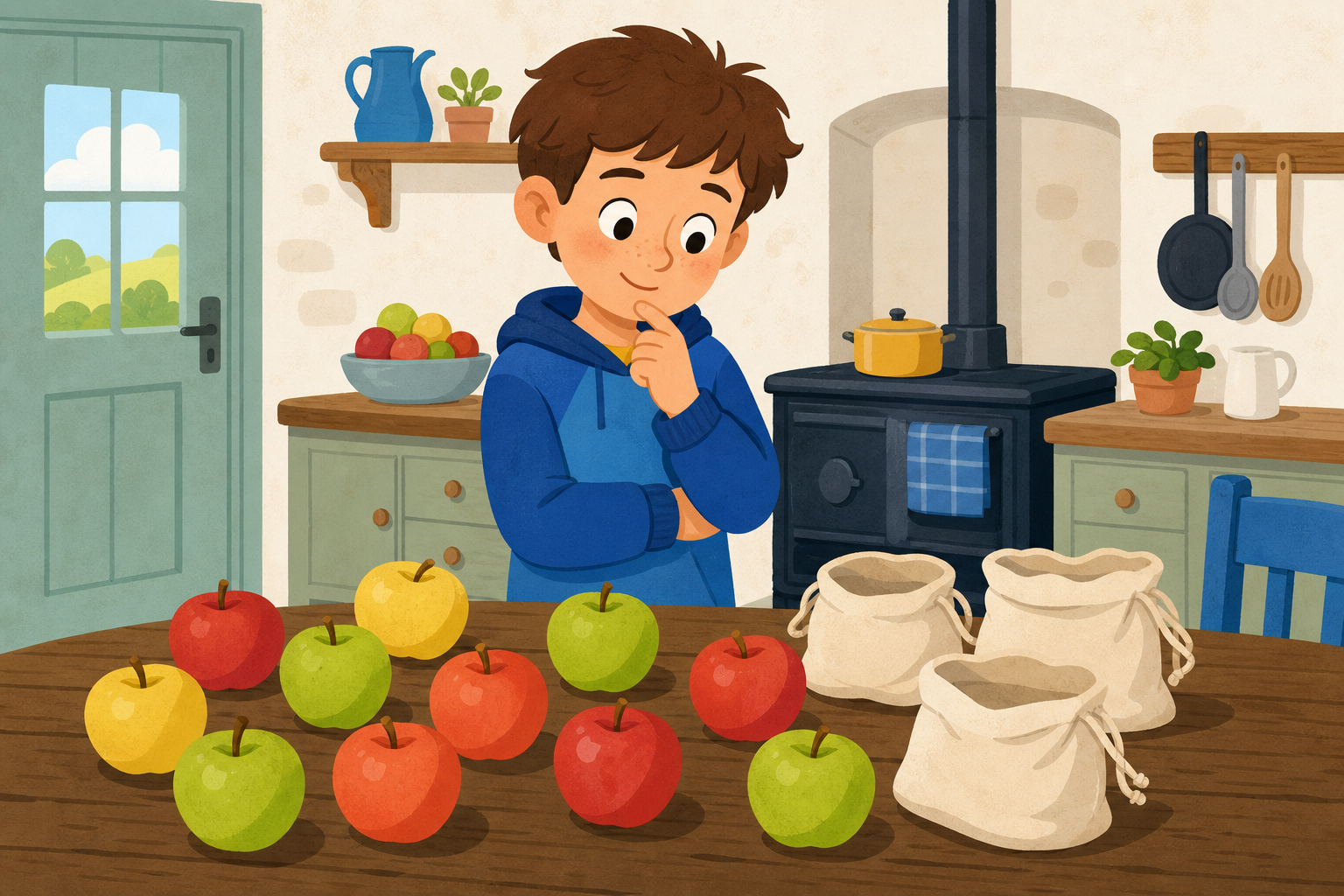
Here are 12 counters on the board. How many groups of 4 can we make from them? And once you know that, what times fact does it match?
We make equal groups from a pile of counters and read what we find two ways. Watch how a division question and a multiplication fact turn out to be the same three numbers.
First: how many fours are in 12? Then: how many fives are in 20? Look for the pattern between the groups you make and the times fact hiding underneath.
Today we work these together on the number line: how many fives in 20, how many fours in 12, then how many threes in 18. Start at 0 and add equal jumps of the group size until the marker lands exactly on the total. Then count the arcs to say how many groups, and name the times fact it matches.
In your maths copy, write the fact family for 4, 5 and 20 — two multiplications and two divisions. Then do the same for 3, 6 and 18.
Now write all four sentences for 3, 6 and 18 the same way.
Today we work through these together on the number line, from 0 each time: reach 12 in 2s, then 15 in 5s, then 28 in 4s, then 30 in 6s. Each one uses only that one jump size. When the marker lands on the total, count the arcs to say how many groups fit — then tell us the times fact that checks it.
You're previewing this lesson. Get full access to this lesson and hundreds more — each one ready to teach, with interactive activities, printable resources and pupil progress tracking built in.