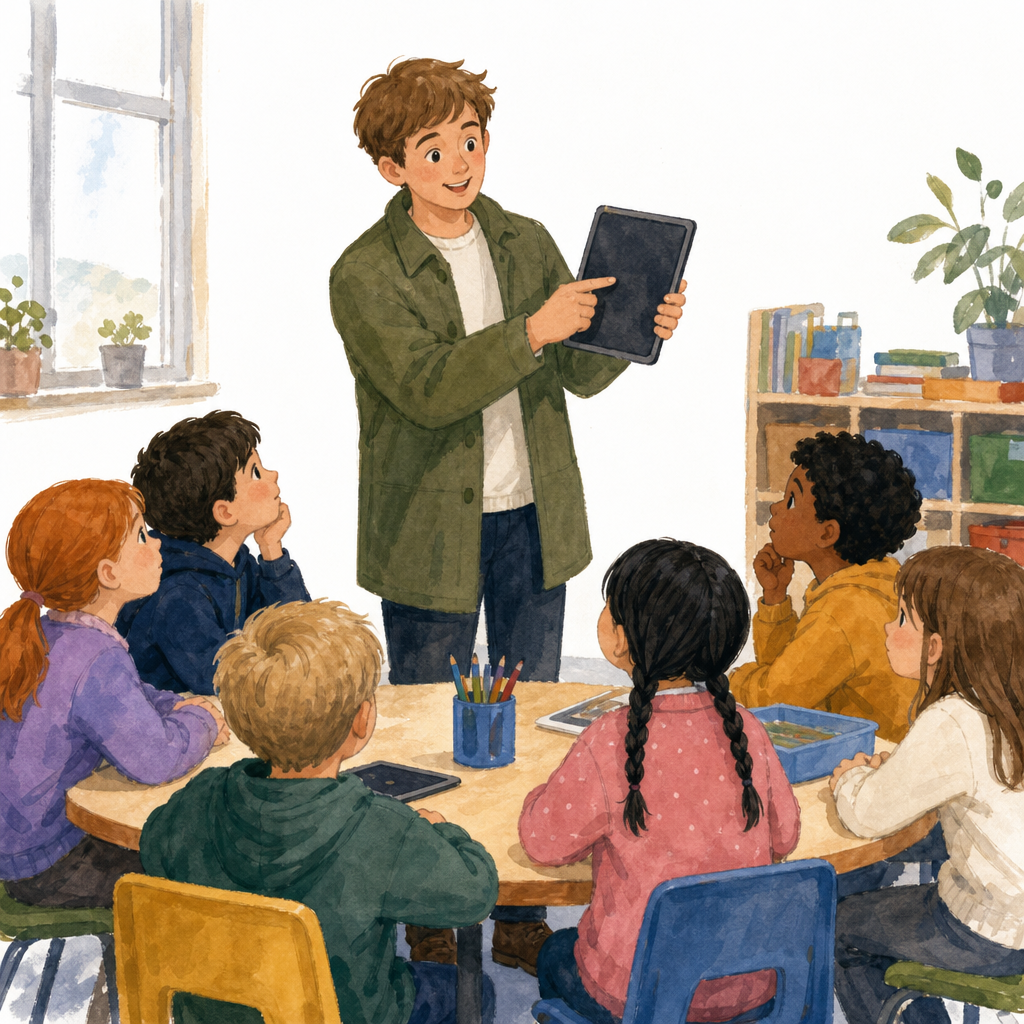
Look carefully at what your teacher is wearing today. In English, describe it in one full sentence: the item and its colour.
Today you will do the same thing in Spanish. You will learn eight clothing words, then build sentences with Llevo (I am wearing) and a colour that matches the clothing word.
Take three or four quick English descriptions of what you (or a volunteer) are wearing. Keep it light and move on; the point is to set up a full clothing-plus-colour sentence, not to invent Spanish yet.
Remind the class that they already know colour words from earlier in the course. Today those colours join clothing nouns, and the ending of the colour has to agree. You will keep agreement tightly scaffolded with a visible colour bank and choice prompts (¿roja o rojo?), not free generation of every ending.
Imagine you are packing for a weekend in Barcelona. Here are today's eight clothing words. Tap each one, listen, then say it back together. Always keep the article with the noun.
Colour bank (words you already know):
Model sentence: Llevo una camisa roja y unos pantalones azules (YEH-boh OO-nah kah-MEE-sah ROH-hah ee OO-nos pan-tah-LOH-nes ah-THOO-les): I am wearing a red shirt and blue trousers.
When we name a word on the table we say la camisa; when we say what we are wearing we often use una / un / unos / unas. Both are right. Today's full sentences use the indefinite form plus a colour.
Tap each word on the board. Class repeats twice: once all together, once by table. Always say the article with the noun so the pair sticks: la camisa (lah kah-MEE-sah), not bare camisa.
After every two or three clothing words, pause and model one full oral pair from the colour bank, then choral-repeat. Examples: la camisa roja, los pantalones azules, el abrigo negro, las botas negras. Point at the matching ending on the colour bank so pupils see why it changes.
Before you leave the table, model the full Barcelona packing sentence slowly twice and have the class repeat: Llevo una camisa roja y unos pantalones azules. Underline that roja ends in -a because camisa is feminine, and azules ends in -es because pantalones is plural. That noticing skill is today's agreement goal; keep it oral and choice-based (¿roja o rojo?).
Definite vs indefinite: when we name the word we say la camisa; when we say what we are wearing we often use una / unos. Both are right. Today's full sentences use una / un / unos / unas + colour. Pin this model on the board for the rest of the lesson.
Make a small show of the accent on suéter (SWEH-ter) and the strong rolled feel of the r in abrigo. Have the class stage-whisper el suéter like they are sharing a secret fashion tip for Barcelona.
Flip two cards at a time and find each Spanish clothing word with its English meaning. Say the Spanish quietly, article included, as you turn each card. Keep the Llevo model and colour bank in mind for later.
Run whole-class on the IWB with volunteers taking turns. Insist on the full form: los zapatos, not just zapatos. Keep the model sentence and colour bank visible at the side of the board.
If the same pair is missed twice, pause and say it together before continuing. Keep the pace brisk; this is consolidation after the word-table, not a first meeting with the words.
Optional enrichment only: if devices are available, small groups may run a second round after the whole-class game.
First, say it: point at one thing you are wearing and say one short phrase with the class frame.
Frame: Llevo un/una ___ ___
Worked examples (repeat together):
Colour bank: rojo/roja/rojos/rojas · azul/azules · negro/negra/negros/negras · blanco/blanca/blancos/blancas · verde/verdes
Then write: open your copy and write one sentence only: Llevo + one clothing item + one matching colour. Use the frame and word-table on the board to help with articles and spellings.
This step comes after labelling Sofía and the classmate guessing game, so pupils have already heard and said clothing-plus-colour sentences. Do not start writing until the oral round is done. Keep the clothes word-table, the Llevo un/una ___ ___ frame, and the full colour bank (including plurals) fully visible on the IWB.
Oral warm-up (about 2 minutes): whole class points at one item of their own clothes and chorally builds one Llevo phrase from the frame. Spot-check three volunteers. Use ¿roja o rojo? choice prompts rather than asking pupils to invent endings from scratch.
Writing (about 3–4 minutes): everyone writes the same kind of sentence, capped at one clothing item + one colour. Walk the room and check two things: the indefinite article fits the noun (una camisa, un suéter, unos zapatos, unas botas), and the colour ending matches. Do not collect these copies.
If a pupil is stuck, whisper the starter: Llevo una camisa ___ or Llevo unos zapatos ___ and point at the colour bank.
Multi-item agreement sentences are for a follow-up lesson; today's win is one clear, correct line.
Label the clothes on Sofía, dressed for a rainy Monday morning in Bilbao. Click the correct Spanish label for each item you can see (think coat, boots, jumper, trousers…).
When the figure is fully labelled, we will build spoken sentences about it.
Speaking frame: Lleva un/una ___ ___ y unos/unas ___ ___ (he/she is wearing…).
Colour bank: rojo/roja/rojos/rojas · azul/azules · negro/negra/negros/negras · blanco/blanca/blancos/blancas · verde/verdes.
Run whole-class on the IWB with volunteers. After each correct label, ask the class for a colour that would fit using a choice prompt only from the bank: ¿roja o rojo? / ¿negro o negra? so agreement stays alive without slowing the game.
When the figure is fully labelled, display the fixed frame: Lleva un/una ___ ___ y unos/unas ___ ___. Choral-repeat Lleva (YEH-bah) twice. Model one full sentence about Sofía, for example Lleva un abrigo negro y unas botas negras, then invite two volunteers to build one spoken sentence each using the frame and colour bank only.
Classmate guessing game (feeds the next writing step): Invite three volunteers to describe a classmate in one kind Spanish sentence with the Lleva frame while the class guesses who it is. Keep the colour bank and clothes word-table on screen. Praise each try with ¡Qué estilo! (what style!). This oral round comes before any writing.
Optional enrichment only: if devices are out, pairs may label a second figure after the whole-class round.
You're previewing this lesson. Get full access to this lesson and hundreds more — each one ready to teach, with interactive activities, printable resources and pupil progress tracking built in.