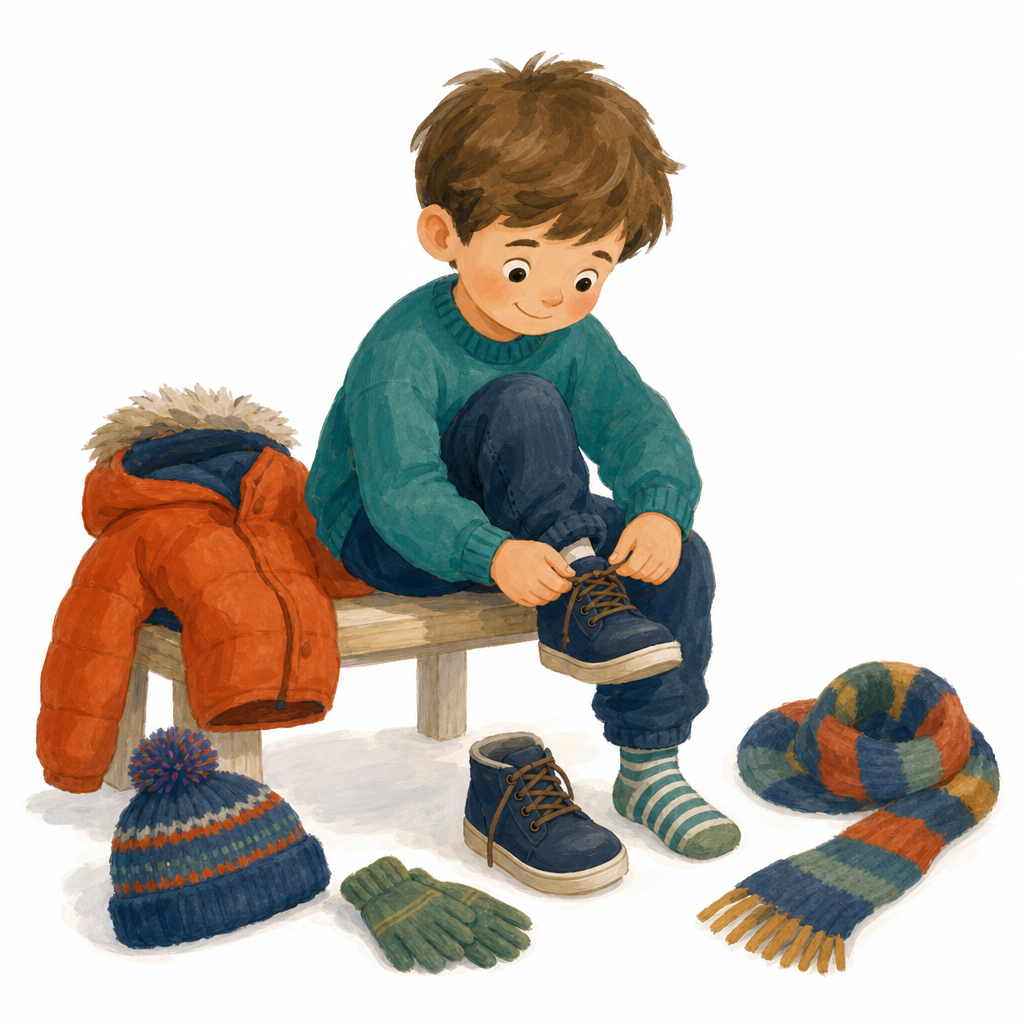
Look at the person beside you. In English, describe what they are wearing in one short sentence. Ready? Three, two, one: go!
You already notice clothes — today we put German words on them.
Take three or four quick English descriptions only. The point is to notice clothes already in the room before the German words appear. Do not teach any German yet. The board work runs to about 47 minutes; the last quarter of an hour is the Activity Book page at their desks.
We will meet eight clothing words in two groups of four.
For each card: listen to the audio first, then repeat the German with der, die or das twice. After that, flip to check.
Every answer needs the article in front — the noun alone is not enough. Every German noun starts with a capital letter: watch for that when you flip.
Whole class on the IWB. Teach in two chunks so the load stays manageable.
Chunk 1 (upper body and layers): run four cards only. Tap, play audio, class repeats the full article-plus-noun twice (once together, once by table), then flip. Quick choral recap of chunk 1 before you open chunk 2.
Chunk 2 (lower body and accessories): same routine with the remaining four. Finish with a fast run through all eight if energy is high.
Insist on the article every time. Point out that German nouns always start with a capital letter. Celebrate full phrases — a big cheer when a table lands a longer one like die Handschuhe cleanly.
Tricky sounds for you: die Handschuhe (DEE HAHNT-shoo-uh), der Schal (dair SHAHL), der Mantel (dair MAHN-tel). In much of Germany children hang coats and scarves in the Garderobe by the classroom door — the same idea as our cloakroom.
Mia is heading out to the Weihnachtsmarkt (Christmas market), but the labels on her winter outfit are missing.
Volunteers place each German label on the board. Everyone else: whisper the full phrase (article plus noun) and point to that part of your own clothes — or to the picture — while the label is placed. Thumbs up if you agree before we lock it in.
Model the first label yourself so the class hears the full article-plus-noun pair. For example: “This is the coat, so we choose der Mantel (dair MAHN-tel).” Then invite volunteers to the board.
Keep the seated class busy: they whisper and point on every turn, then show thumbs up or down before you confirm. If a label lands in the wrong place, say the correct word together before moving on. Keep listening for bare nouns without articles and gently correct — then praise the next full phrase you hear.
Write four things you are wearing right now, each with der, die or das and a capital letter on the noun. If you are not wearing four of them, choose any four from the list. Copy the German spelling exactly.
Pause the board interaction. Everyone writes; this is the only three minutes where every pupil’s pen is moving. Keep the completed label image, matching grid, or flashcard grid pinned for the full three minutes so nobody is spelling from memory alone.
Walk the room and check that der, die or das sits in front of every word, and that nouns are capitalised. Pupils in uniform may only be wearing one or two of today’s items — that is fine; they take the rest from the board list. Do not collect these.
If someone manages four articles and four capitals, tell them that is proper German already.
Help Mia finish packing for the Weihnachtsmarkt. Match each German clothing phrase to its English meaning on the board.
When a pair flips open, say the full German phrase together (article plus noun), then point to that item on the winter figure or on your own clothes.
Whole-class on the IWB only — no pupil devices. Two volunteers per turn tap cards; the seated class chorally says the full German phrase on every successful flip, then points to the matching part of the figure or their own clothes. If a pair is missed, say the correct German together before continuing.
Optional 60-second warm-up before the first flip: you call three full phrases (e.g. die Hose, der Schal, die Handschuhe); class points only, then you start matching. Keep the tone playful — cheer clean article-plus-noun answers.
This oral and matching pass comes before writing so spelling and articles are still warm when pens come out.
You're previewing this lesson. Get full access to this lesson and hundreds more — each one ready to teach, with interactive activities, printable resources and pupil progress tracking built in.