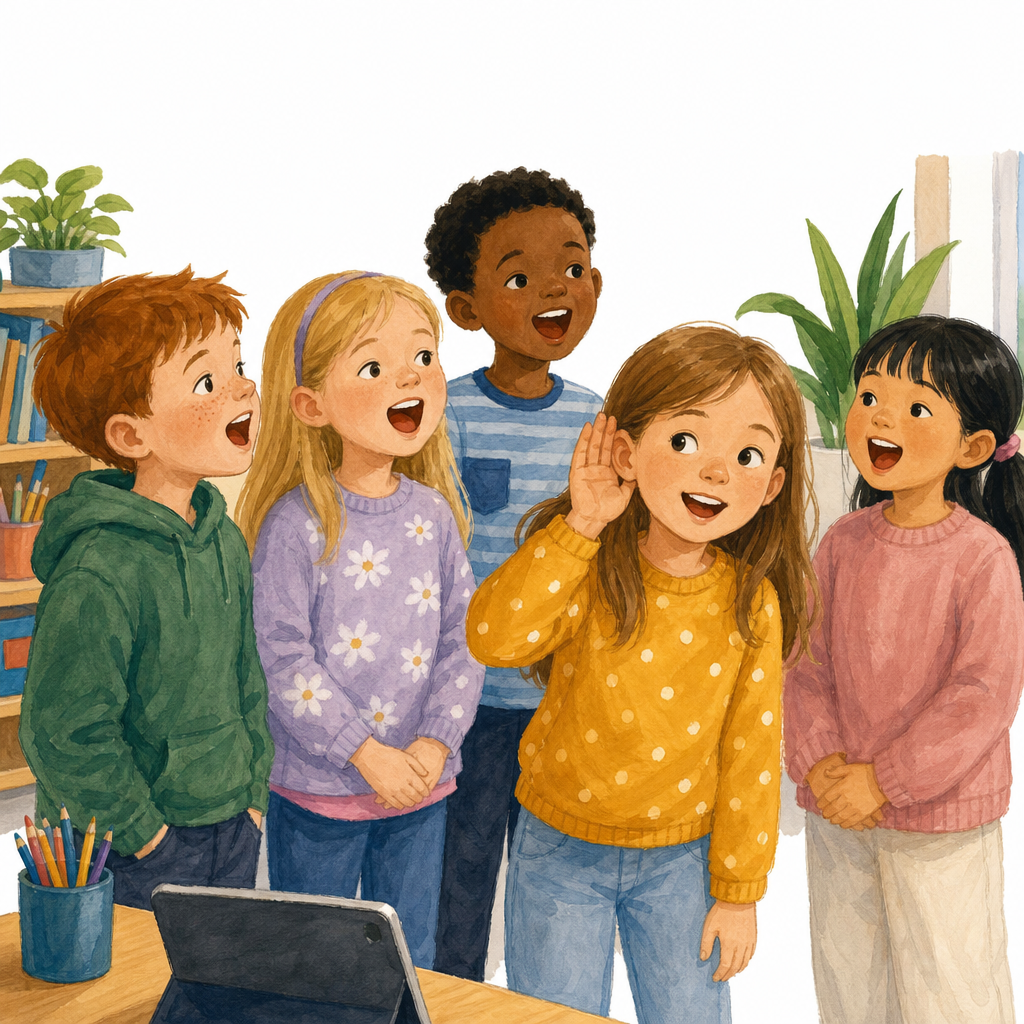
 Count to ten in English with me. Now count to ten in Irish: a haon, a dó, a trí… What sounds the same? Today we add German. Listen carefully: some numbers will feel familiar already.
By the end of this lesson, you will be able to:
- Count from one to ten in German
- Spot German number words when you hear them
- Notice which numbers sound like English or Irish
We will learn the ten German numbers in two short sets. For each card: look at the English and the picture, listen to the German audio, repeat it twice with the class, then flip to see the spelling. After numbers 1 to 5, we chorus-count them together before moving on to 6 to 10.
You each have a printed bingo card. Imagine a busy Berlin market stall: the seller calls out prices in German (for example drei Euro or fünf Euro). Cross off each German number as you hear it. If you hear drei and it is on your card, cross it off. When every number on your card is crossed off, shout Bingo!
Copy from the board into your copybook. Write the numbers 1 to 10 in German in a column, with the digit beside each word. Take care with the two dots over the u in fünf .
| Digit | German | Say it like |
|---|---|---|
| 1 | eins | ines |
| 2 | zwei | tsvai |
| 3 | drei | dry |
| 4 | vier | feer |
| 5 | fünf | fuenf |
| 6 | sechs | zex |
| 7 | sieben | ZEE-ben |
| 8 | acht | ahkt |
| 9 | neun | noyn |
| 10 | zehn | tsayn |
The wheel lands on a German number. We all whisper it together first, then one pupil says it clearly for the class before the next spin.
Unlock the full learning experience
You're previewing this lesson. Get full access to this lesson and hundreds more — each one ready to teach, with interactive activities, printable resources and pupil progress tracking built in.
This lesson is copyright of Coding Ireland 2017 - 2026. Unauthorised use, copying or distribution is not allowed.