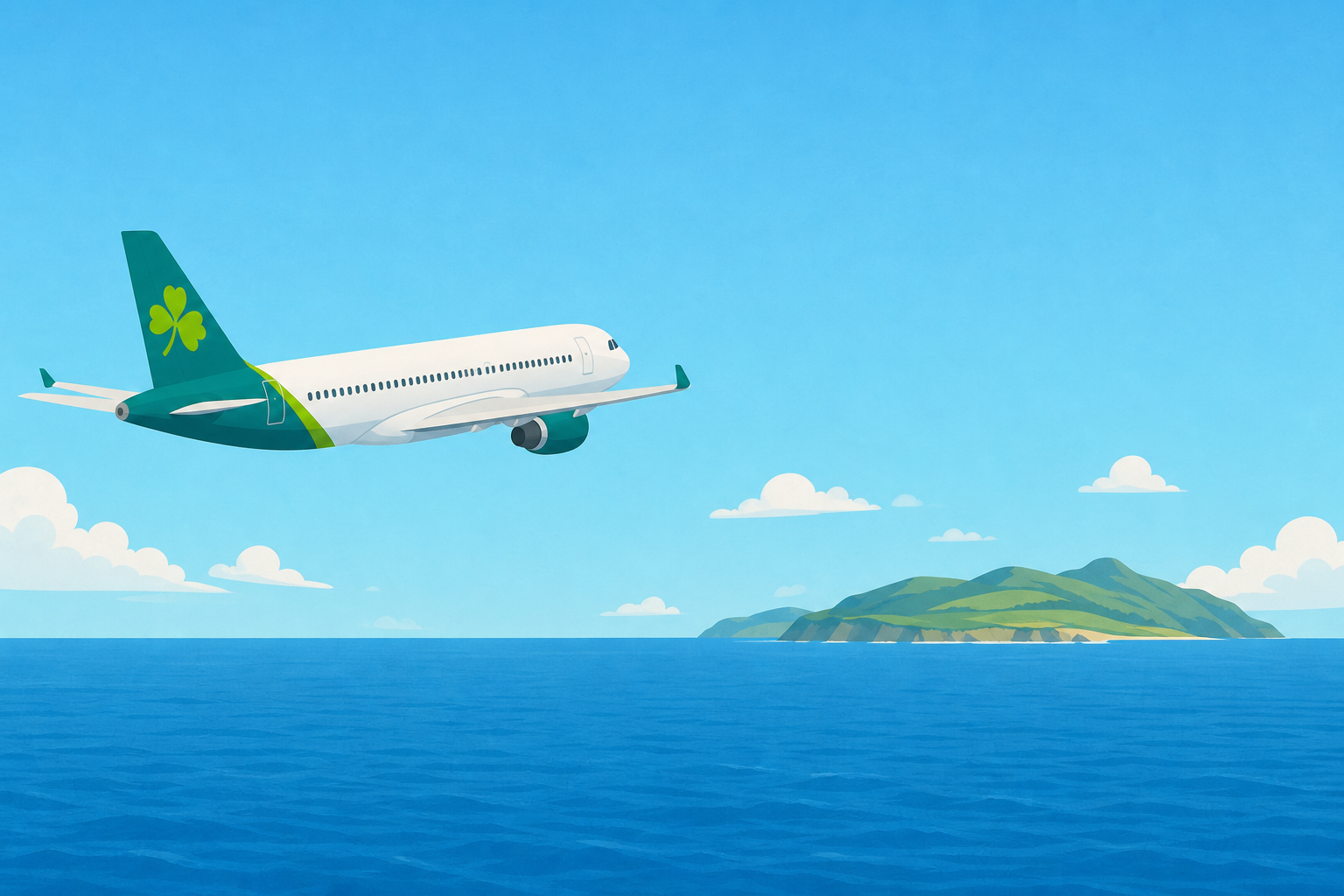
An Aer Lingus flight leaves Dublin for Lanzarote at 06:45 and lands at 11:10. How long is that flight?
Have a think before any hands go up. What would you count first?
Give five seconds of quiet think-time before any hands go up. Take two or three answers; don't confirm yet — the working comes in the next step.
Listen for pupils who try to subtract 11:10 − 06:45 as if it were plain numbers (getting 5:25 or similar). That is the exact slip this lesson fixes with the bridge-the-hour method.
Here are four journeys with their departure and arrival times. Before each one, call out the minutes up to the next whole hour.
For the overnight journey (23:30 to 02:15), call out where the count stops first, before it carries on into the new day.
Work each one live on the board. Let the class predict the minutes to the next whole hour before you start each journey. For the first, ask for the minutes to 07:00 and confirm it together on the board.
The overnight one is the key one: pause on it. Ask where does the count stop first? and hold out for midnight. Mark on the board where the count passes 00:00.
The 09:55 to 10:05 one is deliberately tiny — a nice contrast so pupils see the method doesn't change even when the answer is small.
Today we work through this one together. The Cork to Dublin train leaves at 07:55 and arrives at 11:30.
Say each hop out loud before we set the hands. First, count the minutes up to 08:00. Then count the full hours. Then count the last minutes to 11:30.
Now set the hands to the arrival time and check.
Talk this one through together — pupils take turns at the board and the class agrees or corrects out loud.
Predict-before-set: get the class to call the minutes to 08:00 (5 min), then the whole hours (3 h to 11:00), then the last minutes (30 min) — total 3 h 35 min. A pupil moves the hands to the arrival; the live elapsed readout confirms each part before you press Check. Do not read the total out until the class has worked it.
Watch for pupils who count 08:00 to 11:00 as 4 hours instead of 3 — a fence-post slip. Revoice: from 8 to 11 is three jumps, not four.
In your maths copy, work each journey time by breaking at the hour-mark. Write the minutes up to the next whole hour. Then write the full hours. Then write the minutes to the end. Total them at the bottom.
Walk the room glancing at the three-part working — minutes-to-the-hour, whole hours, last minutes — not just the final answer. This is whole-class copybook practice, not marking.
The last one crosses midnight; check pupils stop at 00:00 first (1 h 15 min).
The board gives you one journey at a time. Each one shows a departure time and a journey length. Count up and set the arrival clock, then press Check.
Work the journey on the board. Agree the arrival as a class. Only then does the next one appear.
One of the journeys passes midnight. When it does, stop the count at 00:00 first. Then carry on into the new day.
This is the practice round — pupils take turns at the board and the class confirms each answer before the next journey appears. The interactive presents the four journeys one at a time, so the class only ever sees the current item. Keep the board work brisk rather than over-explaining.
Each item opens on the departure time; the pupil counts up the given duration and moves the hands to the arrival, and the elapsed readout counts the journey live. The class predicts the arrival before the pupil at the board sets it.
Answers in order: 10:45, 17:30, 23:35, 04:30. The last tips past midnight — hold out for the class to say what date the arrival is on.
You're previewing this lesson. Get full access to this lesson and hundreds more — each one ready to teach, with interactive activities, printable resources and pupil progress tracking built in.