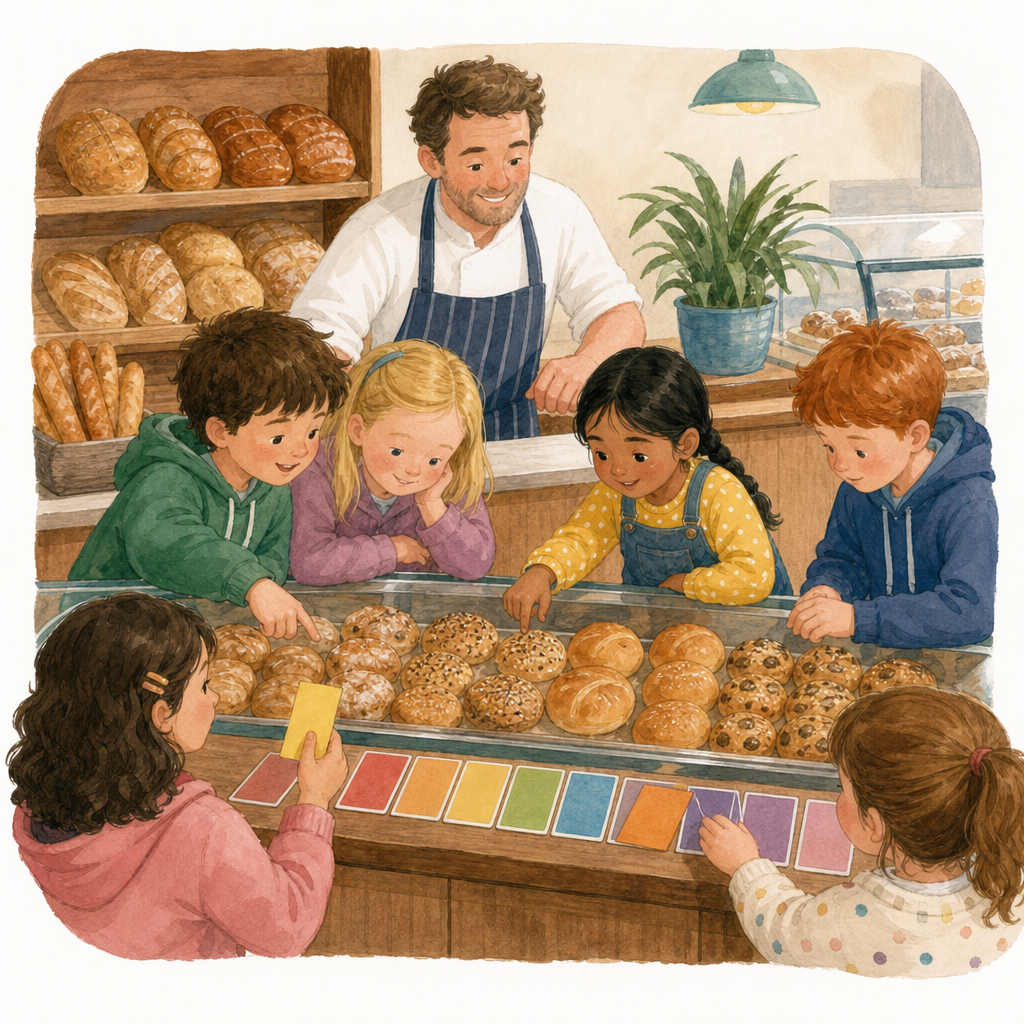
 You can already count to twenty in English, so picture a busy German bakery where the trays of Brötchen (bread rolls) go fast and the queue climbs past ten. German does not build every teen the way English does, and at twenty-one the order flips to "one-and-twenty". Today you will spot the pattern hiding in the teens and count from eleven to twenty out loud.
By the end of this lesson, you will be able to:
- Count and recognise German numbers from eleven to twenty
- Spot which numbers are built from two smaller ones
- Join a spoken counting round from eleven to twenty
Each card shows the English on the front, so you will hear the German first, and then the whole class repeats it twice before anyone tries it alone. Once you have said it, flip the card to check how it is spelled. After a few teens, listen out for the ones that end like zehn (tsayn), because those are built from a smaller number plus ten.
Use the printed bingo card on your desk, or open Bingo on the class devices if you have them. Listen for each German number and mark it. When every number on your card is marked, call Bingo and read your numbers aloud in German with the class. Stay sharp: the calls are the teens and twenty, not the small numbers you already know.
Copy the German words for 11 to 20 from the list on the board into your copy, and as you go, circle the ones that end with zehn so the built numbers stand out. Watch the umlaut on zwölf and the short stems sech- and sieb-, because those are the three that are easiest to get wrong.
- elf — eleven
- zwölf — twelve
- dreizehn — thirteen
- vierzehn — fourteen
- fünfzehn — fifteen
- sechzehn — sixteen
- siebzehn — seventeen
- achtzehn — eighteen
- neunzehn — nineteen
- zwanzig — twenty
Picture the bakery counter with rolls still left on the tray, and then spin the wheel to see which number comes up. We all say that German number together, and then a volunteer or a table counts on toward zwanzig, saying up to three more numbers and stopping at twenty. A mini number line from eleven to twenty stays on the board to help you.
Unlock the full learning experience
You're previewing this lesson. Get full access to this lesson and hundreds more — each one ready to teach, with interactive activities, printable resources and pupil progress tracking built in.
This lesson is copyright of Coding Ireland 2017 - 2026. Unauthorised use, copying or distribution is not allowed.