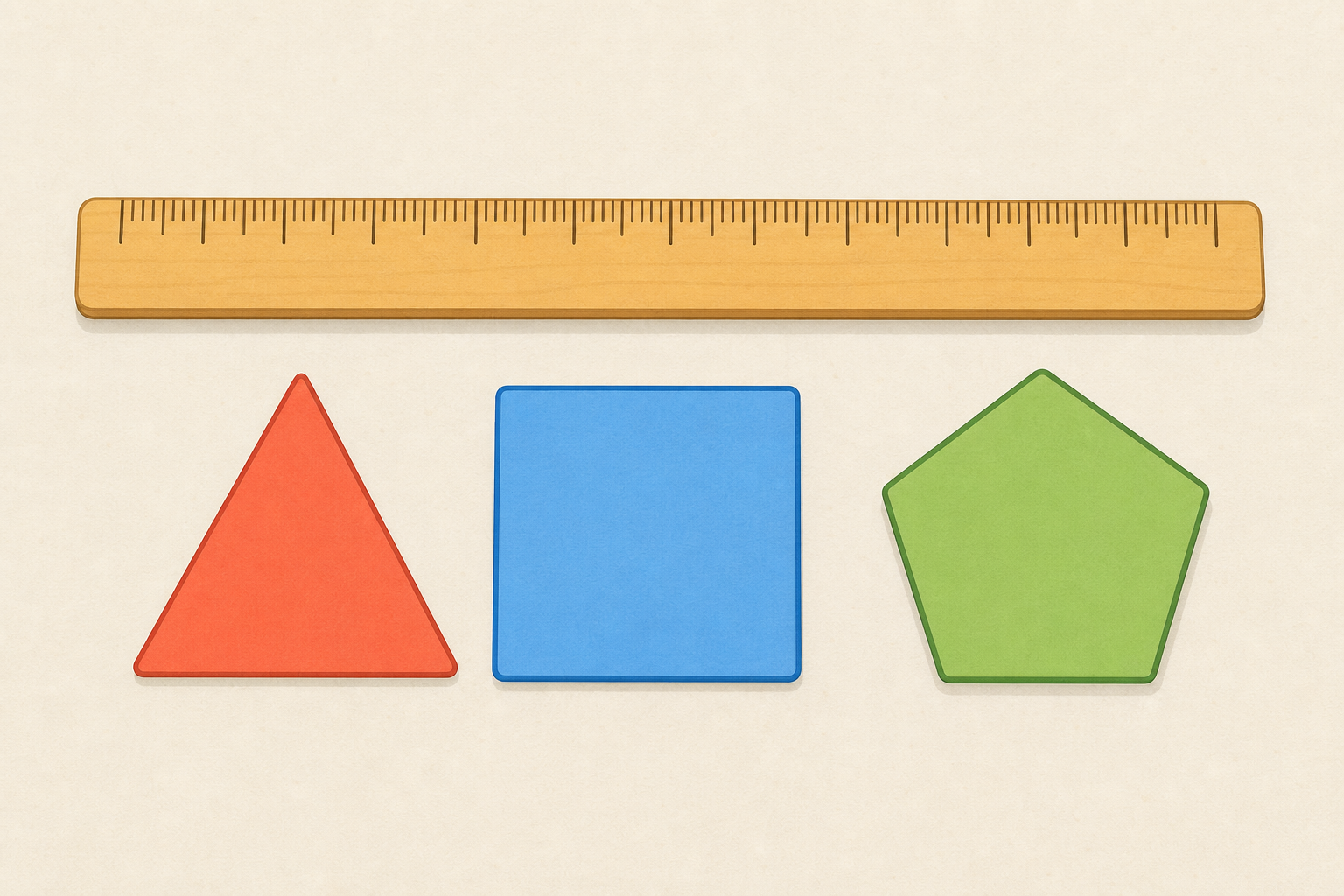
Think back over the whole year. What is one thing in maths you can do now that felt hard back in September?
Maybe it was reading a big number, measuring in metres, or naming a shape by its sides. Hands up when you have one in mind.
Take three hands-up answers, aiming for one from number, one from measures, one from shape. Give five seconds of quiet think-time before any hands go up.
Revoice each answer into the area of maths it belongs to — so that's a number one, that's a measures one — to prime the sorting that runs through the whole lesson.
A number built from place-value blocks. Read it aloud and watch which column holds the biggest digit.
Here is 235. Now here is 240. Which is greater, and which column told you?
These are all number ideas. In a moment we will look at a measures idea and a shape idea too.
For 235, point at the single unit cubes last — pupils tend to read the flats and forget the units. Ask which digit is worth the most before anyone reads the number.
When 240 appears, hold both numbers in mind and let the tens column do the work: both numbers share two hundreds, so the hundreds cannot break the tie. Revoice a strong answer as so we only had to look at the tens.
Close by naming the two other areas of maths you will meet today — measures and shape — so the sorting activity next has somewhere to land.
Today we sort mixed review cards into the area of maths each one belongs to. An area of maths is a big topic — like number, measures or shape.
We will work these together on the board. The cards are: round 268; how long is a pencil, centimetres or metres; a shape with four equal sides; and a true-or-false card saying a square has four sides.
For the last card, you are not deciding if it is true yet. You are just saying which topic it is about.
Talk this one through together — pupils take turns at the board and the class agrees or corrects out loud.
The point of this round is not the right bucket — it is naming the topic aloud first: is this a number card, a measures card or a shape card? Ask that question every time before the drop.
Watch for the true/false card — pupils will want to sort it by its answer rather than its topic. Steer them to the topic: it is about shapes, so it goes with shape.
In your maths copy, round 268 to the nearest 10 and then to the nearest 100. Write each answer underneath the other so you can see them.
For the nearest ten, look only at the units digit. For the nearest hundred, look at the tens digit.
Then name one 2D shape that has four equal sides.
Walk the room glancing at the two rounding answers — this is whole-class copybook practice, not marking. Watch for pupils who round 268 up to 300 for the ten as well; the ten looks only at the units digit (8), the hundred looks at the tens digit (6).
Today we work through these sorting rounds together, each one a step harder. Say which topic each card comes from as you place it. We take the rounds one at a time:
This is the practice round — pupils take turns at the board, check each answer, and the class confirms before moving on. Keep the board work brisk rather than over-explaining.
The four rounds climb: the number round is a clean split, the metres/centimetres round asks pupils to picture the real object, the sides round needs careful counting, and the true/false round pulls from every topic at once — the one that proves the whole year has stuck.
On the true/false round, ask which topic is this card testing? before is it true? — the topic-spotting is the thread of the lesson. The 240-and-235 comparison there is the one you modelled in Watch and Notice, so link back to it.
You're previewing this lesson. Get full access to this lesson and hundreds more — each one ready to teach, with interactive activities, printable resources and pupil progress tracking built in.