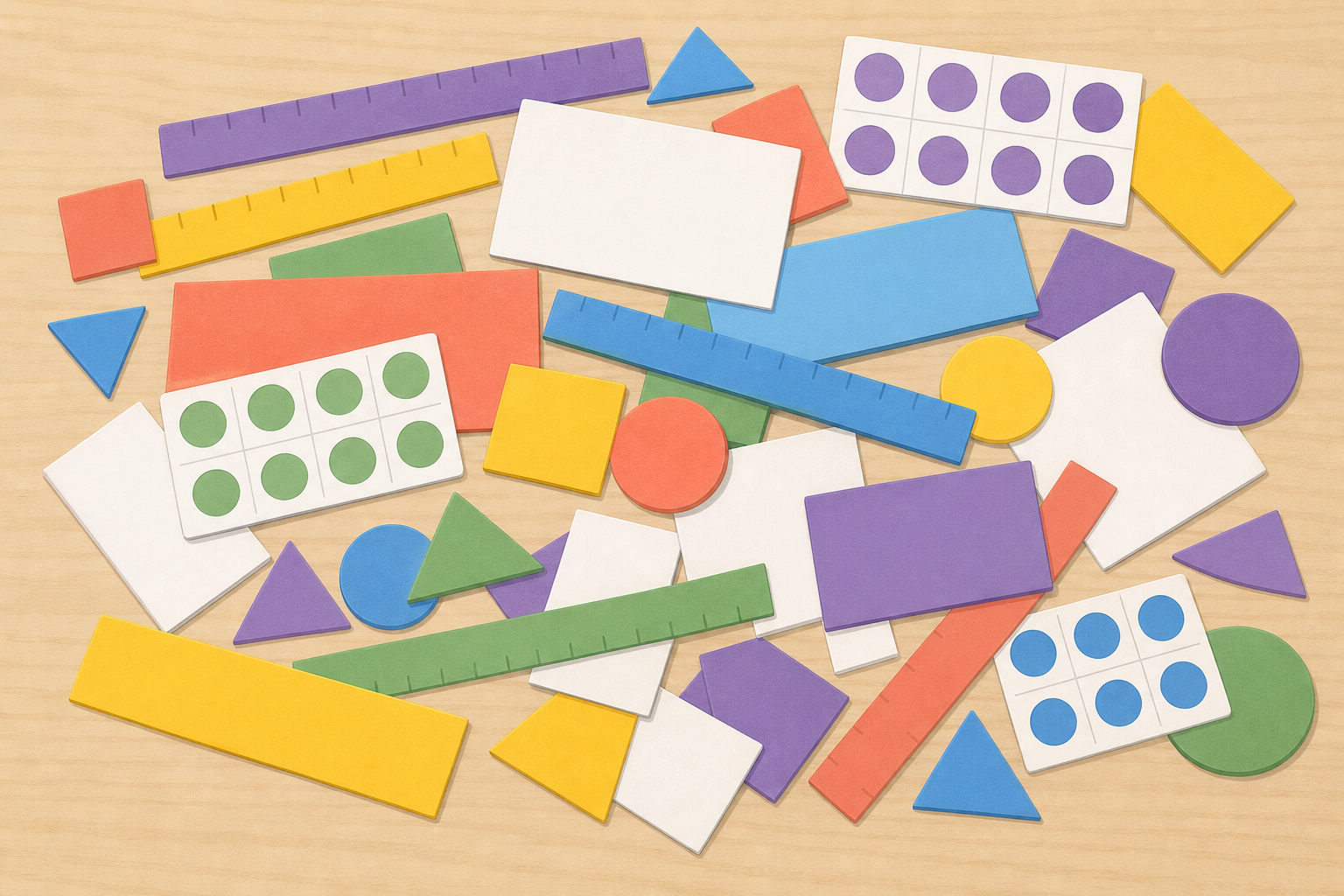
I am holding up a jumbled pile of cards for you to see. Some are numbers, some are lengths, and some are shapes. What is the same and what is different about them? Which cards do you think belong together, and what would you look at to decide?
Two sorts on the board, each done with a different rule. Look at how the number cards have been put into two groups, and how the shape cards have been put into two groups. For each sort, look for the single test that decides where every card lands.
First we build a four-digit number on the place-value mat. We build 3,072 digit by digit and read it aloud, watching the zeros: the zero in the hundreds column holds the place so the 3 stays in the thousands. After we have read that one, we will build another four-digit number, 4,905, on the board mat beside it and read that aloud too.
Now we change task, from building numbers to renaming a length. Renaming a length means writing the same length two ways, using a different unit. We know 1 m = 100 cm, so to change metres into centimetres we multiply by 100. That means 2 m = 2 × 100 = 200 cm, and 3 m = 3 × 100 = 300 cm. It is the same length, just written in a smaller unit.
In your maths copy, write three quick lines, one for each of the three topics we reviewed today, number, measures and shape:
This is your own "what I know" from the year.
Today we sort four sets in order, each a step trickier than the last. First sort numbers into odd and even. Then sort lengths into shorter than a metre and longer than a metre. Then sort shapes into triangles and quadrilaterals. The last set is different: instead of sorting a card by a property, you decide whether each statement is true. Say what test you are using before each reveal.
You're previewing this lesson. Get full access to this lesson and hundreds more — each one ready to teach, with interactive activities, printable resources and pupil progress tracking built in.