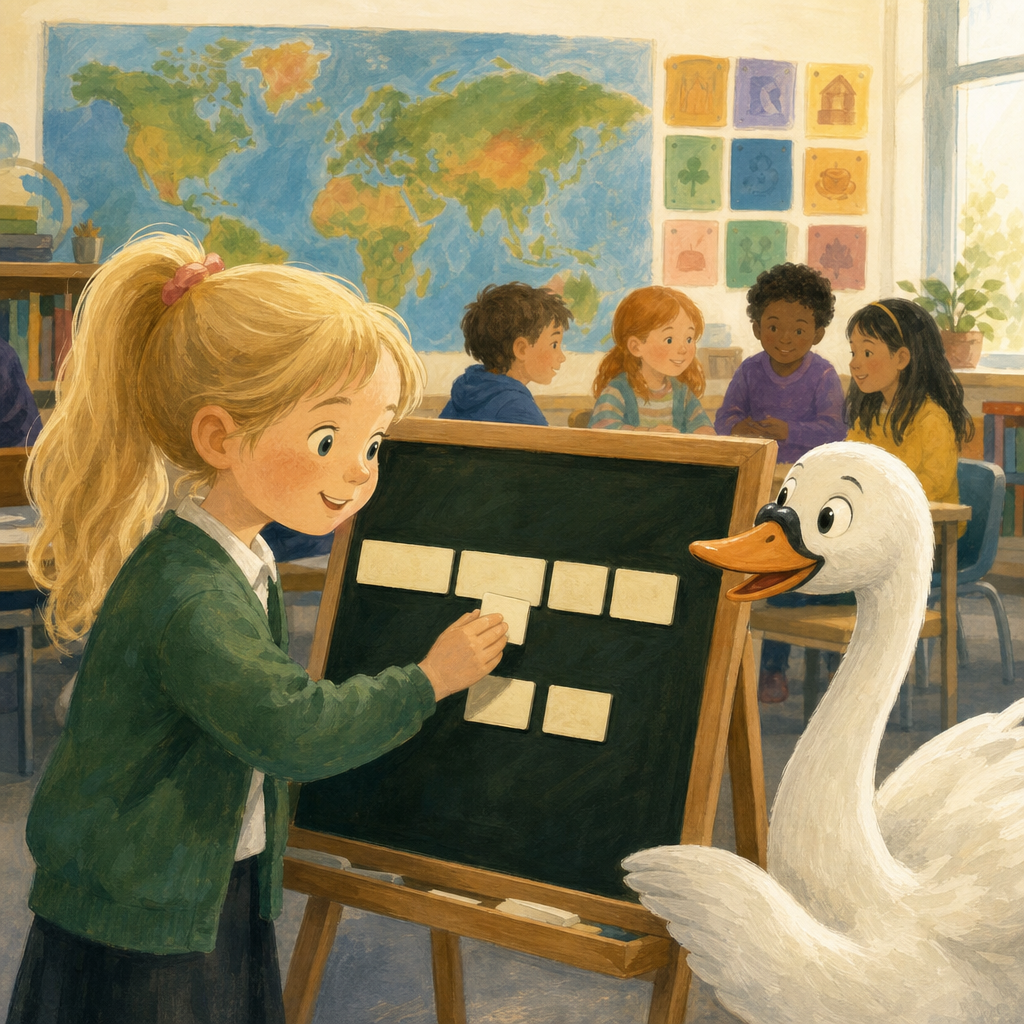
 Think of this English sentence: The swan is big.
Do you think every language lines those words up in the same order? Today we listen for where the action word (the being-word or verb) lands, and we find out why Irish often puts it first.
By the end of this lesson, you will be able to:
- Notice that languages arrange the same sentence pieces in different orders
- Listen for where the action word lands in spoken clips
- Copy a short English sentence in Irish word order and mark what moved
Listen as we play each row: same bird, different languages. Which two sound closest?
We will say the English and Irish names together. The other languages are for curious ears: listen only.
Listen to each clip and name the language.
Then listen once more. We will find out whether that language usually puts the action word early, in the middle, or near the end. Point left, middle, or right together. You are hunting position, not translating every word.
Irish often puts the verb (the being-word) first.
'Tá mé' (taw may) lines up more like am I than I am.
Watch one full sentence with arrows for what moved:
- English order: The swan is big (swan → is → big)
- Irish-order sense: Is the swan big (being-word first, then the swan, then big)
- Irish frame: Tá an eala mhór (taw on AL-ah wore)
Say Tá an eala mhór together after the audio.
Open your copy. Copy the worked pair from the board, then draw an arrow (or underline) to mark what moved.
Board pair:
- English: The swan is big
- Irish-order sense: Is the swan big
- Irish: Tá an eala mhór
You are marking the move of the being-word, not inventing a new sentence.
We will play bird bingo from the board. When you hear a bird that is on your card, cross it off and chorus the bird name. Cards are all different, so not everyone has every bird. When every bird on your card is crossed off, call Bingo for a cheer. Listen hard: the same bird may arrive in more than one language.
Unlock the full learning experience
You're previewing this lesson. Get full access to this lesson and hundreds more — each one ready to teach, with interactive activities, printable resources and pupil progress tracking built in.
This lesson is copyright of Coding Ireland 2017 - 2026. Unauthorised use, copying or distribution is not allowed.