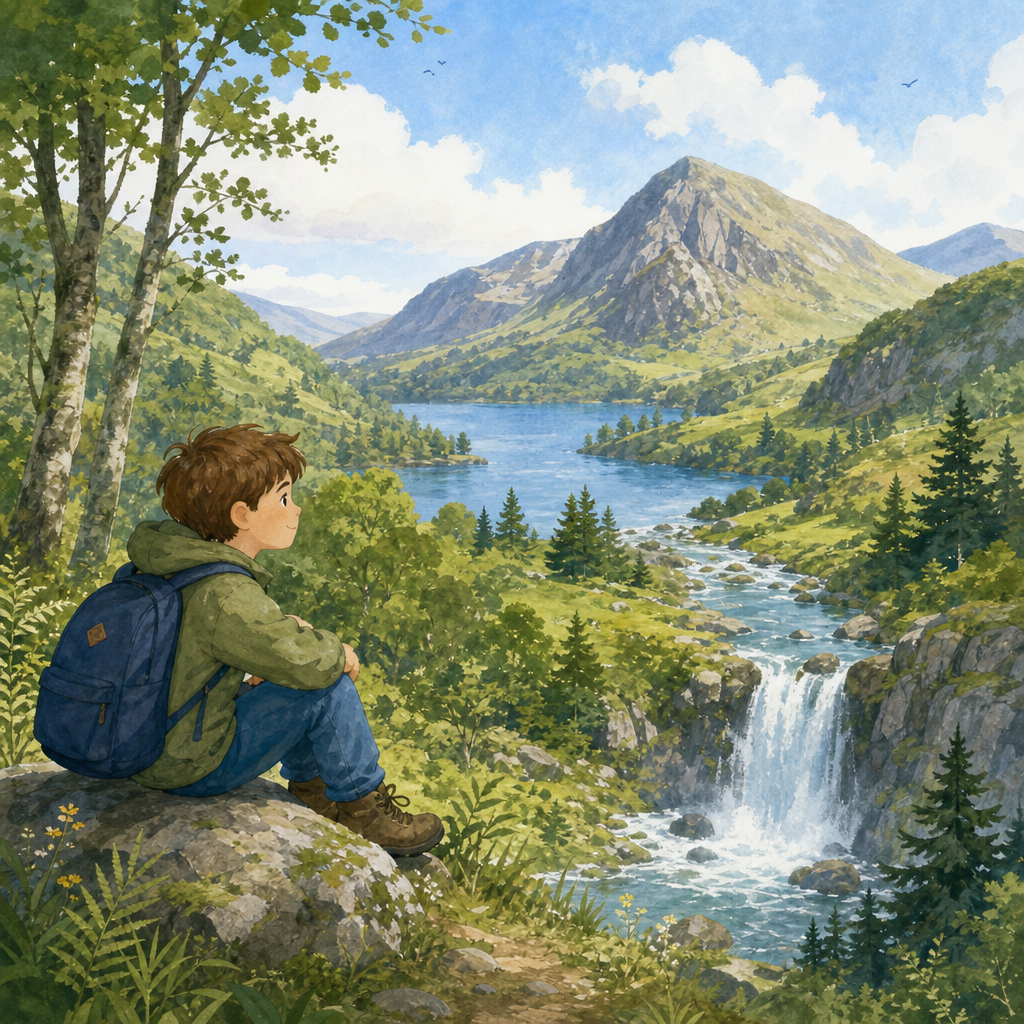
 Look out of the classroom window for a moment. What can you see that was not made by people? Trees, grass, maybe a river or a hill?
Today those everyday things get their German names, and you will match them by ear in a game of pairs.
By the end of this lesson, you will be able to:
- Name eight nature features in German
- Label a landscape with the right German words
- Match each word to its meaning when you hear it
Here are today's eight nature words. Tap each one, listen, then say it back together. Watch the article every time: der, die or das travels with the noun.
A landscape is waiting with empty markers. Look at each part of the picture and click the correct German label.
Open your copy and write four nature words with their articles, and tick the ones you could see from your own home.
- der Baum — the tree
- der Berg — the mountain
- der Fluss — the river
- der See — the lake
- der Wald — the forest
- die Blume — the flower
- der Wasserfall — the waterfall
- das Gras — the grass
Now match today's 8 nature words to their meanings. Tap the speaker beside a German word and listen, then say which meaning it matches before anyone clicks. When a pair is right, you hear the word again.
Unlock the full learning experience
You're previewing this lesson. Get full access to this lesson and hundreds more — each one ready to teach, with interactive activities, printable resources and pupil progress tracking built in.
This lesson is copyright of Coding Ireland 2017 - 2026. Unauthorised use, copying or distribution is not allowed.