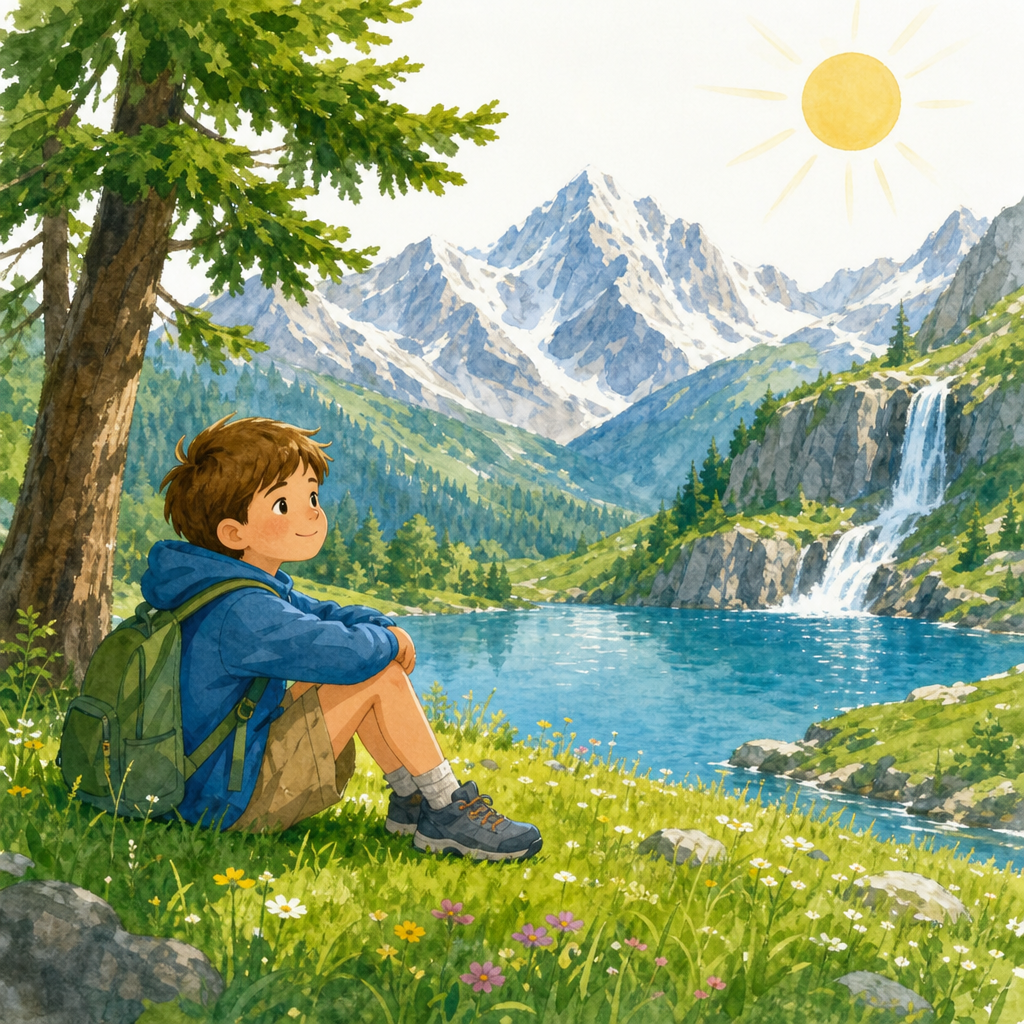
Look out of the window for a moment. What can you see that was not made by people? A tree, the sky, a cloud, a hill?
France is full of mountains, rivers and forests. Today we get eight French words so we can talk about nature like a local on a walk, then listen to a short scene in a Paris park.
Collect four or five answers from the class (tree, sky, grass, bird, cloud). Keep it brisk. Do not translate into French yet; the word-table in the next step does that work. If the view is a blank wall, invite pupils to name something natural they passed on the way to school instead. A quick spark line helps: France’s outdoors is a big part of how people spend weekends, so these words earn their keep fast.
We will hear today’s nature words on the board in two short sets. Listen to each word, then say it back together. Notice which words use le and which use la, and watch for the apostrophe on words that start with a vowel sound.
Run the word-table in two batches so the set sticks. First four: tap, class repeats twice (all together, then by table), then a quick point-and-say check (you point at a row, class says the French with its article). Then the second four the same way. Point at the article every time so pupils hear the pair as one unit.
Celebrate when a pair comes out clearly, especially l'arbre and l'herbe. For rivière and forêt, replay the audio and have the class copy what they hear; the on-screen phonetics are enough. Do not try to teach French r mechanics.
Elision (teach fully today): French drops the e of le or la before a vowel sound and writes an apostrophe instead. So it is l'arbre (not le arbre) and l'herbe (not la herbe). Pupils should learn the shortened form as the normal way to say the word.
A French Alpine landscape is on the board with empty markers. Look at each part of the picture. When your teacher or a classmate chooses a label, say the French word together. Thumbs up if you agree.
Model the first label yourself so the class sees the pattern: point at the tree, say l'arbre, then choose the matching tag. Invite volunteers to the board for the rest, or run it as a whole-class vote with thumbs. After each correct placement, the whole class choruses the word. If a label is wrong, pause and chorus the correct word before moving on.
Nice work if pupils say the word as the label lands: that is how it sticks. This checks both comprehension and pronunciation. Keep the word-table visible as a safety net.
Open your copy and write four nature words with their articles, and tick the ones you could see from your own home.
Pause the board and leave the word-table visible while they write. Everyone's pen should be moving. Check that articles are going in front of every noun, including the apostrophe on l'arbre and l'herbe. Accents matter on rivière and forêt. Four words with their articles is a solid haul: tick any they truly see from home and be honest. Do not collect these copies.
We will hear a short scene in a Paris park twice (think of somewhere like the Jardin du Luxembourg). First time, just listen. Second time, raise your hand when you catch one of today’s nature words. Then we answer the questions together.
Play the audio on the class speakers twice before anyone answers. On the first play, ask pupils only to listen. On the second, invite them to raise a hand when they catch a nature word they recognise from today’s set. Then work through the on-screen multiple-choice questions together as a class. Scenario id is at-the-park. Reassure them they do not need every word; they are hunting for meaning, not translating line by line.
How to steer the MCQs (on-screen content is authoritative): Do not rely on a pre-written answer key. After the second play, read each question and its options aloud from the board. Ask the class which option matches what they heard, then confirm by replaying a short stretch of the audio if needed. Accept the option that best fits the dialogue they actually heard.
Listening hunt: Keep today’s word-table visible. Pupils may catch any of the eight nature words; a city-park chat is most likely to use everyday outdoor items (tree, flower, grass, lake) and less likely to name mountains or waterfalls. Celebrate every correct catch, even if only two or three words appear.
Framing for the class: Picture two friends meeting in a Paris park and chatting about what they can see around them. Light outdoor mood, not a weather report or a mountain trek.
You're previewing this lesson. Get full access to this lesson and hundreds more — each one ready to teach, with interactive activities, printable resources and pupil progress tracking built in.