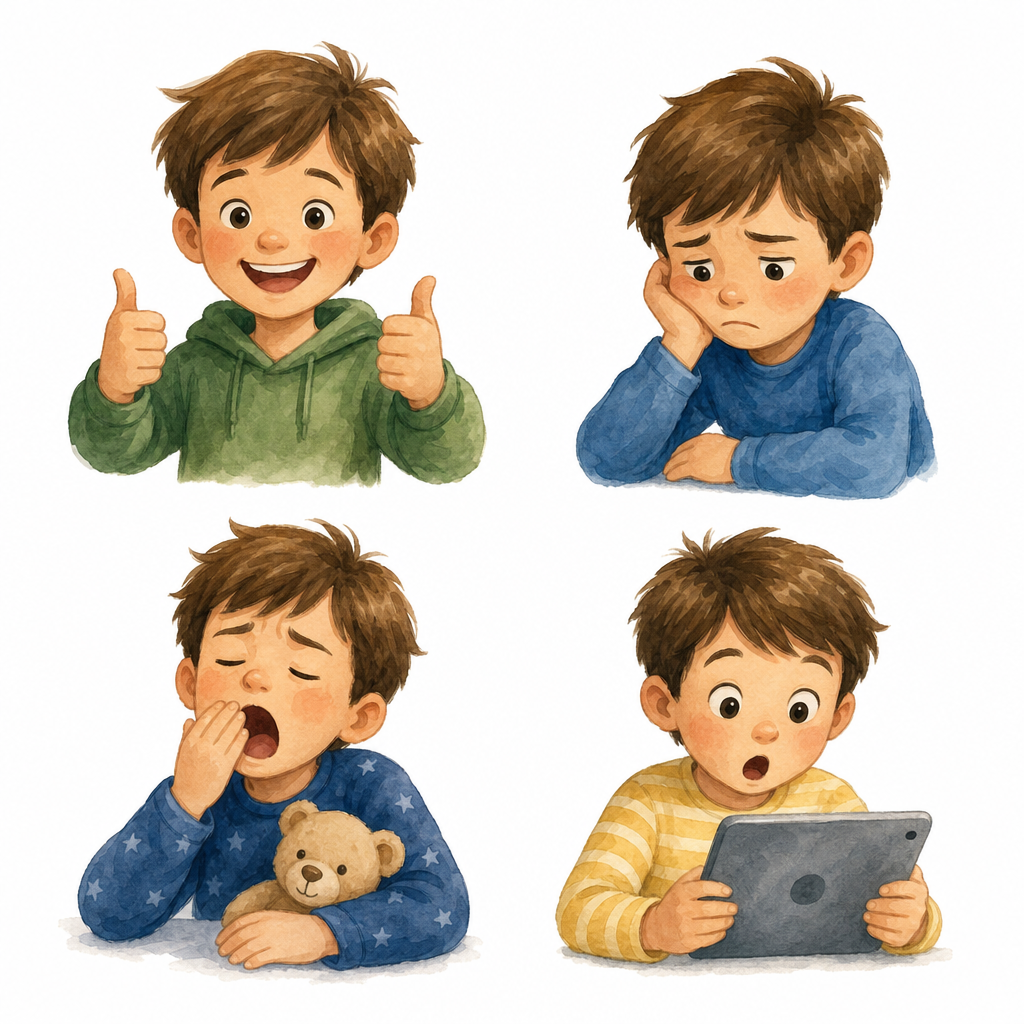
 We start in English, so there is no French to worry about yet. How are you today, and why? Give your answer in English, and make sure it finishes with because and a reason.
Today you will say the same kind of answer in French: how you feel, plus a reason.
By the end of this lesson, you will be able to:
- Name eight feelings in French
- Say how you feel and give a simple reason
- Ask a partner how they feel, and why
Meet today's feelings in two short rounds on the board. First you hear the French (with a say-aloud cue), the class repeats together, then you see the English meaning. Only after every word has been heard and said do we flip English to French.
Listen for the clear ay ending on words like fatigué: that written é sounds like the é in café. Je in Je suis sounds like zhuh.
Try this pattern (play the audio, then say it with the class):
Je suis content / Je suis contente parce que c'est l'anniversaire de Léa. (I am glad because it is Léa's birthday.)
Say-aloud help: zhuh swee kon-TAHN (or kon-TAHNT) / par-skuh / seh la-nee-vair-SAIR duh LAY-ah
Word strip stays on screen all lesson. Most of you can use the forms on the cards; if you want the -e form for a girl speaker, add e (contente, fière).
Click each French feeling, then its English meaning. Say the French quietly as you click each one. The word strip is still up if you need a quick glance.
One honest sentence beats a perfect one: accents you can fix as you go. First we say one class sentence out loud together. Then open your copy and write one sentence: how you feel + why.
Model (stays on the board):
Je suis fatigué / fatiguée parce que c'est lundi.
Je suis fier / fière de mon match parce qu'on a gagné.
Feeling: French from today's eight (word strip on screen). Reason: pick a bank phrase below, or a short English reason if you are stuck.
Reason bank:
- parce que c'est lundi / vendredi
- parce que c'est l'anniversaire
- parce que j'aime le sport
- parce que j'ai un test
- parce qu'on mange un gâteau
- content — happy / glad
- triste — sad
- fatigué — tired
- En colère — angry
- effrayé — scared
- surpris — surprised
- excité — excited
- fier — proud
Now tell a partner. Read the conversation on screen together first: tap the play button beside each line to hear it. Then make it your own. Partner A asks Comment ça va ?, then Pourquoi ? (why?). Partner B answers with a feeling from today and a reason with parce que, from the reason bank or your copy. Then swap.
Model:
A: Comment ça va ?
B: Je suis fatigué / fatiguée.
A: Pourquoi ?
B: Parce que c'est lundi.
Unlock the full learning experience
You're previewing this lesson. Get full access to this lesson and hundreds more — each one ready to teach, with interactive activities, printable resources and pupil progress tracking built in.
This lesson is copyright of Coding Ireland 2017 - 2026. Unauthorised use, copying or distribution is not allowed.