 A playground slide that is too steep sends children flying. A slide that is too gentle leaves them stuck halfway. How do engineers decide what is safe?
Today each group will pick its own force question about rolling cars and plan a careful test to answer it, changing only one thing at a time. What would you like to find out?
 If two groups get different answers, what might have made their tests unfair?
Fair test: change only one thing. Measure one thing. Keep everything else the same.
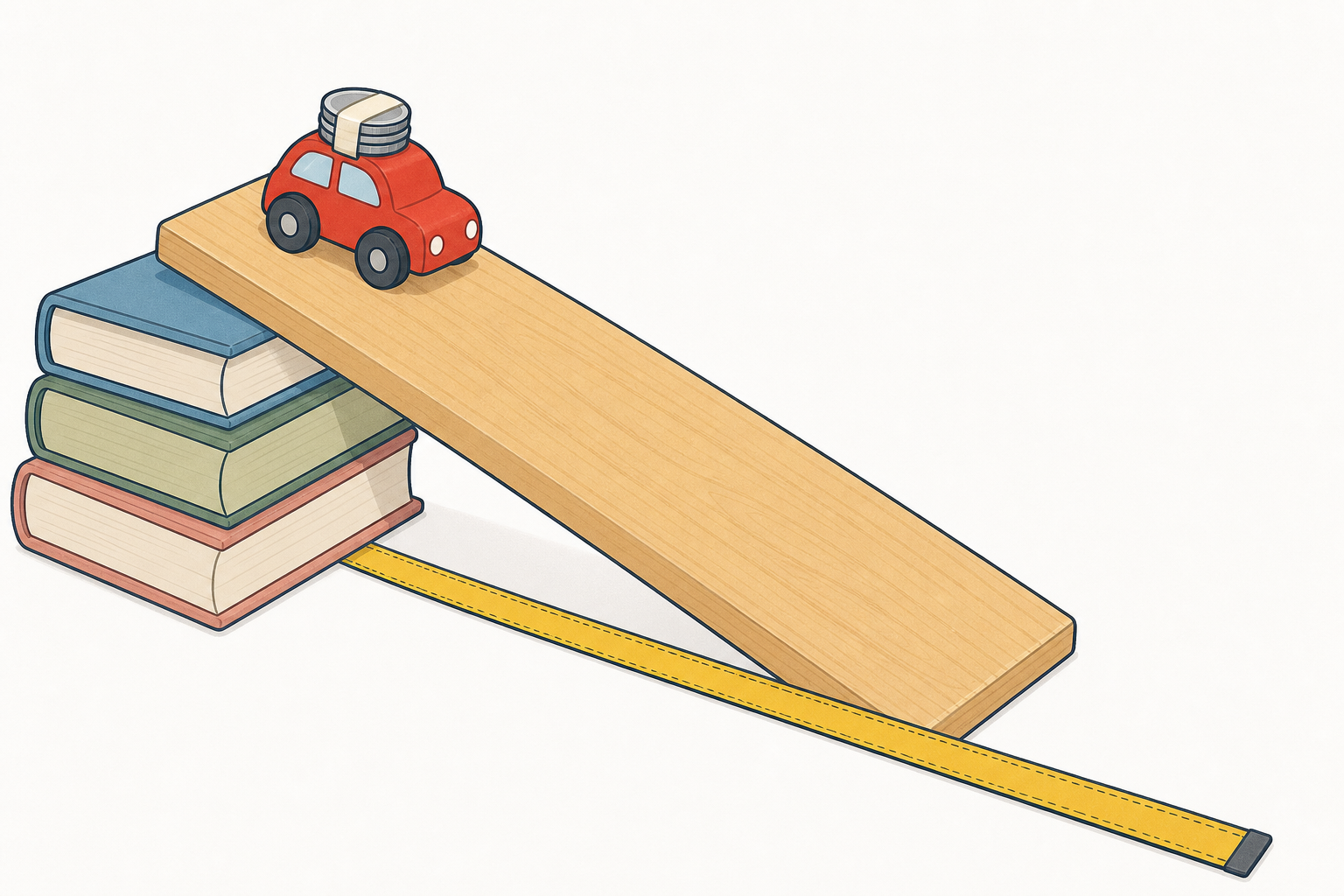
Watch the ramp at the front and look out for the one thing that changes on purpose: here it is the ramp height. Then watch for what gets measured, and for how several results turn into one average.
In your group, pick one force question you can really test with a car and a ramp. Turn it into a clear question, then say what you predict and why.
Ideas to choose from: Does a heavier car roll further? Does a steeper ramp make it go further? Does a smooth floor let it roll further than carpet?
Together we sort five cards for one example question: weight of the car, distance rolled, ramp height, starting point and floor surface.
Which card goes in Change? Which goes in Measure? Which three must stay the same? Then plan your own group's question on your Investigation Journal page: what you change, what you measure and what you keep the same.
Does a heavier car roll further?
 You are about to find out whether your force idea holds up: the averages will settle the argument.
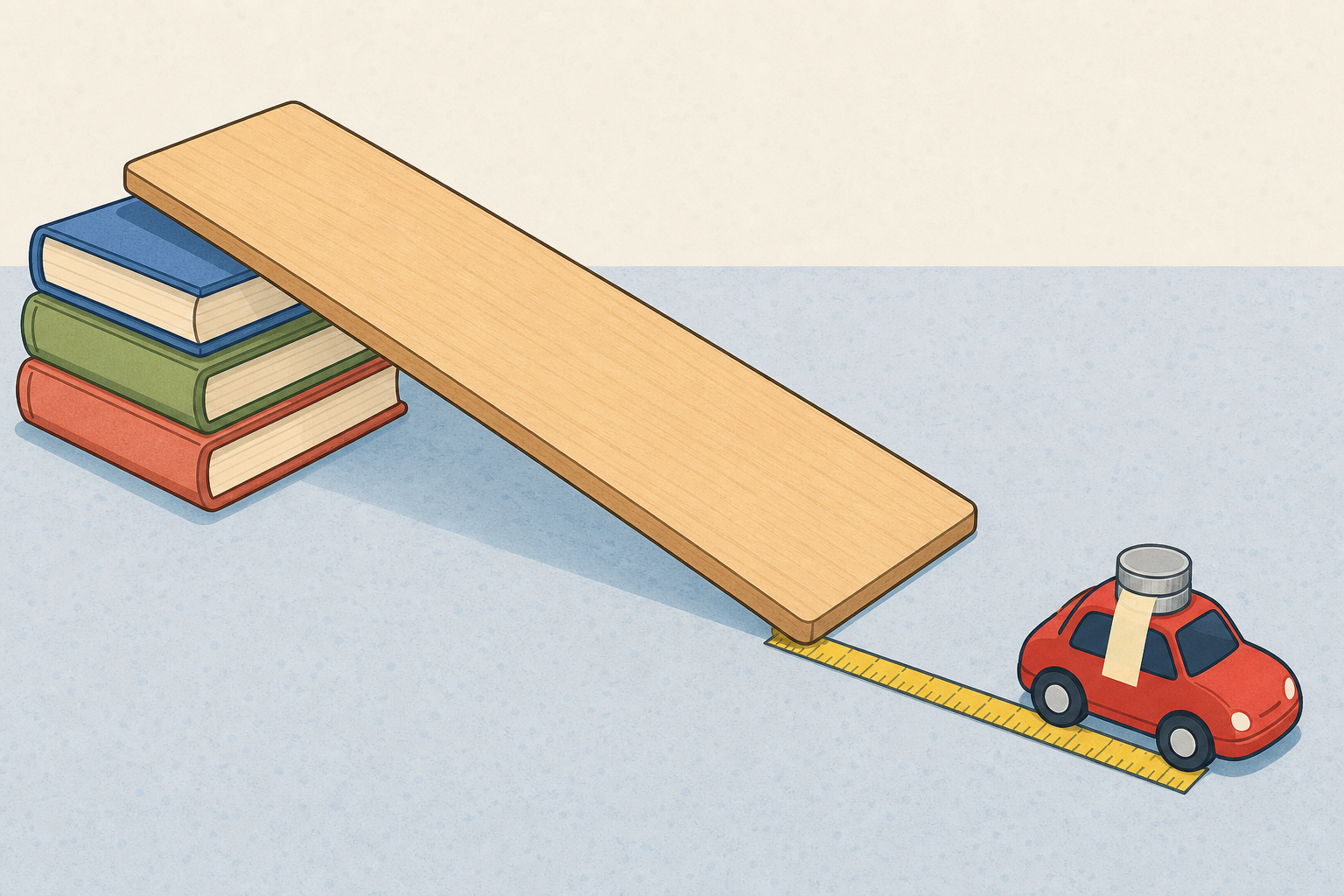
Set up the test your group planned. Change only the one thing on your planner. Release the car the same way every time: no pushing.
Run at least three trials for each version you try (for example 0 coins and 3 coins, or low ramp and high ramp). Measure from the bottom edge of the ramp to the front of the car on the floor, in centimetres. Write every reading on your Investigation Journal page as you go.
To find each average, add the three trial distances and divide by three. Board example: 80 + 84 + 76 = 240, and 240 ÷ 3 = 80 cm.
Unlock the full learning experience
You're previewing this lesson. Get full access to this lesson and hundreds more — each one ready to teach, with interactive activities, printable resources and pupil progress tracking built in.
This lesson is copyright of Coding Ireland 2017 - 2026. Unauthorised use, copying or distribution is not allowed.