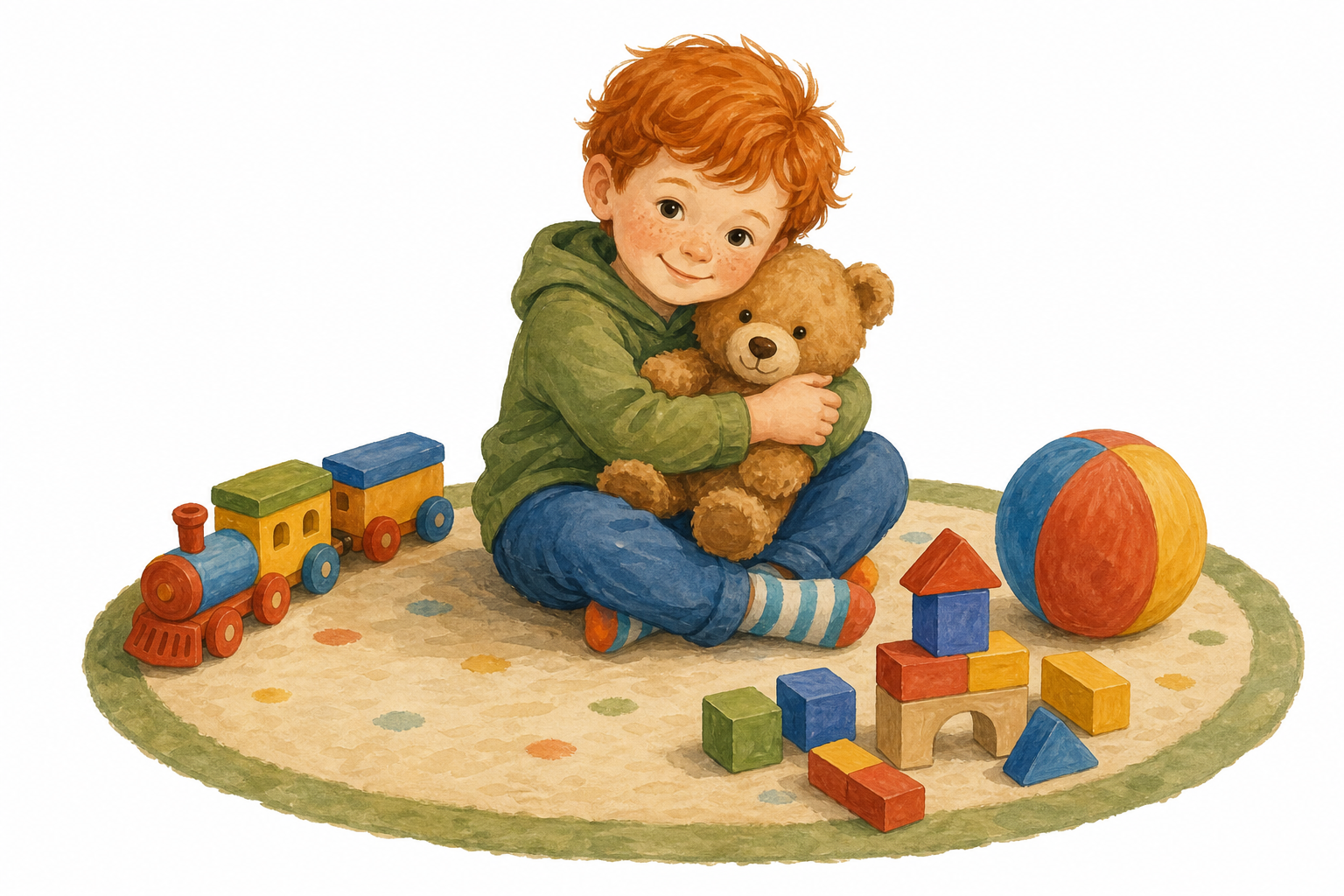
What did you play with most when you were six? Think of one toy, not a screen. Keep it in your head for a moment.
Today you will name toys in Spanish and describe them with two words: a colour and a size. Picture yourself choosing a toy in a Spanish toy shop for a younger cousin.
Take four or five quick answers in English only. The point is to wake up the idea of favourite toys, not to translate yet. If someone names a game console, gently steer them toward a physical toy so the new vocabulary will fit. Do not introduce Spanish words on this step; the flashcards do that next. You can plant the shop idea lightly: later they will pretend to pick a toy for a younger cousin.
Listen to the Spanish first, say it back with el or la, then flip the card to check. Listen for the soft ny sound in muñeca.
Imagine you are in a Spanish juguetería (toy shop), choosing a toy for a younger cousin. You will need colours and sizes for your description.
Colour and size bank (say these with the class):
Articles: On the cards we learn el / la + toy. When we describe, we often say Es un / una + toy + colour + size.
Model descriptions:
Es un robot rojo y pequeño. (It is a small red robot.)
Es una muñeca grande y rosa. (It is a big pink doll.)
Whole class on the IWB. First pass for each card: play the audio (or say the Spanish yourself), class repeats with the article, then flip to confirm the English. Do not ask pupils to guess Spanish from English on the first pass. Insist on the article every time: the noun alone is not enough. Run all eight once together, then invite volunteers for a second pass.
Colour and size reactivation (about 2 minutes) before the models: Point at the on-screen bank and chorus each item once. Pronunciation support: rojo/roja (ROH-hoh / ROH-hah), azul (ah-SOOL), verde (BEHR-deh), amarillo/amarilla (ah-mah-REE-yoh / ah-mah-REE-yah), blanco/blanca (BLAHN-koh / BLAHN-kah), negro/negra (NEH-groh / NEH-grah), rosa (ROH-sah), grande (GRAHN-deh), pequeño/pequeña (peh-KEH-nyoh / peh-KEH-nyah). Remind them that some colours change ending to match the toy (rojo/roja, pequeño/pequeña) while azul, verde, rosa and grande stay the same in the singular.
Then leave the two model sentences on the board and read them chorally. Point out that colour and size come after the toy. Pronunciation for the models: Es un robot rojo y pequeño (ess oon ro-BOT ROH-hoh ee peh-KEH-nyoh); Es una muñeca grande y rosa (ess OO-nah moo-NYEH-kah GRAHN-deh ee ROH-sah).
Board note in one line: today the cards use el/la; descriptions often use Es un/una. Both are correct in their place.
Flip two cards at a time on the board and find each Spanish toy with its English meaning. Say the Spanish quietly with the class as each card turns.
Whole-class game on the IWB only. Volunteers take turns flipping on the board; the class says the Spanish on each reveal. Audio plays on each flip, so keep the volume up. If the same pair is missed twice, stop and say the Spanish together before continuing. This locks the eight words in before sentence work. Do not run this as a pupil-device activity.
You have already said these sentences out loud on the wheel. Now open your copy and write one sentence describing a toy with a colour and a size from the bank on the board.
You may copy and adapt a model. Use the frame Es un / una ___ ___ y ___. Take care with accents and with un or una.
The wheel has just given choral and volunteer oral practice, so writing now follows hear → say → write. Before pens move, do one quick whole-class oral build as a bridge: point at a toy image (or name one from the wheel), and the class says the frame together once more (Es un / una ___ ___ y ___). Then pause the interactive. Everyone writes; this is the only three minutes where every pupil's pen is moving.
Keep one completed model and the gapped frame visible, plus the short colour/size choice bank so pupils are not inventing from an open set. Good models: Es un tren de juguete azul y grande or Es una pelota roja y pequeña. Pupils may copy and adapt rather than invent from scratch. Walk the room and check that the article matches the noun and that feminine nouns take feminine adjective endings where needed (roja, pequeña, blanca). Do not collect these.
The wheel lands on a toy from the juguetería. Describe it in Spanish with one colour and one size from our bank, as if you are telling your cousin what you found.
Use the frame: Es un / una ___ ___ y ___.
Keep the sentence frame and the colour/size bank on screen for every spin. This is the main oral production step: every pupil should hear and say full sentences before any writing. Scaffold the stakes down:
Accept any sensible pair from the bank. If a pupil freezes, offer the frame and let them fill the gaps. Celebrate full sentences more than perfect agreement; correct gently by repeating the right form once. When a full sentence lands, hit a quick ¡Qué bien! or ¡Muy bien dicho! before the next spin.
Useful teacher prompts: ¿Qué es? (keh ess): What is it? Descríbelo / Descríbela (des-KREE-beh-lo / des-KREE-beh-lah): Describe it (masculine / feminine object).
You're previewing this lesson. Get full access to this lesson and hundreds more — each one ready to teach, with interactive activities, printable resources and pupil progress tracking built in.