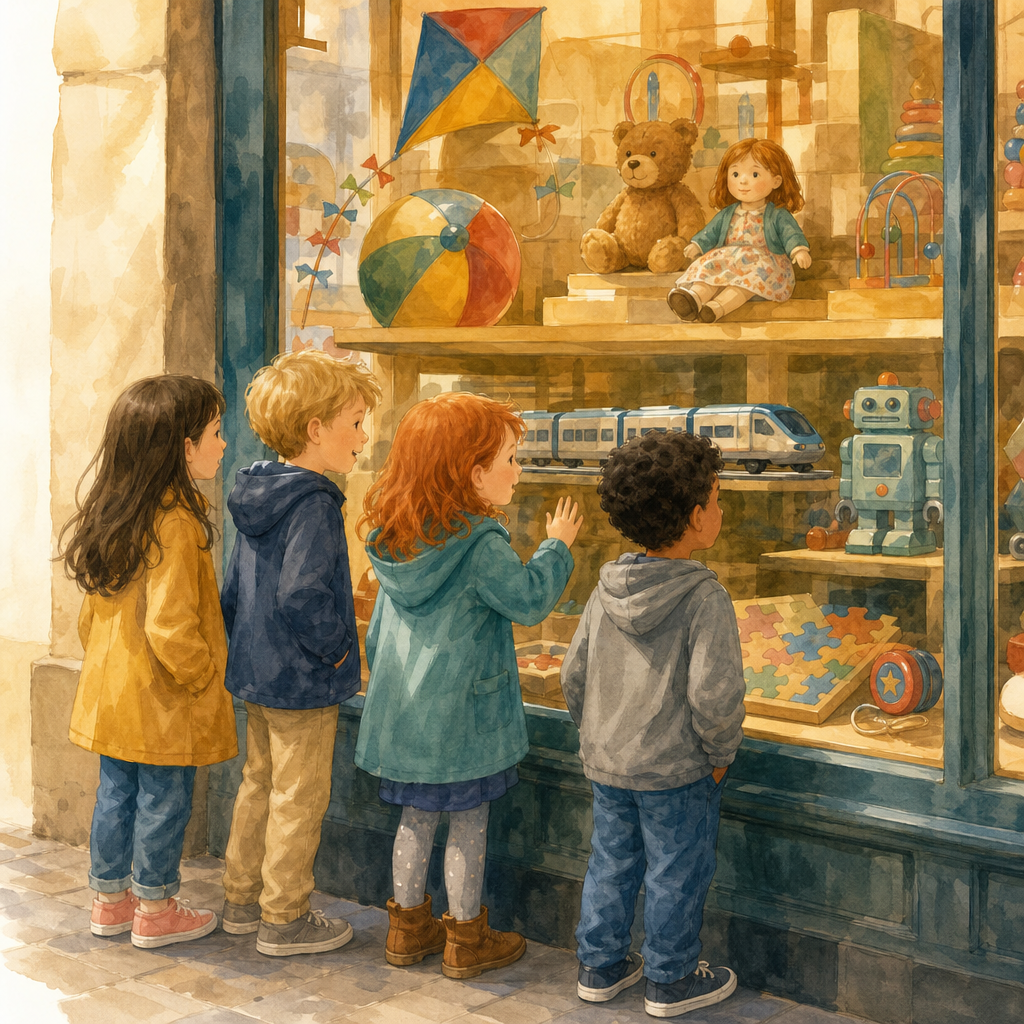
 Imagine standing outside a bright magasin de jouets (toy shop) in Lyon. Which toy in the window would you point at first? Keep that picture in your head.
Today you will name eight French toys with le or la, then describe one using a short French sentence.
By the end of this lesson, you will be able to:
- Name eight toys in French with le, la or l'
- Say a short describing sentence about a toy
- Compare French board-game cafés with pastimes at home
You are looking into the toy-shop window. Eight toys appear one at a time.
Listen to the French first (with le, la or l'), say it with the class, then check the spelling and the English meaning.
The article is part of the word: keep it every time.
Volunteers click each French toy, then its English meaning, on the board.
When a match is found, the whole class says the French together, article included, then a quick class cheer: Oui!
Open your copy. Leave the frame on the board and write one sentence about a toy from the shop window.
Frame: C'est un / C'est une + size or colour + toy
Size bank: petit / petite · grand / grande
Colour bank: bleu / bleue · rose · rouge · vert / verte
Copy one modelled pattern, then change the toy (and size or colour if you like):
C'est un petit robot. · C'est une grande poupée. · C'est une balle bleue. · C'est un cerf-volant rouge.
You are recording a sentence you have already said, not inventing new French spelling unaided.
- la balle — the ball
- la poupée — the doll
- l'ours en peluche — the teddy bear
- le cerf-volant — the kite
- le train électrique — the electric train
- le yo-yo — the yo-yo
- le puzzle — the puzzle
- le robot — the robot
Still in the toy-shop window. First, learn one short frame together:
C'est un / C'est une + size or colour + toy
Toy cards used le/la/l'. Describing sentences use C'est un or C'est une.
Models (class repeats):
C'est un petit robot. (It is a small robot.) · C'est une grande poupée. (It is a big doll.) · C'est une balle bleue. (It is a blue ball.) · C'est un cerf-volant rouge. (It is a red kite.)
Size bank: petit / petite · grand / grande
Colour bank (from earlier lessons): bleu / bleue · rose · rouge · vert / verte
Spin the wheel. Whisper the sentence with the class, then one volunteer says it aloud. Use C'est un… or C'est une… and add one size or one colour (both only if you feel ready).
Unlock the full learning experience
You're previewing this lesson. Get full access to this lesson and hundreds more — each one ready to teach, with interactive activities, printable resources and pupil progress tracking built in.
This lesson is copyright of Coding Ireland 2017 - 2026. Unauthorised use, copying or distribution is not allowed.