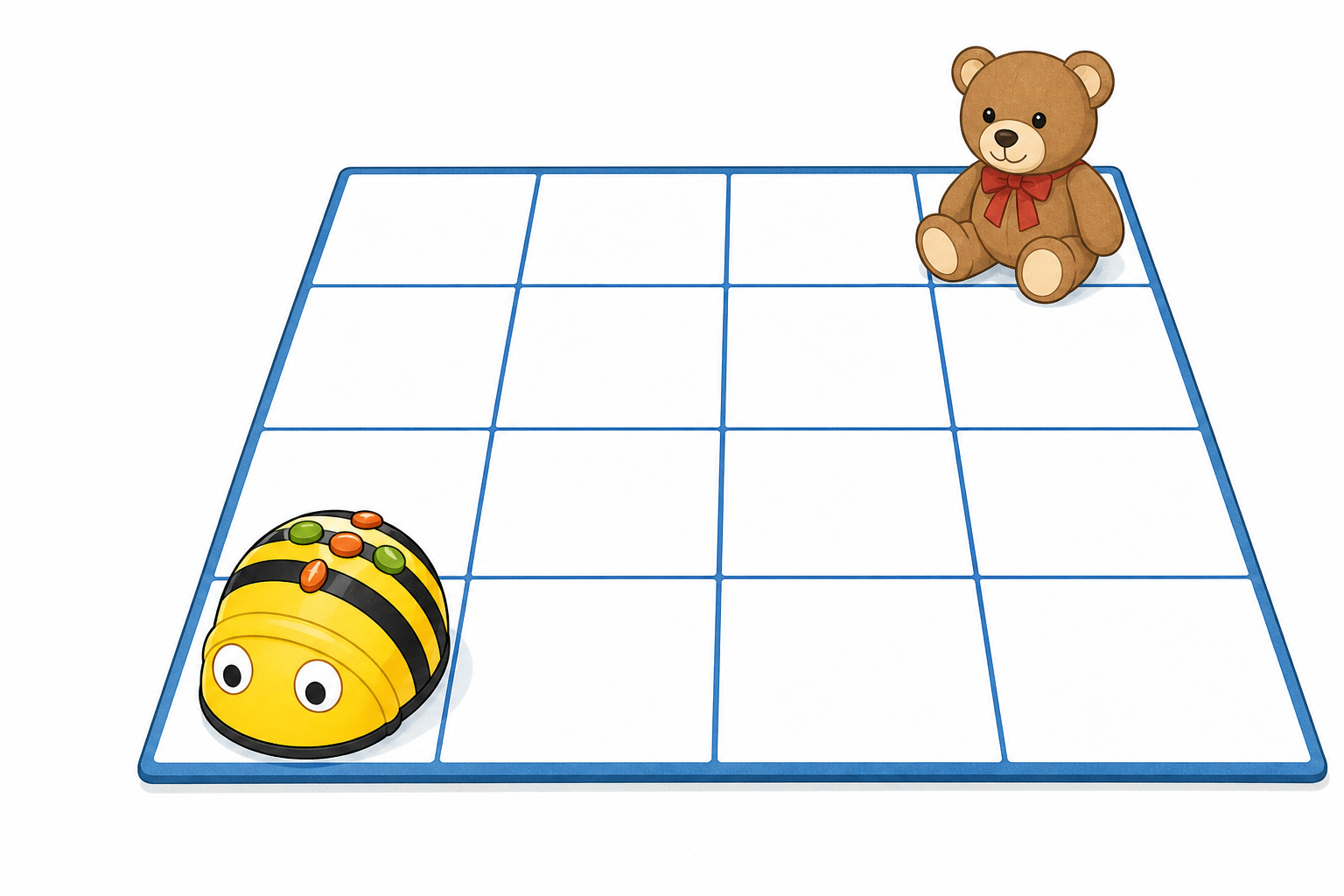
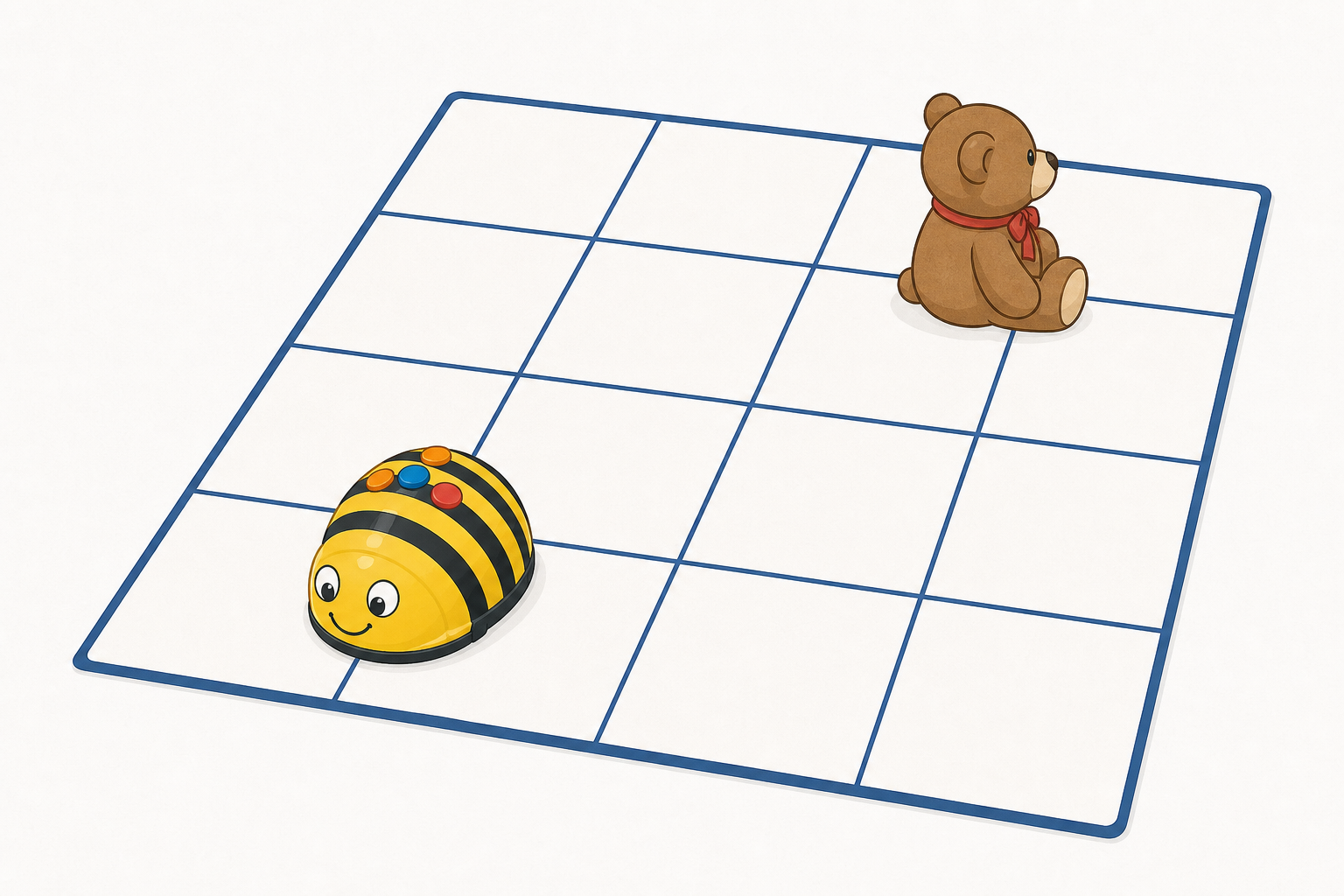
Look: here is our floor robot, the mat, and the teddy. You know the robot follows the steps we press. Sometimes it goes the wrong way. Today we help it get to the teddy.
Keep this light and visual. Place the floor robot on the taped mat with the teddy (or star) clearly in view. Do not run a full sequence yet. Ground the open in what children can see now. Frame prior knowledge as a durable capability: you know the robot follows the steps we press, not as "yesterday" or "ready again". Ask only: What if it goes the wrong way? Clear floor space before children arrive so no one trips. Save the word bug until after they see a miss in the next step.
Watch carefully. I will send the robot to the teddy. Oh no, it missed! Look at this wrong arrow. That wrong step is our bug. It is not a creepy-crawly. We can fix it and try again.
Tape a simple floor grid (about 3 by 3 squares is enough). Mark left and right on the mat edges with simple L/R cards or coloured stickers so children have a visual anchor. Place one target picture on a square the robot can reach in a short sequence. Have arrow cards ready.
Fold the class in: Was that step right? Which arrow would you change? Keep the model to one clear bug only.
Board stays almost empty. Use the table below for yourself only.
| Concept | Why it matters | Example |
|---|---|---|
| Fix — change the wrong step, then try the steps again | When something goes wrong, we change one step and try again instead of giving up | Swap the extra forward for the right arrow, press go, and watch the robot reach the teddy |
| Bug (recap) — a wrong step that sends the robot the wrong way | We look for the wrong arrow, not a naughty robot | Hold up the wrong arrow card: this is the bug, not an insect |
| Our steps (recap, say in speech not as a board word) — the arrows we press, one after another | The robot does exactly the steps we give it, in that order | Forward, forward, turn right, forward |
Misconception to head off: children may think the robot is "naughty" or broken, or look for an insect. Name it gently: the robot did what we asked. The bug is in our steps (point to the card), and we can fix it.
Who helps us: people who make robots test the steps and mend the ones that go wrong, just like us.
Low-cost substitute: if you have no floor robot, a child acts as the robot and follows big arrow cards you lay on the floor. "Bug" means one arrow is the wrong way; the class spots it and swaps the card.
Look at the path on the board. The steps already have one bug. We will find the wrong step, change it together, and press run. Then we try the same idea on the real floor robot.
Drive the interactive activity on the IWB in explore mode for one shared fix only. Keep the grid small (3 by 3). Start by building a short wrong path the class can see (for example one extra forward, or a turn the wrong way), so the first run clearly misses. Do not assume a path is already there.
Match board to floor: before you press run, stand by the real robot and point: this board arrow means the robot faces this way on the mat. Check left/right against the mat markers so screen facing and floor facing stay linked for 4–5-year-olds.
Children call out which command to change. You drag the steps. Press run so the class sees the sprite move. Celebrate one clear fix, then move straight to the real robots on the floor. This is planning together, not a race. No scores.
Commands on screen: forward, turn left, turn right. Goal: reach the target. If you miss, find the bug and fix it.
Your group has jobs. One child lays the arrow cards. One child presses the buttons. Everyone else watches and points to the wrong card if the robot misses. Change that one step. Try again until the robot reaches the picture.
Rotation pattern: If you have one floor robot, use one shared mat. One small group works (about 2 minutes per burst) while the rest of the class sit as watchers on the carpet edge. Swap groups after each fix cycle. If you have two or three robots, run two or three mats maximum; other children wait as watchers, not as idle free play.
Each active group has a target picture and arrow cards to show their steps on the floor before they press the buttons. Keep sequences to three steps and one bug only.
Watcher fold-in questions (use every time): Do you think that arrow is right? Which card would you change? What will happen if we try again?
Success looks like: a child points to a wrong step, the group changes it, and the robot gets closer or reaches the target. Celebrate the fix, not a perfect first try.
Low-cost substitute: child "robot" follows arrow cards. The bug is a wrong arrow; the class swaps it and the child walks the path again.
Safety: robots on the floor only; keep the lane clear of bags and feet; stand clear when the robot moves.
Sit together. One group, tell us the bug you found and how you fixed it. That is the same job robot makers do.
Display-only, oral show-and-tell. Limit to one group speaking, then briefly revoice a second fix you saw while circulating (do not wait for three full reports). Two to three minutes total including the carpet settle.
Sentence stems to say aloud: The bug was… We changed… Then the robot…
Revoice their ideas: we did not blame the robot; we looked at our steps, fixed one, and tried again.
Nature of STEM weave (one short line only): That is the same job robot makers do.
You're previewing this lesson. Get full access to this lesson and hundreds more — each one ready to teach, with interactive activities, printable resources and pupil progress tracking built in.