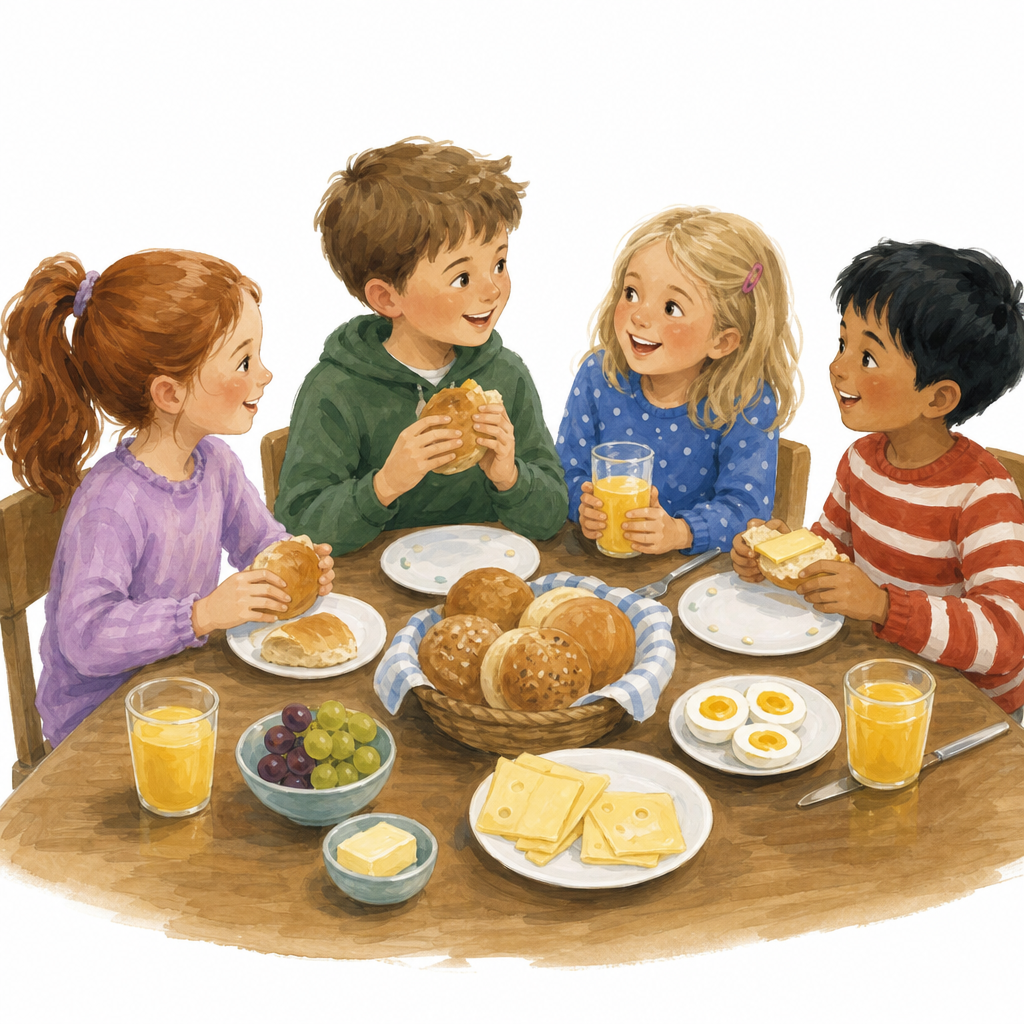
What did you eat for breakfast? Would you eat it every day? Tell a partner in English in one sentence, then we will learn how to say what we like and do not like in German, with a reason.
Take three or four quick breakfast answers, then move on. The point is to open the preference idea, not to list every cereal brand. Smile at the odd ones: cold pizza at 8am still counts. Remind the class that German nouns keep their capital letter and their article: das Brot, not bare Brot.
These are foods you might see at Abendbrot or in a German school Mensa. English and the picture appear first. Listen to the German with its article, say it with the class, then flip to check.
After all eight cards, we learn one useful pattern:
Like / do not like + because:
Ich mag der Käse, weil er lecker ist. (I like cheese because it is tasty.)
Ich mag das Brot, weil es frisch ist. (I like bread because it is fresh.)
Ich mag die Suppe nicht, weil sie komisch ist. (I do not like the soup because it is odd.)
Ich mag die Eier, weil sie lecker sind. (I like eggs because they are tasty.)
After mag you may sometimes hear den instead of der. Using der, die or das with the noun is fine today. Watch out: die Eier means more than one egg, so we say sie … sind (not ist).
Reason bank (keep these three adjectives): lecker (tasty), frisch (fresh), komisch (odd).
Pronoun helper: der → er · die (one thing) → sie · das → es · die Eier (plural) → sie … sind
Noun drill first (cards only): Show English + image. Play or say the German with its article. Class repeats twice (whole class, then by table). Flip to confirm. Cheer every full phrase with its article: a clean das Brot! deserves a class high-five. Stress the article every time: das Brot (dahs BROHT), der Käse (dair KAY-zuh), die Eier (dee EYE-er), das Hähnchen (dahs HAYN-khen), der Salat (dair zah-LAHT), die Suppe (dee ZOOP-uh), die Pizza (dee PIT-sah), der Reis (dair RICE). Flag once that die Eier is plural (eggs, not one egg).
Then the preference frame (after all eight): Put the four model sentences on the board. Model slowly and run choral, then table, repetition of each full sentence. Respellings: Ich mag (ikh MAHK), nicht (nikht), weil (vile), lecker (LEK-er), frisch (frish), komisch (KOM-ish), ist (ist), sind (zint), er (air). Keep the reason adjectives closed: only lecker, frisch, komisch. Drill the plural model clearly: Ich mag die Eier, weil sie lecker sind. Drill the masculine model clearly: Ich mag der Käse, weil er lecker ist. Pronoun helper on the board: der→er, die (singular)→sie, das→es, die Eier→sie+sind. Do not teach accusative as a rule; if a pupil freezes on a masculine noun, accept der/die/das + noun.
Quick pair beat before you leave this step: Point at two food images. Partners whisper one like and one dislike using the frame. If someone picks die Eier, coach sind. If someone picks der Käse, der Salat or der Reis, coach er. Thirty seconds is enough. This is the pupil-owned speaking turn before any writing.
Listen carefully. Two classmates are choosing lunch at a Berlin school canteen (a Mensa). Your teacher will play the clip twice (or read a short Mensa chat). Then answer these questions together as a class:
What success looks like: catch any food language you can, then build your own Mensa tray from today's eight foods on the board and say one full Ich mag …, weil … sentence to a partner.
Purpose of this step (read this first): Listening is for gist and culture (a real Mensa order). Today's eight nouns are checked in the post-clip tray beat, not by matching the stock audio word-for-word. Success = pupils catch any food language, judge tone, then speak with today's list.
Before the lesson: Play the clip once yourself at class volume. Jot any food words you hear and note the interactive's on-screen feedback so you are not guessing live. Today's board words (for the tray beat) are: das Brot, der Käse, die Eier, das Hähnchen, der Salat, die Suppe, die Pizza, der Reis.
Guaranteed teacher-read script (use this as the main listen input if the clip is unclear, silent, or has zero overlap with today's foods; you may also use it after the clip as a second listen):
Read slowly twice, pointing at board images as each food is named:
Answer key for the teacher-read script:
In class: listen phase: Books closed. Prefer the platform clip first if audio is clear; otherwise go straight to the teacher-read script above. Play or read the whole thing once, then a second time before anyone answers. Work through the three on-screen questions together. If you used the clip, use the interactive's feedback as your answer key after each item. If a pupil is stuck, replay or reread just that line rather than translating the whole scene into English. Celebrate any food word heard.
If the clip uses few or none of today's words: Say openly: "That Mensa had different dishes — now listen to our menu chat." Switch to the teacher-read script, then move to the tray beat.
Post-listen tray beat (always run this): Each pupil points to two foods from today's list they would put on a Mensa tray and whispers to a partner: Ich mag …, weil … (one full sentence is enough). Cold-call two pairs. Model answers you can accept: Ich mag der Salat, weil er frisch ist · Ich mag die Pizza, weil sie lecker ist. This is where today's vocabulary is checked.
Pupil questions (also on the IWB):
Keep the tone light: a canteen queue is everyday German life, not a test of perfect hearing or of the stock clip's exact word list.
First we say it, then we write it.
On the board (leave these up):
Foods: das Brot, der Käse, die Eier, das Hähnchen, der Salat, die Suppe, die Pizza, der Reis
Pronouns: der → er · die (one thing) → sie · das → es · die Eier → sie + sind
Adjectives: lecker · frisch · komisch
Open your copy. Copy one like sentence and one dislike sentence. Use a food, the matching pronoun, and an adjective from the bank. If you pick die Eier, use the special line with sind.
Oral pass before pencils (about one minute): Point at a food image. Class answers together with a full sentence from the models, e.g. Ich mag der Käse, weil er lecker ist, Ich mag das Brot, weil es frisch ist, or Ich mag die Suppe nicht, weil sie komisch ist. Do one round that includes die Eier … sind so plural is heard before anyone writes it. Then pairs whisper one like and one dislike. Only then: pencils.
Keep both gapped frames, the Eier special line, the eight foods with articles, the pronoun helper, and the three adjectives visible for the whole writing slot. Pupils copy the frame and swap food + pronoun + adjective; this is supported writing, not a memory test. Walk the room and check capitals, articles, and ist vs sind. If someone writes die Eier, weil sie lecker ist, smile and point at the special line: "Eggs are plural — switch to sind." Big quiet thumbs-up for anyone who keeps der/die/das with the noun. Do not collect these.
Models to leave up: Ich mag der Käse, weil er lecker ist · Ich mag das Brot, weil es frisch ist · Ich mag die Suppe nicht, weil sie komisch ist · Ich mag die Eier, weil sie lecker sind · Ich mag den Käse / der Käse, weil er frisch ist (accept der Käse after mag today).
When it is your table's turn, help decide der, die or das. Everyone say the full phrase quietly when the word is dropped, for example die Pizza or das Hähnchen.
Volunteers drag on the board, or tables agree first and one pupil comes up. Most pupils stay at desks and speak. After each drop, the class choruses the full noun with its article. Wrong column is useful, not a fail: pause, fix together, then celebrate the re-drop. Quick check list: masculine der Käse, der Salat, der Reis; feminine die Suppe, die Pizza; neuter das Brot, das Hähnchen. Plural note: die Eier takes the die column because it is plural (like English "the eggs"), not because a single egg is feminine — one egg is das Ei, which we are not teaching today. If a pupil asks, give that one-line answer and move on.
You're previewing this lesson. Get full access to this lesson and hundreds more — each one ready to teach, with interactive activities, printable resources and pupil progress tracking built in.