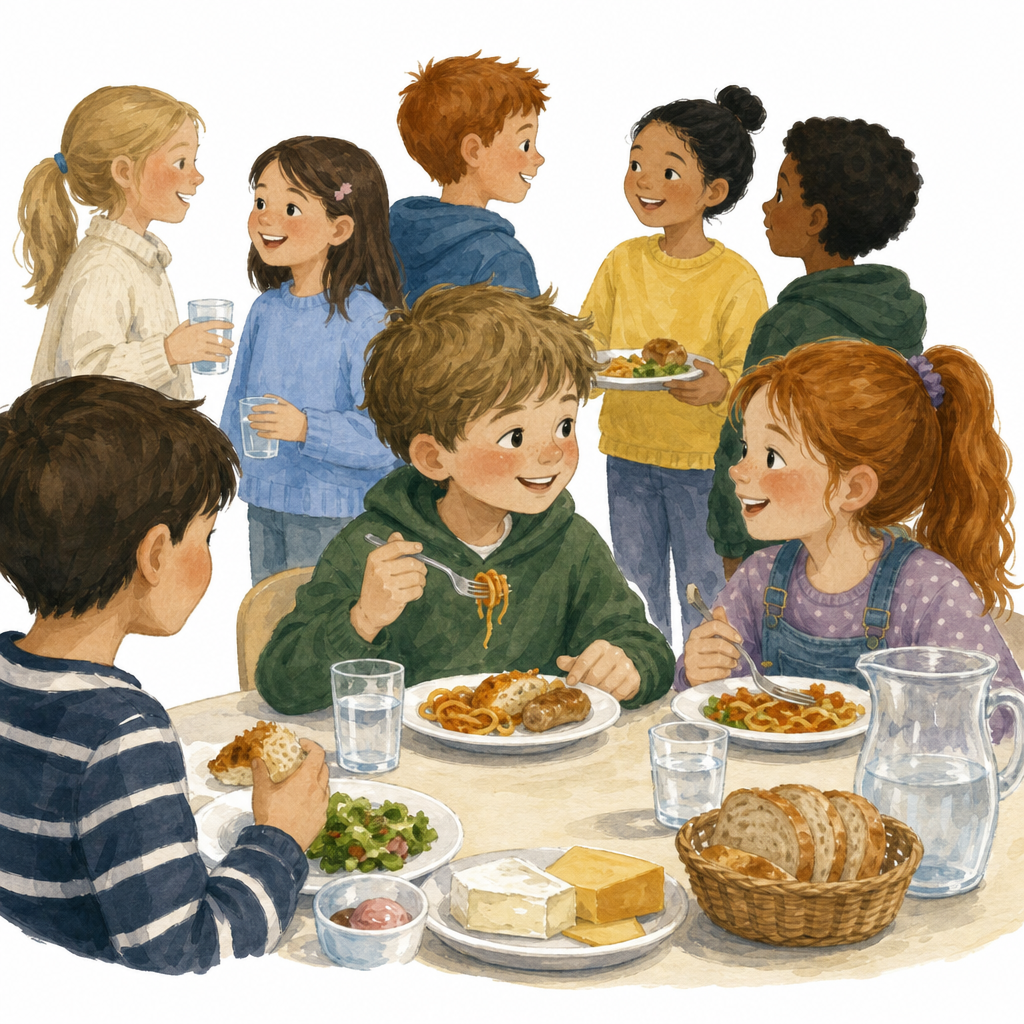
What did you eat for breakfast? Would you eat it every day?
Today you will name eight foods in French, then say which ones you like and which ones you do not, with a short reason, as if you were choosing lunch à la cantine (in the school canteen).
Take three or four quick breakfast answers in English only. Do not translate them yet. The point is to open the idea of preference, not to start teaching vocabulary. Then point to the learning list and move straight to the flashcards.
We are at the canteen board. Look, listen, and repeat each French food with its article after you hear it. Do not guess the French from the English side first.
When every food has been heard and said, we practise two opinion frames and swap in foods from the deck: J'aime … parce que … and Je n'aime pas … parce que ….
Phase 1 – foods only (about 6 minutes). Run the deck French-first (or reveal French with audio together). For each card: you play or say the full form, class repeats twice, then check the English meaning. Insist on the article every time.
Pronunciation guide (say these aloud from the board notes):
Phase 2 – frames (about 4 minutes). Only after the full deck has been heard and said once, model the chunks slowly: J'aime (zhaym), Je n'aime pas (zhuh nem pah), parce que (par-skuh), c'est bon (say boh(n)), c'est sucré (say soo-CRAY), c'est trop chaud (say troh shoh), je préfère (zhuh pray-FAIR). Class echoes each full model. Write these four models on the board as you say them:
Then choral or volunteer substitutions with two familiar foods from the deck (e.g. J'aime le pain... / Je n'aime pas la glace...). Keep c'est bon as the easy support reason. If someone says a food opinion with real feeling, cheer it.
Drag each food word into the masculine or feminine column (plurals follow les). Say the full form out loud (le..., la... or les...) before you drop it.
Quick spoken recap, not a silent test. As each word is sorted, the class says the full form together (le pain, la soupe, les pâtes). If a word is sorted wrong, say it with the article and try again. Keep energy light: this is checking that gender stuck before listening and speaking, not a grammar exam.
First we say it once more together. Then open your copy and write one sentence about a food you like and one about a food you do not, each with a reason.
Keep these on the board while you write:
J'aime le gâteau parce que c'est sucré.
J'aime ______ parce que ______.
Je n'aime pas la soupe parce que c'est trop chaud.
Je n'aime pas ______ parce que ______.
Before pens move (1–2 minutes): teacher or a strong pupil says a full model; class repeats; three or four volunteers say one like or one dislike aloud using a food from the board.
Then write (about 3 minutes): leave both frames, the filled examples, and the eight foods with articles visible. Everyone writes; this is the only stretch where every pupil's pen is moving. Walk the room and check the article is in front of every food noun. Accept simple reasons (c'est bon, je préfère...) and funny ones. Copying the frame with one swapped food is a full pass for anyone who needs it. Two sentences is enough. Do not collect these.
We will hear a short food order twice (think café or canteen counter). Listen for which foods you hear and whether the speaker sounds happy with the choice.
Before we play, know what to listen for:
Listen only the first time. After the second play, we answer together as a class.
How to run it (whole class on the IWB): Play the full built-in clip once with no questions yet. Play it a second time, pausing after each speaker turn with the player controls if anyone is stuck. Then take answers to the three board questions together. Pupils listen and respond orally or with hands; they do not need devices.
One-line summary of the clip: A short café or canteen counter exchange in which a customer orders food and reacts to the choice. The interactive holds the real audio and the built-in checks; you do not need to speak the scene yourself.
Suggested listen breaks (use pause on the player):
Board questions and expected answer shape:
Support without fluent French: Replay the relevant turn from the player rather than translating the whole scene. After answers, pause on any food word that overlaps today's eight and have the class say the full form back.
Today's foods to listen out for and recycle: le pain, le fromage, le poulet, la soupe, le gâteau, la glace, la pizza, les pâtes. Only drill the ones from today's list.
You're previewing this lesson. Get full access to this lesson and hundreds more — each one ready to teach, with interactive activities, printable resources and pupil progress tracking built in.