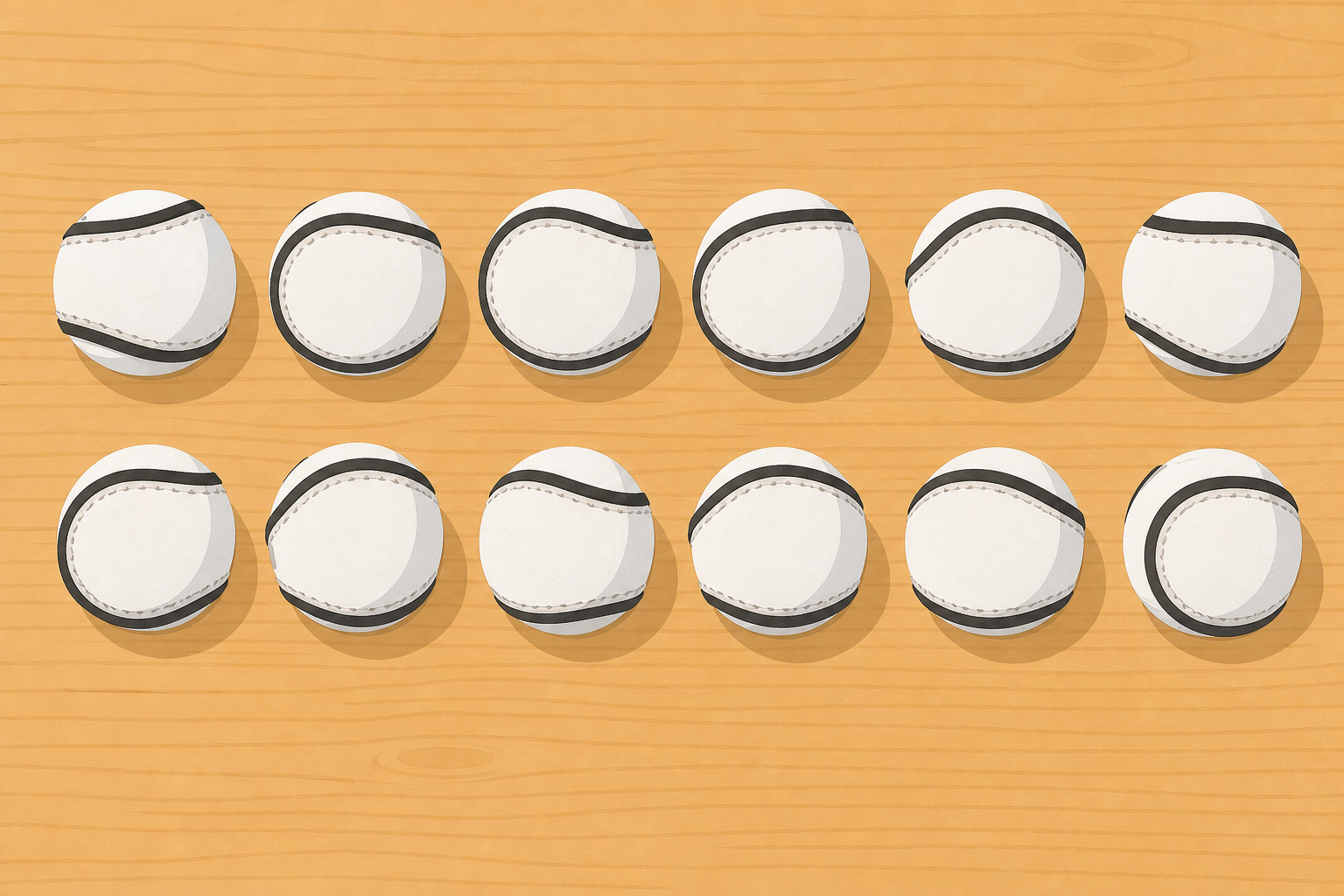
Picture twelve hurling sliotars laid out on the table in front of two GAA teams. One team needs to take their fair share. If we give one half to one team and one half to the other team, how many sliotars does each team get? Have a think before any hands go up.
Watch the fraction strips on the board. First we split a whole strip into two equal parts and shade one half. Then we split a strip into four equal parts and shade one quarter. Then a strip into three equal parts for one third. Notice the rule: split the whole into equal parts first, then take the parts you need. The very same rule works when we share a set of counters into equal groups.
The board shows four strips as a reference: one half, one quarter, one third, then two quarters, each already split into equal parts and shaded. You each have your own paper strip. We read the board together, one strip at a time, and you fold or shade the same fraction on your own strip. One classmate at a time points to the next strip on the board and names it aloud, and the rest of us agree or correct. Each time, count the equal parts carefully before you shade, and check the parts are exactly the same size.
First we watch one worked example on the board together. The teacher draws 4 dots in a row. We share them into two equal groups to find one half, ring one group, and count how many we ringed. After that, in your maths copy, draw 8 dots in a row and ring one half of them. Then, underneath, draw 6 dots and ring one third of them. Count how many you ringed each time and write the number beside your rings.
You each have counters and a 12 cm paper strip at your own desk. We work through these four together, one at a time.
Each time, share into equal parts first, then count.
When we took one half of a length and one half of a set, what was the same about what we did each time?
Both jobs start the same way: make equal parts first, then count.
Next we place fractions on a number line, finding exactly where one half, one quarter and one third sit between 0 and 1.
You're previewing this lesson. Get full access to this lesson and hundreds more — each one ready to teach, with interactive activities, printable resources and pupil progress tracking built in.