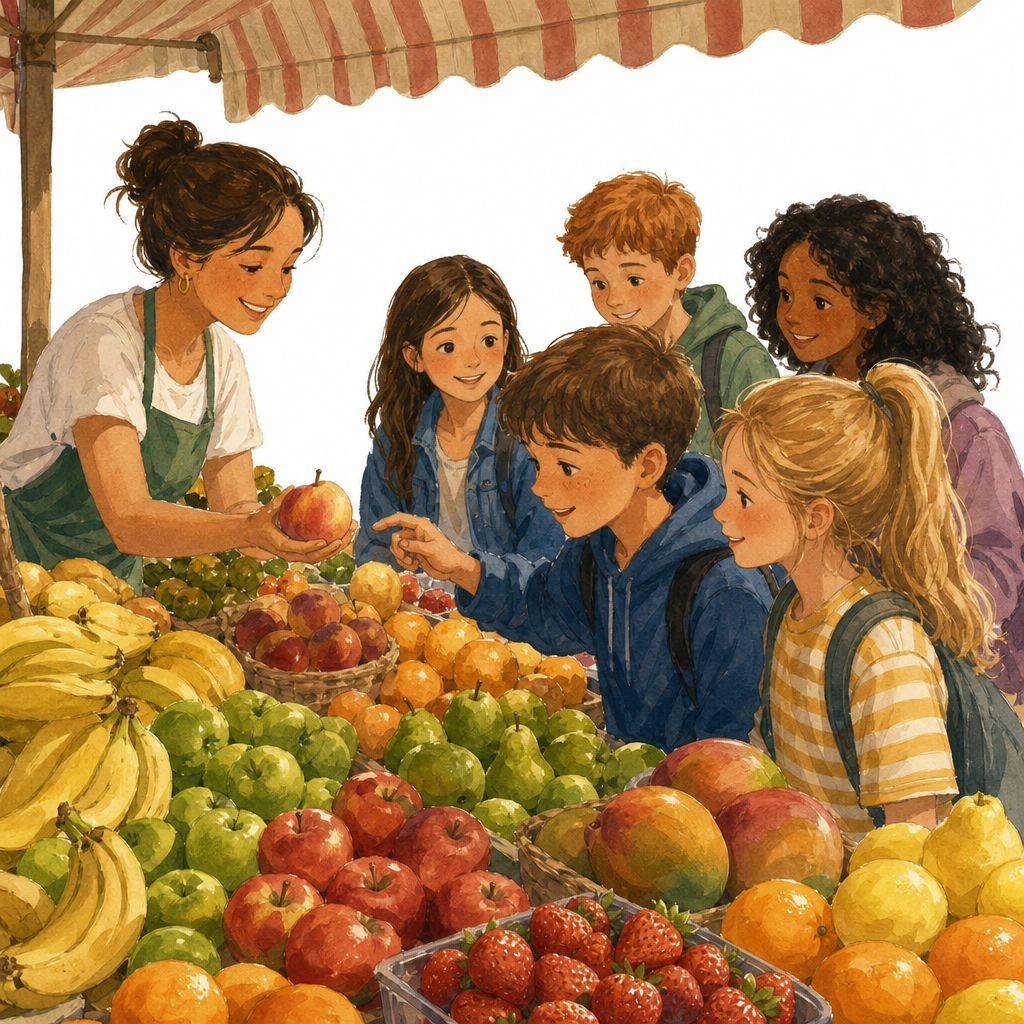
Which fruit word do you already know in Spanish? Someone in this room almost certainly knows one. Call out any you have heard on a packet, a menu, or a cartoon.
Take three or four guesses and write them on the board if they are close, but do not confirm the full list yet. The word-table in the next step reveals the eight properly. If nobody offers a word, prompt gently with cognates such as banana, lemon or mango, then move on. Keep this beat light and curious; the real teaching starts when the articles appear on screen.
Here are today's eight fruits. We will hear each one and say it back together. Watch the little word in front: some take el and some take la.
el means masculine (a he-word) and la means feminine (a she-word). Learn each fruit as a pair with its article. There is no shortcut today.
First we meet four fruits, chorus them, then we meet the next four.
Run this as teacher-led whole-class listening on the IWB. Pupils do not tap devices. Split into two chunks of four so the load stays manageable.
Chunk 1 (easier cognates first): play and chorus el limón, la naranja, el plátano, la pera. Point at the article every time. Quick all-class chorus of those four before revealing the rest.
Chunk 2: la manzana, la fresa, el mango, el melocotón. Same pattern: audio, class repeat twice (once all together, once by table), finger on the article.
Model the first one yourself from Chunk 1: el limón (el lee-MOHN). Say clearly that Spanish nouns come with a partner word and that today is about noticing which one each fruit keeps. Confirm cognates from the hook (el plátano, el limón, el mango). Praise a strong chorus, for example: "Big chorus on la fresa — that landed nicely."
Pronunciation crib (all eight):
If audio glitches, read from this list rather than guessing.
You are labelling Señor Ruiz's stall before the morning rush. Look at each fruit on the picture. When your table is called, say the full phrase together (article and all), then a volunteer clicks the label.
Whole-class IWB only; no pupil devices. Before the first label, give a 30-second all-class whisper rehearsal of all eight phrases from the word-table still on screen. Then run the stall: tables call the full form, one volunteer clicks. Insist on the full phrase: la fresa is the answer, not bare fresa. If a label is missed, stop, replay the word from the table if needed, and chorus it once before moving on. This is still recognition practice after first contact, so keep the pace friendly rather than competitive. Celebrate clear full phrases from quieter tables.
Keep looking at the fruit list on the board. Copy each full phrase (el or la + fruit) into your copy, including any accents on the letters. Star any article that surprised you.
This is the first meeting with grammatical gender, so go slowly. Keep the word-table projected the whole time; pupils copy from the board, not from memory. Before they start, model one accented word on the board (for example write el limón and point to the accent). Walk the room and check that el or la is going in front of every word and that accents appear on plátano, limón and melocotón. A list of bare nouns will not carry the gender pairing. A star beside a surprise (for example el plátano or el mango when a pupil expected la) is useful talk for the next game. If anyone is still writing at five minutes, set the remaining phrases as homework so the sort still has an accurate anchor. Do not collect these copies.
Back at the stall, we sort the fruit labels into two baskets before the shoppers arrive.
We sort each fruit into the el column (masculine) or the la column (feminine). Use the article you wrote in your copy. You learn each pair; there is no sound shortcut today.
Whole-class on the IWB. Point at the column headers (el — masculine; la — feminine) and chorus one example into each column before volunteers drag, for example el limón (el lee-MOHN) into masculine and la pera (lah PEH-rah) into feminine. Model the first drag yourself. Then take table suggestions while one volunteer moves the card; let pupils check their copy before each answer. If the class debates one, ask which article they wrote rather than guessing from the English meaning. Green and red feedback does the correcting. If the sort is clean, a quick round of aplauso. Celebrate sharp article memory out loud.
You're previewing this lesson. Get full access to this lesson and hundreds more — each one ready to teach, with interactive activities, printable resources and pupil progress tracking built in.