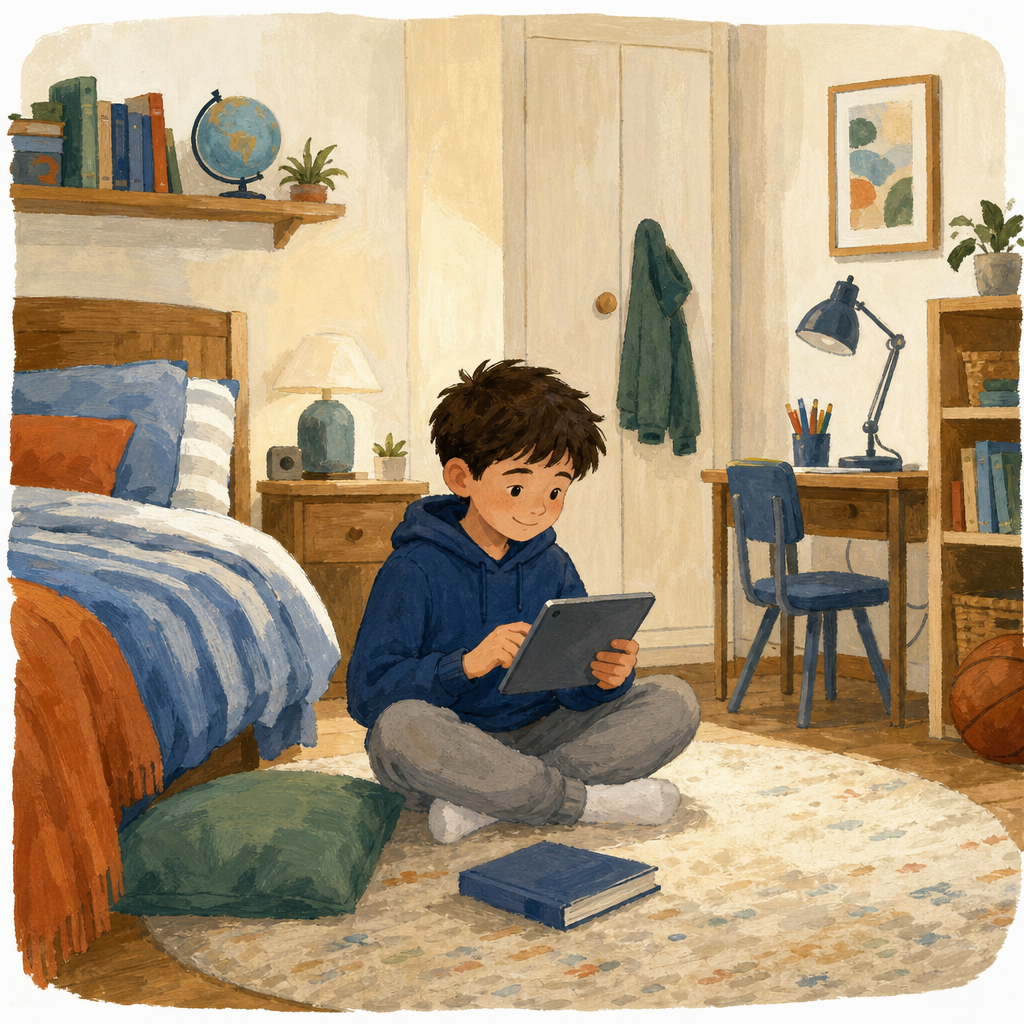
Name everything in your bedroom in ten seconds, in English. Ready? Go!
Today we put those things into German sentences, and we say where they are: on, under or beside something else.
Time the class for a genuine ten seconds and take a quick chorus of answers. Do not translate yet; the point is to warm up the room idea and the English position words they already know. Link lightly to room vocabulary they already know from this unit: today they fill one room with furniture and place each piece.
Imagine a small Berlin bedroom: a Bett against the wall, a Kleiderschrank by the door, a Lampe on the Tisch.
Here are today's eight pieces of furniture. Listen to each one, then say it back together. Watch the article every time: der, die or das travels with the noun.
Core four (everyone says and writes these today): der Tisch, der Stuhl, das Bett, die Lampe. The other four are listen-and-point bonus words you will still hear often.
Now three place words, learnt as whole chunks: auf (owf) means on, unter (OON-ter) means under, and neben (NAY-ben) means beside. Our models: Die Lampe ist auf dem Tisch. (The lamp is on the table.) Der Stuhl ist neben der Lampe. (The chair is beside the lamp.)
Part A – furniture only (about 6 minutes). Play each word; class repeats twice, once together and once by table. Point at the article every time so the pair is what they hear. German nouns are always capitalised: keep that visible on the board and sell it as a fun German quirk ("every noun gets a capital – like a tiny crown"). Core four for production today: der Tisch, der Stuhl, das Bett, die Lampe. The other four (der Kleiderschrank, das Sofa, der Teppich, das Bücherregal) are recognition bonus: pupils point or whisper when they hear them. Teppich ends with that soft ich-sound – smile on the ch, not a hard k. Class, one big der Teppich!
Part B – place chunks (about 4 minutes). Only after all eight nouns have been heard, reveal auf, unter, neben with a hand gesture (palm flat on desk = auf; hand under chair = unter; hand beside = neben). Model these exact phrases and respellings, using only today's words: auf dem Tisch (owf dem tish) on the table; unter dem Bett (OON-ter dem bet) under the bed; neben dem Kleiderschrank (NAY-ben dem KLY-der-shrahnk) beside the wardrobe; neben der Lampe (NAY-ben dair LAM-puh) beside the lamp. Keep the dative endings light: pupils copy the whole chunk rather than analysing it. Point out once, calmly, that feminine die Lampe becomes der Lampe in these place chunks (not dem) so they do not overgeneralise dem. Extra models (rotate the subject): Die Lampe ist auf dem Tisch; Der Teppich ist unter dem Bett; Das Sofa ist neben dem Kleiderschrank; Der Stuhl ist neben der Lampe; Der Stuhl ist neben dem Bett.
Leave up through steps 3–5: a sticky strip or second board panel with auf dem / unter dem / neben dem / neben der plus the eight nouns. Do not clear the word-table.
Still in that Berlin bedroom. The wheel lands on a furniture word. We all whisper it first with its article, then one pupil says it aloud, nice and clear for the class.
After a couple of warm-up spins we build a full place sentence together, for example Der Stuhl ist neben dem Bett or Der Stuhl ist neben der Lampe.
Then turn to your partner and whisper one full place sentence from the board.
Spin on the board. Every spin: whole class whispers the German word with its article first, then cold-call one pupil to say it aloud. Full article gold star – der Stuhl beats plain Stuhl every time. If a pupil hesitates, play the audio once and have the class echo, then let that pupil try again.
After two warm-up spins (article + noun only), stretch every spin to a full place sentence. Wheel gives the furniture; you supply (or point to) one of auf / unter / neben. Class builds the chunk chorally first, then one pupil says it alone. Stay inside today's room, e.g. der Stuhl ist neben dem Bett (dair shtool ist NAY-ben dem bet); die Lampe ist auf dem Tisch; der Teppich ist unter dem Sofa; das Bücherregal ist neben dem Kleiderschrank; der Stuhl ist neben der Lampe (feminine dative: der, not dem). Keep the place-chunk strip visible. Aim for several full oral reps of the exact pattern they will write later.
Pair whisper (about 1 minute at the end). Pairs face each other. Each pupil whispers one full place sentence to their partner, using a model still on the board. No writing yet; this is a low-stakes spoken pass before bingo and the copy.
First we say it together. Look at the board pictures: chorus Die Lampe ist auf dem Tisch, Der Stuhl ist neben dem Bett and Der Stuhl ist neben der Lampe.
Now open your copy. Use the frames on the board to write two sentences about your bedroom. Keep every capital letter and every article.
Frames: _____ ist auf dem _____. _____ ist neben dem _____. _____ ist neben der _____. (You may also use unter dem.)
Oral build first (about 2 minutes), pencils down. Point at two board images or classroom objects and run 4–6 full chunks chorally, rotating subjects: Die Lampe ist auf dem Tisch; Der Stuhl ist neben dem Bett; Der Teppich ist unter dem Sofa; Das Sofa ist neben dem Kleiderschrank; Der Stuhl ist neben der Lampe. Core four should appear as subjects at least once, and at least one model must use feminine dative der Lampe.
Then write (about 3 minutes). Leave the word-table, the place-chunk strip (auf dem / unter dem / neben dem / neben der), and two full model sentences pinned on the IWB for the whole write (include one feminine model such as Der Stuhl ist neben der Lampe). Offer the gapped frames: _____ ist auf dem _____. / _____ ist neben dem _____. / _____ ist neben der _____.. Support: give the frame already half-filled for anyone who freezes. Walk the room and check each sentence has an article, a capitalised noun, and one of auf, unter or neben. Do not collect these. The task is: write two sentences saying what is in your bedroom and where it is.
Look at your paper bingo card. Cross off each piece of furniture you hear. First full line shouts Bingo! then stands and reads their winning line aloud in German.
How to Play Bingo:
Option 1: Students on Devices (Digital Version)
Option 2: Print Out the Bingo Cards
You're previewing this lesson. Get full access to this lesson and hundreds more — each one ready to teach, with interactive activities, printable resources and pupil progress tracking built in.