Give today's forecast in English in one sentence. Include the weather and a temperature if you can.
You already know numbers from earlier. Today you join weather and temperature into one short German forecast, the way a board in München might show it.
Take three or four spoken forecasts in English, no more. The point is that a real forecast is a full sentence, not a single word. Do not translate yet; the word-table in the next step supplies the German. Praise a clear temperature mention: "Eighteen degrees and rain — that already sounds like a real forecast." The board work runs to about 47 minutes; the last quarter of an hour is the Activity Book page at their desks.
Here are today's eight weather words. Tap each one, listen, then say it back together.
Two forecast frames you will use (only these):
Grad (graht) means degrees. Slot into Frame B after gibt es: Sonne, Regen, Schnee, Wind, Sturm, Nebel. Use sonnig only after ist es in Frame A. die Wolke is for matching and the map only today (not for the forecast sentence).
| Concept | Why it matters for learners | Example in target language (with English gloss) |
|---|---|---|
| German nouns keep a capital letter — Sonne, Regen, Wind always start with a capital in German | Writing sonne looks unfinished to a German reader; the capital is part of spelling the word correctly | die Sonne (the sun), der Regen (the rain) |
| Forecast frame + Grad — join weather to a number with Grad (degrees) | A bare weather word is a label; weather + Grad is a real forecast you can say aloud | Heute gibt es Schnee und null Grad (Today there is snow and zero degrees) |
Tap each word; the class repeats twice, once together and once by table. Point out that German nouns keep their capital letter: die Sonne (dee ZON-eh), der Regen (dair RAY-gen), der Schnee (dair shnay), der Wind (dair vint), die Wolke (dee VOL-keh), der Sturm (dair shtoorm), der Nebel (dair NAY-bel). For the adjective, model sonnig (ZON-ikh) only inside Frame A: Heute ist es sonnig und … Grad.
Sound support: Sonne is soft ZON-eh (not "sunny"). Sturm is a short stamp: shtoorm. Nebel is NAY-bel. Celebrate a crisp Sturm — "That sounded like weather on the Alps."
Grad: teach it now as part of the frame, not as a ninth flashcard. Say Grad (graht) chorally three times. Numbers are prior knowledge; if a table freezes, supply the number yourself and let them finish the weather half. Model fünf as fuenf (round your lips as if to say "oo", then say "ee" — not like English "fun").
die Wolke — recognition only: Keep die Wolke on the word-table, matching game and map for listening and labelling. Do not drop it into Frame B today and do not introduce the plural Wolken. That keeps one form only on screen and avoids a singular/plural split. Productive Frame B slots today: Sonne, Regen, Schnee, Wind, Sturm, Nebel.
Whole-class oral drill (do this before leaving the slide): Keep both frames on screen. Cue five forecasts; class answers chorally each time. Spotlight these five for speaking and writing today: sonnig, Regen, Schnee, Wind, Sturm. Examples you can read out with audio-style clarity:
1. sonnig + 18 → Heute ist es sonnig und achtzehn Grad
2. Regen + 5 → Heute gibt es Regen und fünf Grad (fuenf graht)
3. Schnee + 0 → Heute gibt es Schnee und null Grad
4. Wind + 12 → Heute gibt es Wind und zwölf Grad
5. Sturm + 8 → Heute gibt es Sturm und acht Grad
Optional city hook once: In München gibt es heute Regen und zehn Grad. Optional sixth cue if energy allows: Nebel + 4 → Heute gibt es Nebel und vier Grad. Do not invent forms such as windig, heiß, kalt, or Wolken — they are not in today's productive list.
Flip two cards at a time and find each German weather word with its English meaning. Say the full German (with its article if it is a noun) quietly as you turn each card.
Whole class on the IWB with volunteers taking turns — stay at the board; this is not a desk-pair device game. If a pair is missed twice, stop and say the German together before moving on. Insist on the article for the nouns: Sonne alone is not enough; die Sonne is the answer. sonnig has no article. For die Wolke, accept article + singular only — never prompt Wolken.
Support: invite a second pupil to help the volunteer say article + noun, rather than sending anyone off to work alone. After two or three successful pairs, throw in one quick oral cue using a spotlight word (e.g. hold up five fingers and say "Regen") so the class answers together: Heute gibt es Regen und fünf Grad (fuenf graht). Keep the energy warm: "Full phrase — that is forecast German."
Open your copy. On the board stays this gapped model:
Heute ist es ______ und ______ Grad
or
Heute gibt es ______ und ______ Grad
Word bank (only these): sonnig · Sonne · Regen · Schnee · Wind · Sturm · Nebel
Write one full forecast sentence, including a temperature number and Grad. Use Frame A only with sonnig; use Frame B with the other bank words.
Pause the board games. Before anyone writes, choral-repeat two complete examples still on screen:
1. Heute ist es sonnig und achtzehn Grad (HOY-teh ist es ZON-ikh oont ACHT-tsayn graht)
2. Heute gibt es Regen und fünf Grad (HOY-teh gibt es RAY-gen oont fuenf graht)
Leave the gapped model and the word bank visible while they write. The bank deliberately omits die Wolke / Wolken so nobody has to invent a plural. Everyone writes one full sentence. Check that each sentence has weather + a number + Grad; a bare list of nouns will not do. If a pupil is stuck, point at the bank and supply a number. Do not collect these. Warm line when you see a complete line: "If your sentence has weather + Grad, that is a real forecast — brilliant." Hear one or two sentences read aloud before you move on.
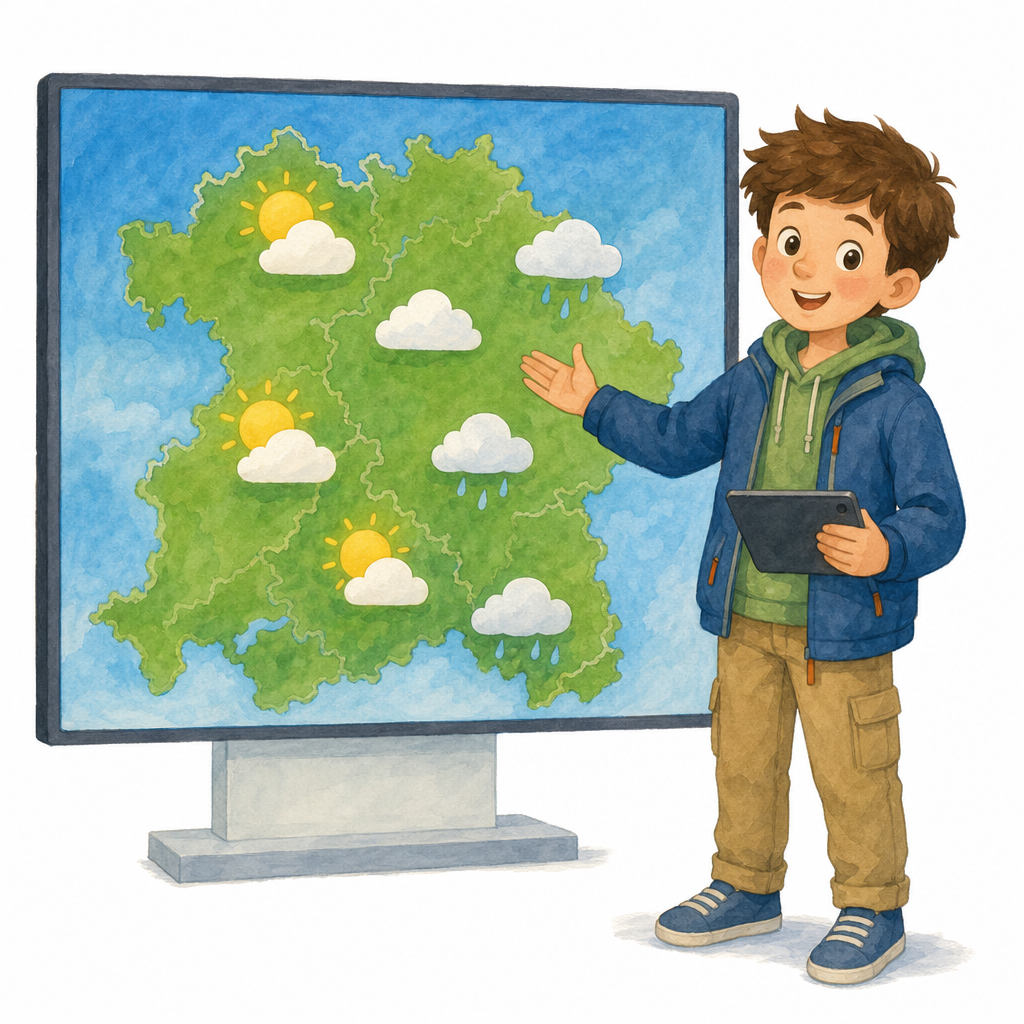
Look at the weather map (think of a simple board for München) and click the correct German label for each symbol. Use today's words exactly as they appear on the word-table.
A different route at the same eight words. Invite one volunteer per marker. After each correct label, the whole class responds as below — you supply a simple number each time. Only use the taught frames; never prompt untaught adjectives.
Do not prompt windig, bewölkt, heiß, kalt, or Wolken. Optional 30-second false-forecast beat: say Heute ist es sonnig und zwei Grad while pointing at a snow symbol; class calls the repair with Schnee. Keep it playful and whole-class.
You're previewing this lesson. Get full access to this lesson and hundreds more — each one ready to teach, with interactive activities, printable resources and pupil progress tracking built in.