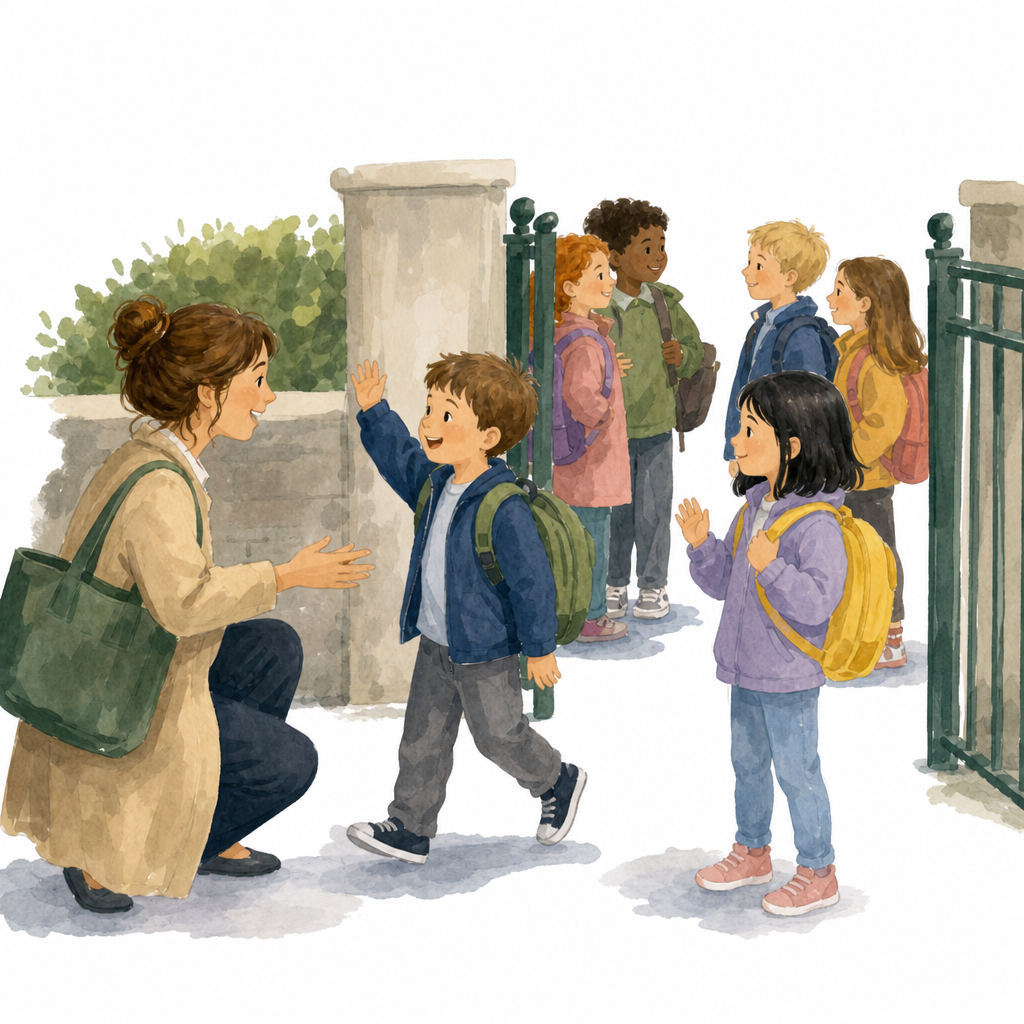
 You might already know a German hello. Today the job is different: choose the right hello for the person in front of you.
Think about how you would greet your teacher if they were your friend, and then how you would greet the principal in the corridor. Should those two hellos sound the same?
By the end of this lesson, you will be able to:
- Pick a friendly German greeting or a polite one, and say why you chose it
- Say how someone is, in the right form for who they are
- Explain why German splits "you" in a way English does not
A grid of German greetings comes up on the board, and you can tap any word to hear it said. We take them in two groups.
The friendly group comes first: listen, then say each one back together. Show a thumbs-up if you would use it with a classmate.
Then the everyday and polite group: hellos that depend on the time of day, plus the careful way of asking an adult how they are. Chorus each line, then show a thumbs-up for "works with almost anyone" or a flat hand for "save this for an adult".
Last of all comes a reply you can give when someone asks how you are. Tap it, listen, and say it back twice. When you hear it again in the matching game, put a hand on your heart, because that card is an answer and not a hello.
Watch the cards on the board. Volunteers click each German line, then its English meaning.
When a match is found, the whole class says the German together. Then sort it with a quick gesture:
- Thumbs-up for friendly (classmate)
- Flat hand for everyday time-of-day (works with almost anyone)
- Arms crossed for the polite adult how-are-you
- Hand on heart for the reply you give when someone asks how you are
Open your copy and write one friendly greeting and one polite greeting. Beside each one, write who you would say it to and who you would not.
- Hallo — Hello (friendly)
- Hi — Hi (friendly)
- Guten Morgen — Good morning
- Guten Tag — Good day (daytime hello)
- Guten Abend — Good evening
- Wie geht es dir? — How are you? (friendly)
- Wie geht es Ihnen? — How are you? (polite / to an adult)
- Mir geht es gut, danke — I am fine, thank you
Say the reply together from the board one more time so it is ready on your tongue. Then greet a partner for real: Partner A starts, Partner B answers with that reply, and then you swap.
Try at least one friendly exchange and one polite exchange before you finish. Pick a situation for each one: meeting a classmate at the school gate in Munich, buying bread in a Berlin bakery, or meeting the principal in the corridor.
Unlock the full learning experience
You're previewing this lesson. Get full access to this lesson and hundreds more — each one ready to teach, with interactive activities, printable resources and pupil progress tracking built in.
This lesson is copyright of Coding Ireland 2017 - 2026. Unauthorised use, copying or distribution is not allowed.