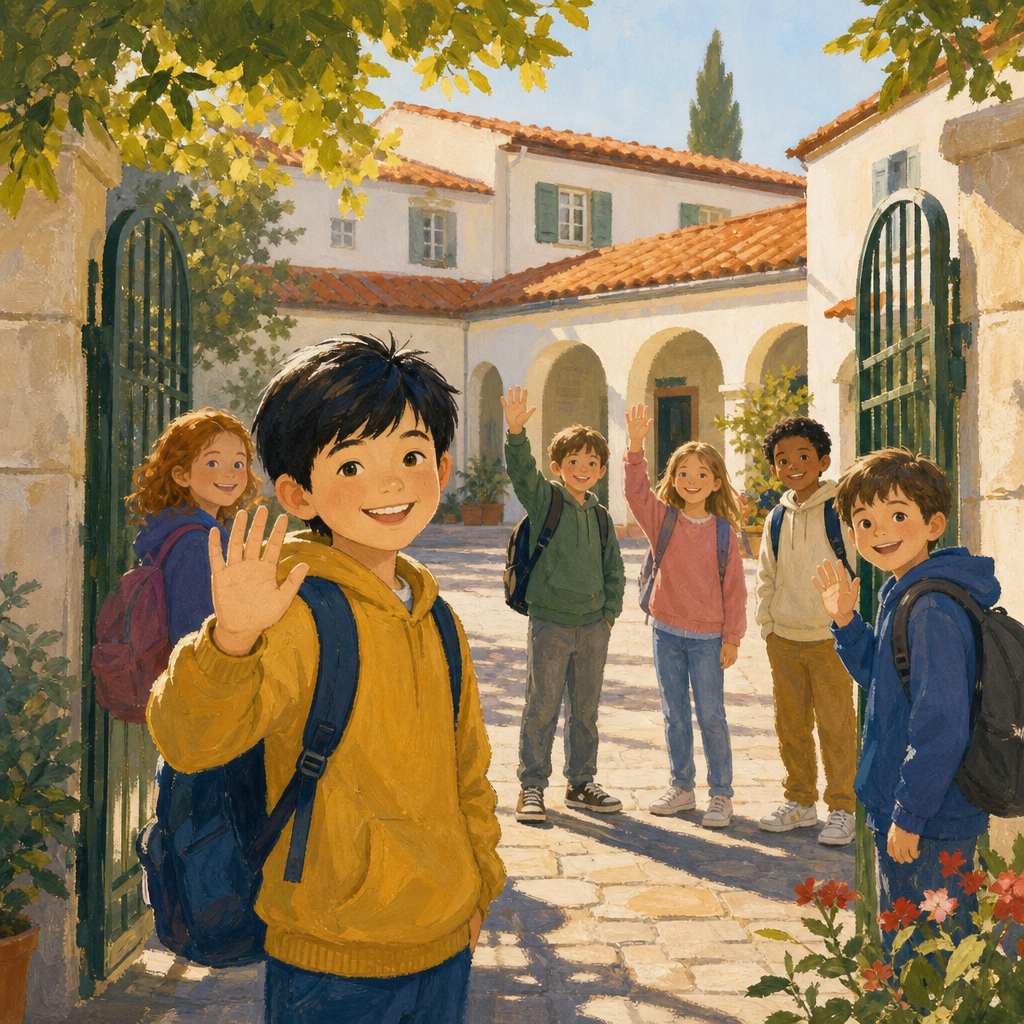
Picture the gate of a Spanish primary school just before nine. Children wave to friends in the patio and greet the teacher at the door. Before nine o'clock this morning, how many different ways did you say hello? Think of family, friends, teachers, the bus driver. Let's collect four from the class.
Set the scene in one sentence (a Spanish school gate before nine), then collect four English hellos quickly (hi, hello, morning, hey) and leave them on the board. Do not teach any Spanish yet; the word-table in the next step does that job. The point of the hook is to show that English already has several greetings, so Spanish having eight is not strange. Smile and keep it light: this is their first Spanish lesson of the year.
Here are today's eight Spanish greeting phrases, met in two short groups. First come the four time-of-day hellos, then the four that ask how someone is or say nice to meet you. Listen to each one, then say it back together. Listen for the soft h in Hola: it is almost silent, not like the English h in hello. For the how-are-you pair: ¿Cómo estás? is for a friend; ¿Cómo está usted? is for a teacher or other adult. Listen for the extra word usted.
First Spanish words of the year: make Hola big and friendly, and cheer the soft h when they nail it. Celebrate the first full-class Hola; make a fuss, it is their first Spanish word together.
Chunk 1 (about 4 minutes): Play and chorus the four time-of-day items twice each: Hola (OH-lah), Buenos días (BWEH-nohs DEE-ahs), Buenas tardes (BWEH-nahs TAR-dehs), Buenas noches (BWEH-nahs NOH-chehs). Point and ask when each would be used. Note briefly that Buenas noches greets someone in the evening and can also mean good night when leaving; they will meet the goodbye use again later. Quick thumbs-up check, then move on.
Chunk 2 (about 5 minutes): Play and chorus Estoy bien, gracias (ehs-TOY bee-EN GRAH-see-ahs), ¿Cómo estás? (KOH-moh ehs-TAHS) for a friend, ¿Cómo está usted? (KOH-moh ehs-TAH oos-TEHD) for an adult, and Mucho gusto (MOO-choh GOOS-toh). Model the friend/adult split clearly on the first hearing and point out the extra word usted on the formal line. Second thumbs-up check before the matching game.
Volunteers flip two cards on the board. When a Spanish card turns, everyone says the Spanish aloud together. Find each Spanish greeting paired with its English meaning.
Run this on the IWB only, with volunteers taking turns. There are no pupil devices for this step. If a pair is missed twice, stop and say the Spanish together before moving on. Insist on the full phrase: Buenos días, not just días. Audio plays on every flip, so pronunciation keeps landing while they play. Celebrate clean matches out loud.
Open your copy. Copy these three greetings and write morning, afternoon or evening beside each one: Buenos días, Buenas tardes, Buenas noches. Then add one more phrase you would also use before lunch, such as Hola or ¿Cómo estás?. Watch the accents carefully while the word-table stays on the board.
Pause the board interactives. Everyone writes; this is the only three minutes where every pupil's pen is moving. Keep the word-table on screen so spelling and accents are visible. Point once to the accented letters on días, Cómo and está / estás, and to the opening inverted question mark ¿ on the question forms, before pens move. The three time-of-day lines are the checkable core; the fourth line is free choice from the anytime phrases. Do not collect these.
You bump into your partner at the school gate. Watch the three short model exchanges first, then act them out with your partner using the prompts on the board. Take turns so each of you is Partner A and Partner B. One exchange is with a classmate, one is with a teacher in the morning, and one uses an afternoon or evening hello.
The partner-practice interactive supplies the prompts on the IWB. Before pairs begin, model these three worked exchanges once with a volunteer so every pupil has heard the full scripts. Use only the phrases already on the word-table; do not add extra Spanish.
Exchange 1: classmate at the gate
A: ¡Hola! ¿Cómo estás?
B: Estoy bien, gracias.
A: Mucho gusto.
B: Mucho gusto.
Exchange 2: teacher in the morning
A: Buenos días. ¿Cómo está usted?
B: Buenos días. Estoy bien, gracias.
Exchange 3: afternoon or evening hello
A: Buenas tardes. (or Buenas noches.)
B: Buenas tardes. (or Buenas noches.) Hola.
Pronunciation guides: Hola (OH-lah), ¿Cómo estás? (KOH-moh ehs-TAHS), Estoy bien, gracias (ehs-TOY bee-EN GRAH-see-ahs), Mucho gusto (MOO-choh GOOS-toh), Buenos días (BWEH-nohs DEE-ahs), ¿Cómo está usted? (KOH-moh ehs-TAH oos-TEHD), Buenas tardes (BWEH-nahs TAR-dehs), Buenas noches (BWEH-nahs NOH-chehs). Keep the interactive prompts visible the whole time so pairs never invent Spanish. Circulate and listen; if a pair freezes, point them back to the board. After each exchange, ask pairs to swap roles so each pupil asks and answers. Expect giggles; praise any pair that gets through a full exchange without English. Listen for a confident Hola and celebrate any full exchange, even if messy: courage matters more than perfection on lesson one.
You're previewing this lesson. Get full access to this lesson and hundreds more — each one ready to teach, with interactive activities, printable resources and pupil progress tracking built in.