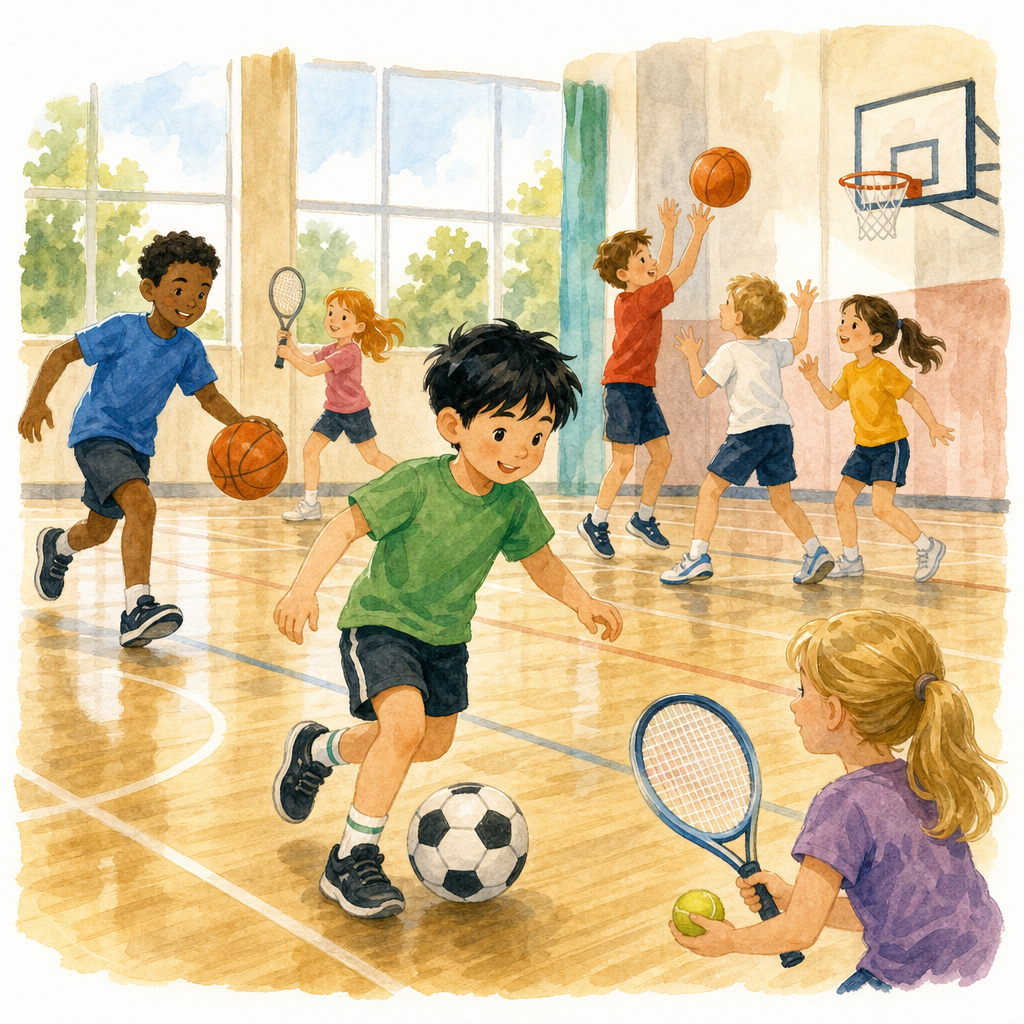
 Which sport does this class play most? Put your hand up for your favourite when you hear it called, and be ready to defend it, because football and swimming both have fans in this room. Today you meet the days of the week again, and by the end you will be able to join a sport to a day in one short Spanish sentence.
By the end of this lesson, you will be able to:
- Name eight sports in Spanish
- Say which sport you play and on which day
- Match each sport to its meaning when you hear it
Here are today's eight sports. Tap each one, listen, then say it back together.
You will build your sentences with two frames, and they stay in front of you for the rest of the lesson:
- Juego al fútbol los lunes (I play football on Mondays). Use Juego al… with ball and team sports: fútbol, baloncesto, tenis, voleibol, hockey, béisbol. Tip: al is a + el.
- Hago natación los miércoles (I go swimming on Wednesdays). Use Hago… only with natación and ciclismo.
Days you already know and use again today: lunes, martes, miércoles, jueves, viernes, sábado, domingo.
This is a school polideportivo in Valencia: the indoor sports centre where Spanish pupils train after class. Look at the picture and help choose the correct Spanish label for each sport you can see. Say the Spanish quietly with its el or la as each label is chosen.
First, say it. Listen for a day in Spanish. Answer with a full sentence using today’s frames: Juego al fútbol los lunes or Hago natación los miércoles. Then whisper one sentence to your partner.
Then write. Open your copy and write one or two full sentences saying which sport you play and on which day. Keep the model sentences and the days list on the board. Take care with accents and with el or la.
Days: lunes · martes · miércoles · jueves · viernes · sábado · domingo
- el fútbol — Football
- el baloncesto — Basketball
- el tenis — Tennis
- la natación — Swimming
- el voleibol — Volleyball
- el ciclismo — Cycling
- el hockey — Hockey
- el béisbol — Baseball
Now match today's 8 sports to their meanings. Tap the speaker beside a Spanish word and listen, then say which meaning it matches before anyone clicks. When a pair is right, you hear the word again.
Unlock the full learning experience
You're previewing this lesson. Get full access to this lesson and hundreds more — each one ready to teach, with interactive activities, printable resources and pupil progress tracking built in.
This lesson is copyright of Coding Ireland 2017 - 2026. Unauthorised use, copying or distribution is not allowed.