1 - Getting Started ~5 mins
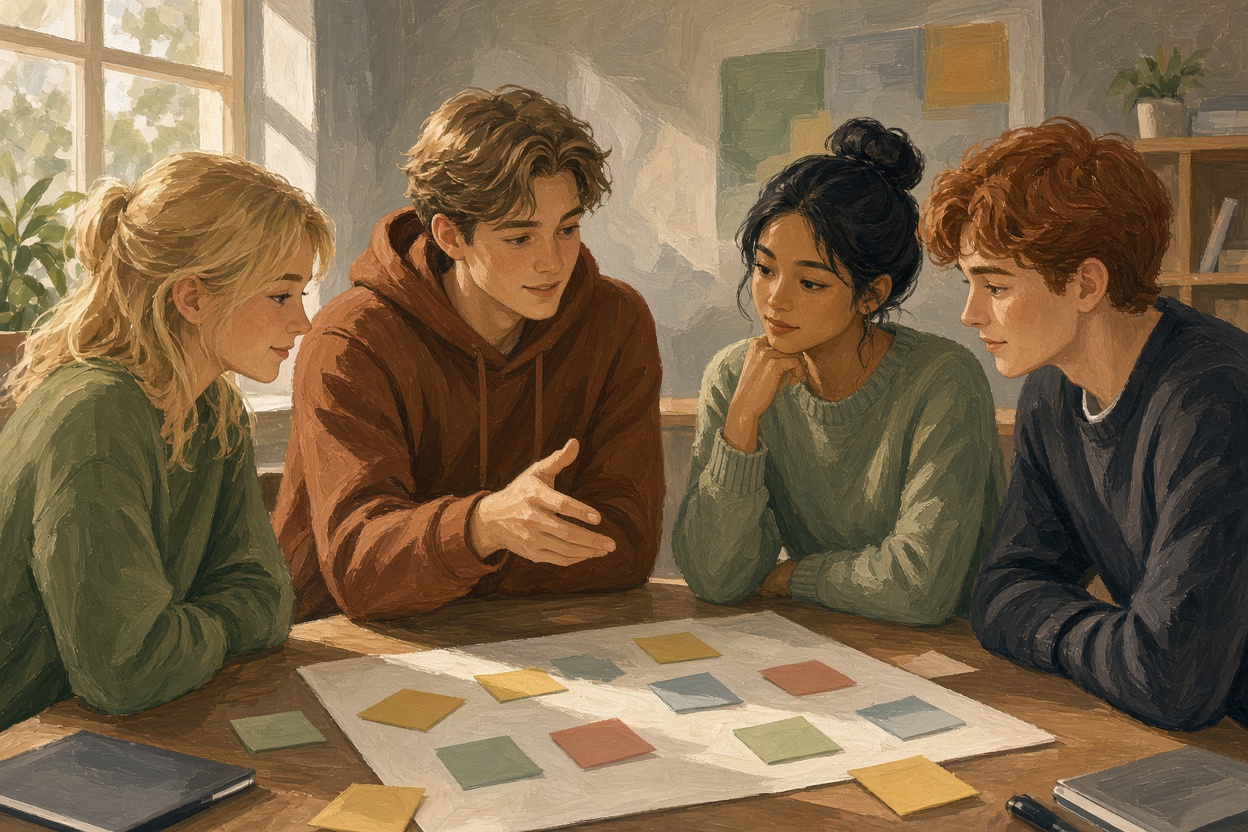 Your group has already named the community issue it is working on and written that down as a problem definition. Today is the ideating stage: you generate as many possible responses to that problem as you can, and you judge none of them yet.
Most groups stop at ten ideas and call it done. The useful ones often sit past idea twenty. You will study a worked three-round board, then run the same rounds on your problem definition and capture the full board in your Collaborative Task Ideation document. That board is evidence of your collaborative task, not a side exercise. Filtering and developing ideas comes next, and that only works if today's list is wide.
2 - What Do You Believe About Ideas? ~7 mins
Before you see how a real group ran ideation, mark each claim true or false on what you honestly think right now. Do not discuss first. You will revisit these instincts after you study a worked board and run your own rounds.
Key terms for this lesson
| Term | What it means for you | Real example |
|---|---|---|
| Ideation: generating many possible responses before choosing | Your group's full idea board for the collaborative task | Thirty-plus sticky notes on one community issue before any filtering |
| Defer judgement: do not praise, mock or kill ideas while listing them | Keeps quiet voices and odd ideas on the board long enough to be useful | Leaving a wild idea up until the starring step |
| Build-on: every new idea must start from someone else's | Stops the loudest person owning the whole list | Turning one library idea into a peer homework club version |
3 - Three Rounds on a Real Board ~10 mins
Study how one student group ran ideation on a local community issue. Notice the three rounds: rapid-fire out loud, silent writing, then build-on. Notice where the three starred ideas actually came from.
Think about while you read the beats:
- Which round produced most of the starred survivors, and what does that suggest about stopping after rapid-fire?
- Find one rapid-fire idea that looked weak alone but became useful in a build-on. What changed?
- If this group had judged ideas out loud during round 1, which later idea would probably never have appeared?
You will run the same three rounds on your problem definition later this lesson. Keep the process in mind; the community issue in the example is only the model.
Nowhere to go after school
4 - Label the Moves on the Board ~8 mins
Now annotate a cleaned-up version of a similar ideation board. Tag each marked phrase as rapid-fire, silent, build-on, starred, or early judgement (a moment where someone broke the defer-judgement rule). When the model appears, notice where you disagreed.
This is skill practice on the sample board. Your own community ideas come next; do not file sample favourites as project evidence.
Label the ideation moves
5 - Run Your Three Rounds ~25 mins
Now do it for real, on your own issue. Open your group's problem definition from clarifying, and create or open the file you will keep this work in:
Filename: Collaborative Task Ideation
Location: Strand 2.1 folder in your Digital Portfolio (create the folder if it is not there yet)
Format: a shared doc or notes file that every member can copy
Paste your problem definition at the top as one line, then add these headings and leave space under each: Round 1: Rapid-fire; Round 2: Silent; Round 3: Build-on; the defer-judgement rule you will keep; your three starred survivors; and which round produced each star.
You then run four timed rounds as a group, on sticky notes or in the list tool, and transfer everything into the document afterwards.
- Rapid-fire, five minutes. Call out concrete options aloud. Nobody discusses or ranks anything, and every shout gets written up.
- Silent, five minutes. Everyone writes alone with no talking at all, and then all the notes go up together.
- Build-on, five minutes. Every new idea has to start from an idea already on the board and add a workable layer to it.
- Cluster and star, five minutes. Group what belongs together, then star exactly three. Aim for thirty-plus ideas across the whole board before you star anything, because ten ideas is a chat rather than ideation.
Every member keeps a full copy of the board in Collaborative Task Ideation, not just whoever was writing. Under the starred heading, name your three survivors and write one line each on which round produced them. Then add one sentence on a moment your group nearly judged an idea too early, and one line on the idea from your board you are most attached to, and whether it survived the starring.
What this entry shows for Portfolio in Action: your group generated a wide set of possible solutions for its community issue, held off judging them, and can show where the strongest ideas came from.
Your group's ideation board
Unlock the full learning experience
You're previewing this lesson. Get full access to this lesson and hundreds more — each one ready to teach, with interactive activities, printable resources and pupil progress tracking built in.
This lesson is copyright of Coding Ireland 2017 - 2026. Unauthorised use, copying or distribution is not allowed.