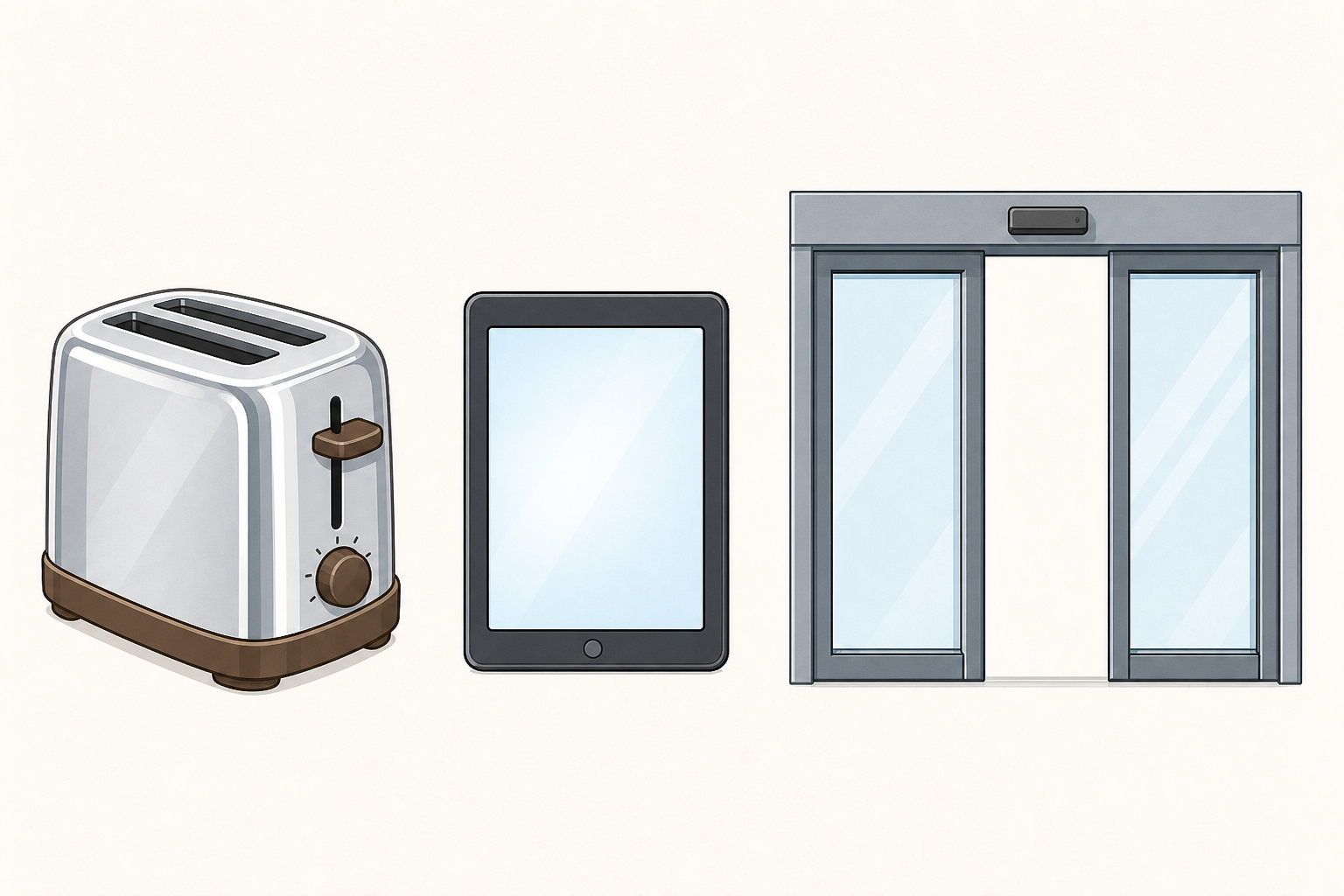
Look at these three everyday things: a toaster, a tablet, and an automatic door at a shop. They look nothing alike. What could they possibly have in common?
Talk with the person beside you for thirty seconds. Be ready to share one idea.
Show the three device pictures or real objects if you have them. Do not hand out the device cards yet. Keep this as a curiosity beat only.
Likely answers: they use electricity; they do a job for us; they have buttons. Accept all ideas. Do not name input, process or output yet.
Say: Today we will find a powerful way technologists describe any device, from a toaster to a tablet. It is the same pattern every time. Later we will see how digital systems (like a tablet) use that same pattern with electronics or software in the middle.
Watch how we map a toaster on the board. What goes in? What happens inside? What comes out?
We will use three short labels for those parts: input (what goes in), process (the work in the middle), and output (what comes out).
A toaster is not a digital device. Technologists still map it this way. Digital systems, such as a tablet, a Leap card reader or our interactive whiteboard, use the same three labels, with electronics or software doing the process in the middle.
| Concept | Why it matters | Example |
|---|---|---|
| Input — something that goes into a system to start it or give it information | If you cannot name the inputs, you cannot fix or improve the device | Bread in the slots, the browning dial set, the lever pressed down |
| Process — the work the system does with the inputs (often hidden) | The process is where the real job happens, even when you cannot see it | Electricity heats the elements; a timer counts down |
| Output — what the system produces when the process finishes | Outputs are how you know the system did its job | Hot toast pops up; you hear a click |
| Digital system — a device that takes inputs, processes them (often with electronics or software) and gives outputs | Technologists map any device this way before they build or repair it; digital systems are one kind of system that uses this pattern | A tablet, a Leap card reader, a school interactive whiteboard |
What appears on the board: draw three empty boxes live and label them Input, Process, Output, with arrows left to right. Fill each box as you talk. Introduce the three short labels only as you fill the boxes, not as a glossary list before the sketch. There is no interactive at this step; the live sketch is the model.
Worked model (plain talk while you fill the boxes):
Watch me map a toaster. What goes in? Bread, the dial, the lever. What work happens inside that we mostly cannot see? The elements heat and a timer runs. What comes out? Hot toast and that click. Same three headings every time: input, process, output.
Bridge to digital (say this clearly, more than once if needed): a toaster is not a digital device. It is a simple kitchen machine. We map it first because the IPO pattern is easy to see. Digital systems use the same three headings, but the process uses electronics or software (tablet, Leap card reader, interactive whiteboard). Check for misunderstanding: if a pupil later calls the toaster digital, restate this bridge.
Misconception to head off: pupils often call electricity the only input, or call the whole toaster the process. Electricity can be an input, but so can the user's actions (press, tap, put bread in). The process is the work done inside, not the whole device.
Nature of STEM: this is how technologists describe any system before they build or fix it. Naming IPO is the first step of design and debugging, not a label stuck on afterwards.
In your group, you will get one device card: toaster, tablet, or automatic door. Read it together. Agree: what are the inputs, what is the process, and what are the outputs?
Make a quick three-box sketch on scrap paper so you can remember your map. Be ready to share your device with the class. If another group has the same device and disagrees, that is useful: we will sort it out together.
Print enough device cards so every group gets exactly one card and the three devices are spread across the class (jigsaw). Aim for a roughly even mix of toaster, tablet and automatic-door cards. Do not print a full set of three cards for each table. Scrap paper or mini whiteboards for a rough three-box sketch. No extra props needed.
Card A — Toaster: A toaster is a kitchen device. You put slices of bread into the slots, choose a browning setting, and press the lever down. Electricity heats metal elements inside. When the time is up, the toast pops up hot and brown, and you usually hear a click or pop.
Card B — Tablet: A tablet is a touchscreen computer. You tap or swipe on the screen, or press the power button. Software and a processor work out what you asked for. The screen shows an app, a game or a video, and the speakers may play sound.
Card C — Automatic door: An automatic door is found at shops, airports and some school entrances. A sensor spots someone walking towards it (or a button is pressed). A control unit decides the door should open. Motors slide or swing the door open so people can walk through.
Groups of three or four. One assigned device per group so they can map it deeply in the time. About six to seven minutes to read, agree IPO, and sketch three boxes; leave a minute for a spokesperson to be ready. Circulate and ask: Is that going in, happening inside, or coming out?
If time allows at the end, take one 20-second headline share per device type so the class hears all three before the board sort. Otherwise move straight to step 4 and let the automatic-door groups lead the first call-outs.
Look-fors:
If a group is stuck: ask them to act the device with their hands first, then name each beat as in, middle, or out.
We will map an automatic door as a system on the board. Six cards will appear. Help decide which column each card belongs in: Input, Process, or Output.
Cards: sensor spots someone approaching, button is pressed, control unit decides the door should open, motors drive the door, door slides or swings open, beep sounds (sometimes).
Groups who mapped the door: lead the first suggestions. Everyone else: for each card, decide whether it is going in, happening in the middle, or coming out. Use the same three headings you used on your own sketch. You are not matching door cards to a toaster or tablet map.
Drive the flow-builder interactive on the IWB in explore mode with layout: ipo. Pupils call out; you drag (or invite volunteers to the board). The six cards on screen are exactly the six named in the pupil description.
Frame this as a whole-class check after the jigsaw maps, not a full remap of a device every group has already done. Invite automatic-door groups to open, then pull in the others as judges of the three headings.
Watcher job (say this aloud so non-door groups know their role): door groups lead the first call-outs. Other groups judge each card: is it going in (Input), happening in the middle (Process), or coming out (Output)? Same three headings as on their own sketch. They are not trying to match door-specific cards to a toaster or tablet map.
Target placement:
Process cards: treat "control unit decides" and "motors drive the door" as two parts of the middle work. Do not spend long splitting hairs; both belong in Process. If a sharp pupil argues that motors are the output, say: Motors are the middle work that makes the output happen; the output is the door actually open (and the beep).
After the door map is agreed, quickly challenge the class: Would the toaster or tablet use the same three column headings? (Yes.) Would the cards be the same? (No.) Which of our three devices is a digital system? (The tablet.)
If the interactive is unavailable: draw three columns on the board labelled Input, Process, Output and sort the same six phrases on sticky notes or as a shared list.
We will take three questions one at a time. There is not one magic yes or no: share a reason, and it is fine to think aloud.
First, think about the toaster we mapped: electricity is often an input. What other inputs matter, especially things people do?
Next, still with the toaster: is the toast an output, or part of the process?
Last, stay with devices we already used: tablet speakers play sound as an output. When might sound be an input instead, for example if you speak into a tablet microphone?
Whole-class science talk. Keep it display-only: no writing, no typing. Signal clearly that reasoned guesses are welcome: I want to hear your thinking, not a single right answer.
Show and take the three prompts one at a time (cover or hide the next until you are ready). After each, revoice using input / process / output and anchor back to a device already mapped before moving on. Do not introduce an unmapped device.
Points to draw out:
Misconception: pupils treat "input" as only buttons. Sensors (motion, touch, light) are inputs too — the automatic door is the clean example.
Closing prompt: If technologists left out the inputs when they described a device, what would go wrong when they tried to build or fix it?
You're previewing this lesson. Get full access to this lesson and hundreds more — each one ready to teach, with interactive activities, printable resources and pupil progress tracking built in.